
Citation Building Packages: What You Get and What to Skip
Every quote for citation building packages leads with a number, and that number is the least useful thing on the page. Fifty listings, one hundred fifty, three hundred. The count gets presented as the product, so buyers compare counts and pick the biggest, then find out later that some profiles duplicate each other, a few point at a dead landing page, and nobody has the logins for the accounts.
That isn't usually fraud. It's a package written to be sold rather than delivered, with no line item a buyer can check once the invoice clears. The count survives because it's the one thing that can't be argued with.
So treat a package as a work order with auditable parts, ignore the headline count until you've seen them, and refuse to pay for anything you can't verify in a private browser window. That holds whether you run a SaaS, an AI tool, an indie app or a single-location service business.
Table of Contents
- What a Citation Building Package Actually Includes
- Software and AI Citations Are Not Local Citations
- What Drives the Price of a Citation Package
- How to Verify the Work Was Really Done
- The Bulk Submission Shortcuts That Cost You Later
- Why Manual Submissions Still Move AI Visibility
- Citation Package Questions Founders Ask Most
- Picking a Package and Starting the Build
What a Citation Building Package Actually Includes
Three proposals land in the same week, each one headlined by a number. On those numbers alone the biggest bundle looks like the best value, which is the comparison the format is built to invite. Set the count aside and ask what the provider will physically hand over.
A legitimate package is five operational commitments, and every one is checkable after delivery. Hand submissions by a person. A duplicate check on each platform before anything is created. A confirmed master record of your name, URL, category and description. A screenshot of each placement. A per-listing status that reads live, pending, rejected or needs your action. If a quote can't show you those five, the headline count is decoration.
Hold any proposal against the table below and tick off what's missing.
| Line item | What it means | What good looks like | Red flag |
|---|---|---|---|
| Confirmed master record | One approved sheet of name, URL, category, description and contact details | Signed off before work starts and reused on every platform | Details collected platform by platform, so descriptions drift |
| Duplicate check | Searching each platform for an existing profile before submitting | Existing profile claimed or edited instead of a second one created | A brand-new duplicate listing on every platform |
| Manual submission | A person fills each form and passes moderation | Human-entered copy that matches the platform's audience | Bulk software or bots filling forms in batches |
| Categorisation and tags | Choosing primary and secondary categories that fit the product | Categories matched to product type and buyer intent | Filed under Other or a mismatched industry |
| Screenshot proof | An image of each listing as submitted or published | Dated screenshots showing the profile live | A spreadsheet of URLs with no evidence behind them |
| Status report | One row per platform with a status and a named owner | Live, pending, rejected, or needs your action | A single line reading completed |
| Correction pass | Fixing typos and rejections after publication | One round of fixes included in the price | Every edit billed as a new order |
Now the part a straight provider says out loud, usually without being asked. No package can guarantee rankings, Local Pack placement, traffic, leads, or a backlink from every listing. Some directories print your brand as plain text with no anchor at all. Others apply rel="nofollow", so the link exists for discovery and passes no ranking credit. Anyone promising otherwise is selling something they don't control.
A listing still does two separate jobs. Google's guidance on crawlable links describes links as both a relevance signal and a route Google uses to find new pages, and notes that the vast majority of new pages it discovers each day are found through links. Your profile is a crawlable reference back to your site and, at the same time, an independent page a prospect can land on.
Coverage is the reason that second job matters. An independent BrightLocal study analysed 8,000 Google search results across 800 manual searches and found that business directories accounted for 31% of top-ten organic results overall, and 37% for informational local-intent queries (BrightLocal business listings visibility study). Those are placements your own domain doesn't occupy.
Put the correction window in the order itself. Fourteen days from the status report, fixes are included. After that, every typo becomes a new purchase and every disagreement is about who caused it.
Agencies ordering for clients should read the scope of white-label directory submissions for agencies before signing, because the report is the deliverable and it should arrive ready to forward to the client. What you're buying is a repeatable build, not a list of URLs.
Software and AI Citations Are Not Local Citations
The quickest way to waste money on citation building packages is to buy the wrong species. Both types get sold under the same label and they share almost no fields.
A local citation is a NAP record tied to a physical location. Name, address, phone, opening hours, service area, and it lives on maps, data aggregators, review sites and regional directories. Its job is to help someone nearby decide to call, get directions, or check whether you're open.
A software citation is a product listing on a marketplace or startup directory. Product name, category, pricing model, integrations, founder details, screenshots and a review profile. Its job is to help someone comparing tools decide to click through and sign up.
| Dimension | Local business citation | Software or AI citation |
|---|---|---|
| Record anchor | Name, address, phone, opening hours | Product name, URL, category, pricing model |
| Fields that matter | NAP, service area, hours, payment methods | Description, integrations, screenshots, founder, launch date |
| Where it lives | Map, data aggregators, regional and review directories | Marketplaces, review platforms, startup and AI directories |
| What the reader does there | Calls, gets directions, checks hours | Compares features, reads reviews, clicks through to the site |
| How you verify it | Screenshot plus a map and search check | Screenshot plus a live product page with working links |
| Typical failure | Duplicate listing or wrong address | Wrong category, dead pricing link, stale feature list |
| Sensible first round | 50–100 listings for a single location | 20–60 listings for a single product |
| Search surface it feeds | Map pack and local organic results | Category comparisons, review queries, AI answers |
Mix the two up and the forms break. Say a SaaS founder buys a local bundle and every form demands a street address and opening hours. The provider either invents a plausible address or abandons four fields, and now your profile contradicts itself across forty sites. Reverse it and a restaurant ends up with a product page on a software marketplace that no diner will ever search for.
Local accuracy isn't cosmetic. BrightLocal's 2025 consumer search research found that 85% of consumers considered accurate contact details and opening hours important when researching a local business (BrightLocal consumer search research). A wrong phone number on forty profiles is forty chances to lose a call.
The routing rule is simple. Multi-location retail, home services, clinics and franchises buy the local side first, in their own country and region. SaaS and AI products buy the software side first and usually never need the local one. A startup preparing a Product Hunt launch needs the software side and nothing else, because there's no address for a moderator to verify. AI tools carry an extra layer, and AI directory submission help covers the discovery lists and answer-engine surfaces that fit neither category cleanly.
What Drives the Price of a Citation Package
A cheap citation package can become expensive once you price the cleanup. Audit the invoice line by line: platform selection, duplicate checks, writing, submission proof and correction terms. The headline count tells you how much work is promised, not how much useful coverage you will receive.
Six variables explain the quote.
- How many listings. Volume affects cost, but a longer list only helps when the platforms fit your business.
- Manual versus automated labour. Manual work includes checking existing profiles and completing each platform's fields. Automation reduces form-filling time; check who handles errors and duplicates.
- Directory quality. Relevant categories, editorial review and a real audience matter more than a directory's willingness to accept anything.
- Copy and categories written for you. Descriptions, tag lines and category mapping take work. Check whether the price covers preparing them or merely copying what you supply.
- Verification and a correction round. Ask what counts as delivery, what happens after rejection and how long corrections remain included.
- Markets covered. Coverage should match your country and area. Extra listings in irrelevant markets add count without meeting that requirement.
The pricing models below buy different deliverables. Treat the ranges as typical comparisons, then check the actual scope.
| Pricing model | How it is billed | Typical range or billing basis | Main cost driver | The trap |
|---|---|---|---|---|
| Flat one-time package | One invoice for a set count | $100–$600 for 50–300 listings | Volume and directory quality | Low-relevance platforms pad the count |
| Per-citation | Unit cost, sometimes within a package | $0.86–$1.58 per submission on StartupSubmit local plans | Manual work per form | Treating submitted as confirmed live |
| Per-link placement | Price per backlink | $250–$1,000+ per editorial link | Publication and editorial review | Comparing editorial placement with directory coverage |
| Monthly retainer | Recurring invoice | Hours committed per month | New submissions and refreshes | Paying after the agreed build is complete |
| DIY tool subscription | Recurring software fee | $20–$100 per month | Distribution network | Leaving cleanup outside the quoted cost |
| Freelance marketplace gig | Fixed project fee | $50–$400 | Scope and manual effort | Missing reports, credentials or correction terms |
StartupSubmit's local plans make the unit-cost distinction concrete: Starter costs $79 for 50 citations, Growth costs $109 for 100, and Authority costs $259 for 300, all as one-time payments. Authority saves $68 against three Growth purchases. Those prices cover submissions, with duplicate checks and screenshot proof, rather than a promise that every platform will publish a live listing.
Editorial placements have a different cost basis. $250 to $1,000 or more was considered a fair price for one high-quality backlink by most respondents in Marketing Lad's link building statistics. Editorial mentions can reach an audience that already trusts the publication, which helps explain the interest in digital PR discussed in the Editorial.Link link building survey. A directory package buys broader profile coverage, not equivalent editorial attention.
The only pricing math that matters. Divide the total price by confirmed live listings to assess delivered value. Separately account for your time chasing rejections and the cost of later updates.
Staleness belongs in the budget. StartupSubmit's manual citation building is a one-time build; changes require a new update. Before paying, distinguish corrections to the original submission from later changes to your name, page or category. A correction window and ongoing maintenance are different purchases.
Boost Your Startup's Traffic & SEO with up to 200+ Directory Listings
Skip the grind. Our team manually submits your product to relevant, high-authority directories, with screenshot proof for every submission, so you get real users, feedback and lasting backlinks without lifting a finger.
Get Listed TodayHow to Verify the Work Was Really Done
Payment timing is a design problem. If the invoice clears before the report lands, you have no influence and the provider has no reason to fix anything. Work on a report-first basis, or stage the payment so the last portion lands with the deliverable.
Four artefacts settle whether the work happened.
- A dated screenshot of every submission, showing the profile live rather than a half-filled form.
- The live URL for each listing, on the platform's own domain, not in a redirect wrapper.
- Login details for every account created in your name, because an account you can't access isn't yours.
- A per-listing status. Our local citation report flags any submission that needs the customer's action, so a rejected listing surfaces as a task for you rather than a silent failure.
Then run the acceptance test in this order.
- Open every URL in a private window where you're logged out. A profile that only renders for members looks live to the provider and invisible to the public.
- Search each platform for your brand. This catches the duplicates a rushed check missed, including listings created years ago by someone else.
- Compare name, URL, category and description against the approved master record, character by character. Check the pricing link resolves to the page you meant, not a legacy slug.
- Check whether the listing is indexed. A page that isn't indexed is a screenshot, not a citation.
- Log in with the supplied credentials and confirm you control the profile. Do this while the invoice is still fixable.
- Send one consolidated fix list instead of a slow drip of single-line emails. One list, one round, one deadline.
The diligence is worth it because wrong information travels. A BrightLocal survey of 1,025 U.S. consumers found that 71% reported a negative experience caused by incorrect business information online, and 68% said they would stop using a business after finding incorrect directory information (BrightLocal's local citations and trust report). The same source reports 90% of surveyed local-search experts consider accurate citations important to local rankings. Your real KPI is the share of priority profiles that are live, correctly categorised, indexed, non-duplicative and consistent with your canonical identity.
A listing you can't log into is a listing you can't fix. Ask who owns the account before work begins, not after.
Set a written window so nobody accepts an open-ended timeline. Our local citation orders are delivered within 5–7 days with a report of every submission and its status. Rejections are the exception, because they wait on platform moderation, and they belong in their own list rather than folded into a completion percentage.
The Bulk Submission Shortcuts That Cost You Later
The shortcut has a familiar shape. Bulk submission software fires one record at hundreds of directories in an hour, sold as a 500-site package with a dashboard and a monthly fee. It feels efficient for about a week.
Three bills arrive later. The first is duplicates you'll chase for years: old listings carrying dead URLs and 2021 pricing that can outrank your own pages for your brand name, with no login to edit them. The second is listings deleted in moderation, because the platform detected automation and removed the profile after you'd reported it as live.
The third is placements on directories that exist mainly to sell links. Google's spam policies treat low-quality directory links, large-scale artificial link creation and bought links intended to pass ranking credit as link spam, and note that paid placements need rel="sponsored" or rel="nofollow" to be properly qualified. An automated blast across 500 sites is the pattern described there, not a loophole around it.
What the gates actually look like: an email verification loop you have to monitor, a moderator who asks which category fits, a CAPTCHA, a phone check, and a profile that goes live then quietly disappears six weeks later.
A person clears those gates and a bot doesn't. Someone can answer a moderator, pick a category that matches the product, and notice the platform already holds an old listing that needs editing rather than a second one creating. That's why every local citation we deliver is submitted by hand, with no bots at any step.
Relevance and editorial purpose come before volume, and the selection question is always the same: does this platform have a reason to exist beyond selling placements? Read our notes on how to pick relevant directories for SaaS if you're choosing between lists yourself. Cleanup routinely costs more than the original build, which makes the shortcut the expensive option.
Why Manual Submissions Still Move AI Visibility
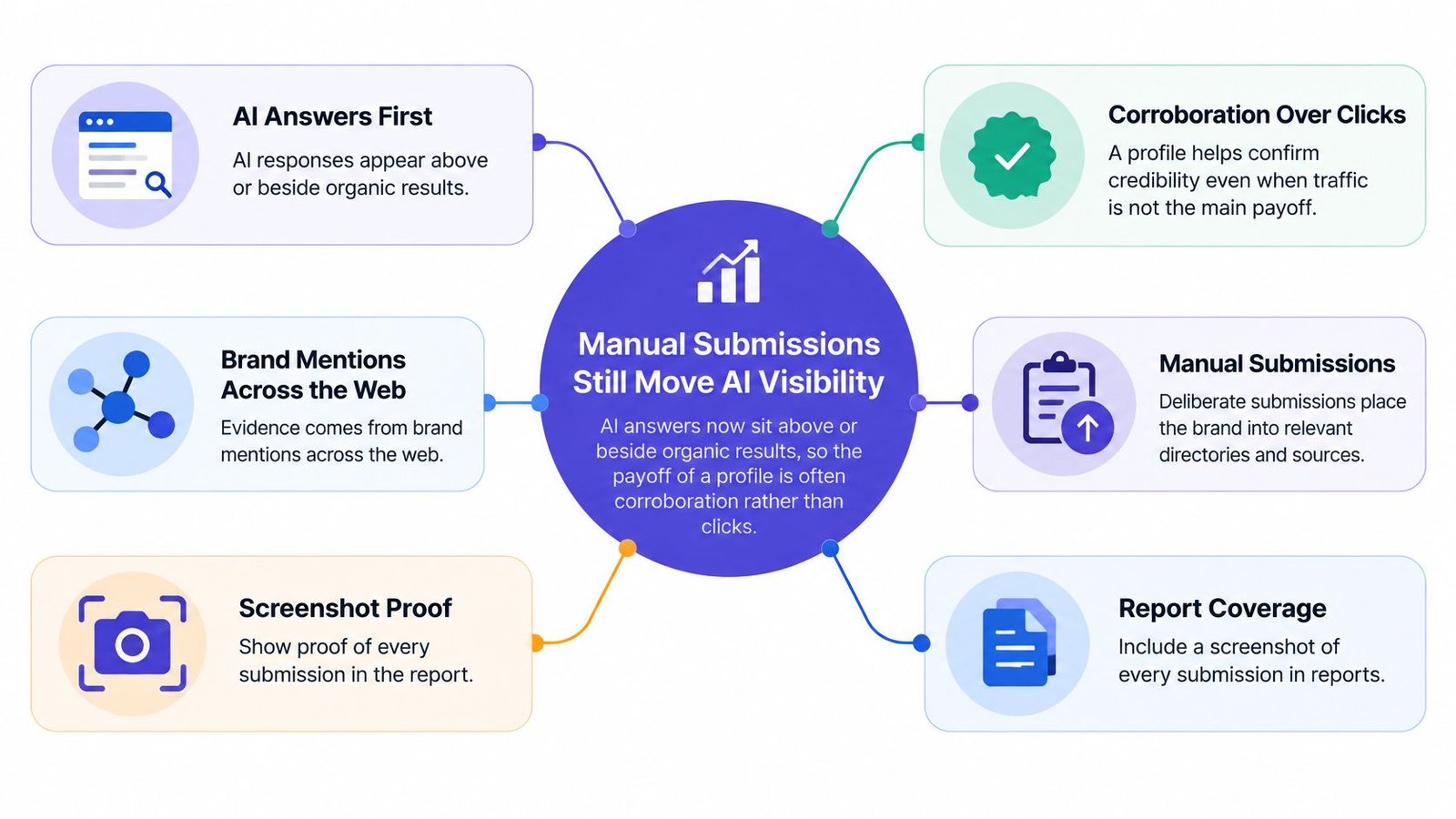
AI answers now sit above or beside organic results, which changes what a profile is for. The link still exists. The click often doesn't.
That shift shows up in click data. A 2025 Pew Research Center analysis of browsing behaviour from more than 900 U.S. adults found that users clicked a website result on 8% of Google visits that displayed an AI-generated summary, against 15% of visits without one, and that roughly one in five Google searches in March 2025 produced a summary (Pew Research Center). Judging a listing by referral clicks alone now means judging it on a shrinking surface.
What correlates with AI visibility is brand presence, not link count. Ahrefs' 2025 analysis of 75,000 brands found that brand web mentions had the strongest correlation with Google AI Overview visibility at 0.664, ahead of brand anchors at 0.527 and brand search volume at 0.392 (Ahrefs on AI Overview brand correlation). Referring-domain count wasn't presented as the dominant factor.
How an answer gets assembled
An AI Overview or a chat reply is built from sources that agree with each other. Your site, G2, Capterra, Product Hunt, Crunchbase, AlternativeTo, a review page and a community thread all act as votes on what you are, who you're for and what you cost. One contradicting profile lowers the confidence of the whole set.
That makes consistency the deliverable. Keep the product name, category, pricing language and core claim identical everywhere a reader or a model can find you. Prioritise the platforms that show up in answers for your category rather than the ones with the biggest directory count, and check the results yourself in an afternoon by running prompts like "best alternatives to [competitor]" and "AI tools for [job]" through the engines your buyers use.
Judge the report by coverage, not by clicks. A package can prove that fifty profiles exist, agree with each other and are indexed. It cannot prove what a model will say next week.
Directory submission remains the cheapest way to build the citation graph that language models lean on when they recommend a tool. The honest limit is that no listing guarantees inclusion in ChatGPT or an AI Overview, and no provider can control which sources a model cites. What a package can prove is coverage, consistency and indexability, so ask for exactly those and nothing more. If you want that work handled by people rather than scripts, our software directory listing services start from a confirmed master record.
Citation Package Questions Founders Ask Most
Are citation building packages worth it for a pre-revenue startup?
Yes for ten to twenty platforms that rank in your category, no for three hundred generic ones. Pre-revenue, your problem is being findable and credible, not accumulating links. Rule of thumb: if you can't name the platform's audience, skip it until you can.
Do nofollow directory links do anything for SEO?
They pass no ranking credit, and they still do two useful things. They create a crawlable reference to your site and they occupy brand-search real estate when an investor, customer or partner looks you up. Rule of thumb: treat a nofollow profile as a credibility asset, not a link.
How many listings do I actually need?
Enough to cover the platforms that rank for your category, which is usually twenty to sixty for a single product. The round number in a sales page measures the provider's effort, not your coverage. Rule of thumb: list the platforms first, then count them.
How long until listings appear in search?
Three stages. A profile usually appears on the directory within days, gets indexed by search engines over the following weeks, and takes longest on review platforms that verify the profile and require a real user before publishing. Rule of thumb: judge by the status report, not by a search check in week one.
Can I do this myself?
Yes for about ten platforms in a weekend, if you have a master record ready and you're willing to sit through moderation. The cost of a package is the forty-odd hours of form filling it replaces, not the listings. Rule of thumb: buy the hours when your time is worth more than the invoice.
Picking a Package and Starting the Build
Match the package to your stage rather than to a discount.
| Your situation | Coverage that matters | Package shape | What to skip |
|---|---|---|---|
| Pre-launch SaaS | Startup and launch directories, Product Hunt preparation | 20–40 hand-built listings, one-time | Review platforms that require live users |
| Post-launch SaaS with reviews | G2, Capterra and AlternativeTo plus comparison sites | 50–100 listings with review profile setup | Generic local directories |
| AI tool in a thin category | AI directories, discovery lists, sources cited in AI answers | 30–60 listings plus category-fit checks | Directories with no AI or software category |
| Local service business | Map, data aggregator, regional and industry directories | 50–300 NAP citations in one market | Software marketplaces |
| Agency or white-label buyer | The client's own category and market | Batch orders with unbranded reports | Monthly retainers for one-time work |
Before paying, ask for a sample report, ask how many of the listed platforms are manually reviewed rather than auto-published, and ask exactly what happens when a listing is rejected. Confirm the price is one-time rather than a subscription, and confirm you'll receive credentials. If you're working the launch side in parallel, these startup launch and acquisition walkthroughs cover the distribution steps that pair with a directory round.
Judge value as cost per confirmed citation, not total price. StartupSubmit's Starter plan is $79 for 50 citations at $1.58 each, Growth is $109 for 100 citations at $1.09 each, and Authority is $259 for 300 citations at $0.86 each, with reporting built for Google AI and LLM citation, screenshot proof and credentials. A single retainer month can cost more than the whole Authority build.
Then follow a sequence you can start today.
- Build the master data sheet. Name, URL, category, description, pricing language and founding year, approved once.
- Run a duplicate search on your ten priority platforms. Claim what exists instead of adding to the pile.
- Request two quotes and one sample report. Compare the line items, not the headline.
- Buy one round and verify it using the acceptance test above.
- Calendar a 90-day re-audit after your next pricing change, because that's when half your profiles go stale.
If you're still deciding which platforms deserve the first ten slots, start with where indie founders should submit first and build outward from there.
StartupSubmit runs citation packages as manual builds: a duplicate check before anything is created, hand submissions with no bots at any step, a screenshot of every listing and a status for each one in an Airtable report, delivered within 5–7 days as a one-time purchase. If you want to see the deliverable before you commit, the team will send a sample report so you can hold it against the checklist in this article. Visit StartupSubmit to compare the Starter, Growth and Authority plans and pick the round that matches your category.
Ready to build high-quality backlinks?
We'll manually submit your product to 60 to 200+ directories in 5 to 7 days, with screenshot proof for every submission. No bots, no boring forms, just more time for selling and building.
See pricing & get started →