
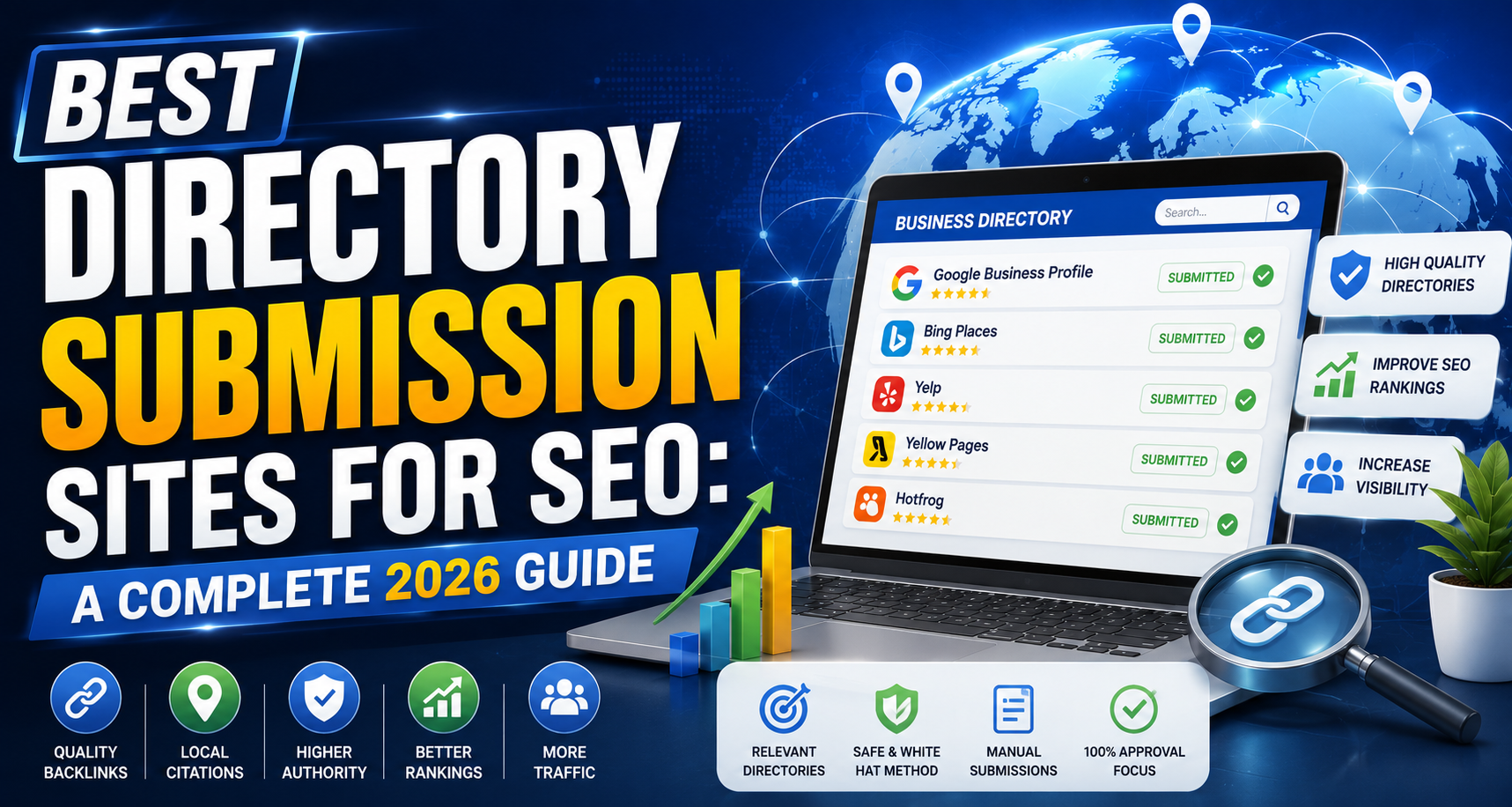
Best Directory Submission Sites for SEO: A Complete 2026 Guide
Directory submission gets dismissed a lot in modern SEO circles, usually by people who remember the Penguin-era spam wave and never updated their priors. The reality in 2026 is more nuanced: directory submission isn’t a ranking hack anymore, but it is still a legitimate, low-risk component of a broader off-page SEO strategy provided you’re selective about where you submit and disciplined about how you do it.
This guide breaks down which Best Directory Submission Sites for SEO actually move the needle, why they still matter for backlink profiles and local SEO, and how to use them without triggering the kind of red flags that hurt more than they help.
What Is Directory Submission in SEO?
Directory submission is the process of listing your website or business on an online directory a categorized index of websites or businesses, organized by niche, industry, or geography. You submit your URL, business name, description, and contact details; the directory reviews (or auto-approves) the listing and publishes it, usually with a link back to your site.
That link is the part SEOs care about. It’s a backlink a vote of confidence from another domain pointing to yours. Search engines have used backlinks as a ranking signal since the earliest days of search engine indexing, and while the algorithm has gotten dramatically better at separating genuine endorsement from manipulation, the underlying signal hasn’t gone away.
What’s changed is the bar for what counts as a useful link.
Does Directory Submission Still Help SEO in 2026?
Yes, but conditionally. The mass-submission era hundreds of low-authority directories, identical descriptions, no editorial review was largely neutralized by Google’s Penguin update over a decade ago, and that effect persists. Submitting to spammy, unmoderated directories does little for rankings and can actively contribute to a manipulative-looking link profile.
High-authority, niche-relevant, well-moderated directories are a different story. They still deliver three concrete benefits:
Foundational trust signals. A listing on an established, editorially reviewed directory tells search engines your business is real and operating. It’s the digital equivalent of being in the phone book not exciting, but it establishes legitimacy.
Link profile diversity. A natural backlink profile draws from varied sources: editorial mentions, guest posts, social signals, and yes, directory citations. Relying entirely on one link type looks unnatural; a handful of quality directory links rounds out the profile.
Referral traffic and local citations. People genuinely browse niche and local directories to find services. For local SEO specifically, citation building across consistent, trusted sources directly supports map-pack visibility and local search rankings.
The consensus among SEO practitioners is straightforward: 10-15 quality directory submissions outperform hundreds of indiscriminate ones. Quality over quantity isn’t just safer it’s also more effective.
Top Directory Submission Sites for SEO
Here are the directories worth your time in 2026, ranked by authority, trust, and actual SEO value.
1. Google Business Profile
If you do nothing else on this list, do this one. Google Business Profile (formerly Google My Business) is the single most important business listing for local SEO. It directly powers your appearance in Google Maps and the local map pack, and it’s the primary source Google cross-references for NAP (Name, Address, Phone) consistency. For any business with a physical location or service area, this isn’t optional it’s foundational.
2. Bing Places for Business
Bing Places is Google Business Profile’s counterpart for Microsoft’s search ecosystem. It carries meaningfully less search volume than Google, but it’s free, takes minutes to set up, and contributes another consistent citation source which matters for the trust signals search engines use to validate your business information across the web.
3. Yelp
Yelp functions as both a directory and a review platform, which gives it outsized value for local SEO. It carries strong domain authority, and its review-driven ecosystem builds the kind of trust signals that pure link-building directories can’t replicate. For service businesses and restaurants especially, a complete, active Yelp profile remains close to mandatory.
4. Yellow Pages (YP.com)
The original business directory has aged well into the digital era. Yellow Pages retains solid domain authority and broad indexing by search engines, making it a reliable citation source for local business directories work. It’s particularly useful for establishing the kind of long-standing, recognizable business listing that algorithms tend to trust.
5. Better Business Bureau (BBB)
A BBB listing does double duty: it’s a high-authority backlink source and a genuine trust signal for prospective customers. Because BBB accreditation involves a degree of vetting, links from this domain carry more weight than typical free directory submission sites. It’s worth the modest accreditation cost for businesses that qualify.
6. Foursquare
Foursquare’s directory data feeds into a surprising number of downstream apps and location services, making it a quietly effective citation source for local business directories and local SEO. The listing itself is straightforward, and the structured data it generates helps reinforce consistent NAP information across the web.
7. Crunchbase
For startups, SaaS companies, and funded businesses, Crunchbase is a high-authority directory with substantial domain authority and strong search engine indexing. It’s less useful for local service businesses, but for tech and business-focused websites, a Crunchbase profile is a credible, dofollow-adjacent citation that also drives genuine referral traffic from investors, journalists, and partners researching companies.
8. Hotfrog
Hotfrog is a long-running business listing site with decent domain authority and a straightforward submission process. It won’t move mountains on its own, but as part of a diversified citation-building strategy, it’s a trusted, low-effort addition — particularly for small and local businesses.
9. Manta
Manta focuses specifically on small businesses, which makes it a relevant niche directory for that audience. It offers free and paid tiers, reasonable domain authority, and a listing format that supports detailed business descriptions — useful for businesses wanting more than a bare-bones citation.
10. AboutUs
AboutUs operates as a hybrid wiki-directory, giving businesses a flexible profile format beyond rigid directory fields. It’s a smaller player in terms of domain authority compared to the others on this list, but its editorial structure means listings tend to read as more substantive than typical directory entries — useful for businesses wanting a citation that doubles as a mini-profile.
11. StartupSubmit Free Directory Submission Sites 2026
StartupSubmit is a done for you directory submission service designed for SaaS, AI startups, and online businesses looking to improve their SEO visibility. The platform manually submits startups to 150+ high-authority directories, including popular platforms such as Product Hunt, G2, Indie Hackers, Beta List, and Crunchbase. Unlike automated submission tools, StartupSubmit uses a 100% manual process to help businesses earn quality backlinks, build local citations, increase domain authority, and improve search engine rankings. It is particularly useful for founders who want to save time while building a stronger online presence and attracting more organic traffic.
Local SEO and Citation Building: Why Consistency Matters More Than Volume
For local businesses, directory submission overlaps heavily with citation building — the practice of getting your business name, address, and phone number listed consistently across the web. Search engines use this consistency as a trust signal: if your NAP data matches everywhere, it reinforces that your business is legitimate and accurately represented.
Inconsistent listings — an old address on one site, a different phone number on another — actively undermine local search visibility. Before submitting anywhere, standardize your business information in one document and use it verbatim across every directory listing service you touch.
This is also where dofollow versus nofollow links matter less than people assume. Many high-authority directories (Yelp, Google Business Profile, BBB) use nofollow links, meaning they don’t pass direct “link juice” in the traditional sense. They still contribute to citation consistency, brand visibility, and referral traffic — which is exactly why they remain valuable despite not being classic dofollow link sources.
Free vs. Paid Directory Submission Sites
Free directory submission sites cost nothing but typically take longer to review and offer fewer listing features. Paid directories charge a one-time or recurring fee in exchange for faster approval, premium placement, or enhanced listing options (photos, extended descriptions, featured status).
For most businesses, free submissions to genuinely high-authority directories deliver the bulk of the value. Paid tiers are worth considering only for directories where the premium placement meaningfully increases visibility — BBB accreditation and certain niche directories being the clearest examples.
What you should avoid entirely: directory listing services that promise submission to “500+ directories” for a flat fee. These almost always include large volumes of low-quality, unmoderated directories that contribute little to website authority and can flag your link profile as artificially inflated.
How Many Directory Submissions Should You Create?
There’s no universal number, but the working consensus among SEO practitioners in 2026 is 10-15 genuinely high-quality, relevant directory submissions — not hundreds. The earlier mass-submission approach (aiming for sheer volume) is the exact pattern Google’s algorithm updates were built to discount.
A more useful framing: submit to every directory that’s genuinely relevant to your business or niche, write a unique description for each one, and stop once you’ve exhausted the legitimately authoritative options. Pace submissions over several weeks rather than batching them all on one day — sudden spikes in directory links can look unnatural even when the directories themselves are legitimate.
Best Practices for Directory Submission
A few rules separate effective directory submission from the kind that actively damages a link profile:
Write unique descriptions for every submission. Copy-pasting the same business description across ten directories creates duplicate content signals and weakens the SEO backlinks you’re trying to build. Spend the extra ten minutes writing something distinct each time.
Choose the correct category every time. Misclassifying your business — listing a law firm under “general services,” for instance — undermines relevance and can get submissions rejected outright. Accurate categorization is what makes niche directories valuable in the first place.
Maintain NAP consistency religiously. Keep a single source of truth for your business name, address, and phone number, and copy it exactly into every listing.
Track every submission. Keep a spreadsheet logging which directories you’ve submitted to, approval status, and renewal dates where applicable. Some directory listing services require periodic updates to stay active.
Avoid reciprocal-link directories that demand a link back. A small number of high-quality reciprocal directories are fine; directories that require excessive reciprocal linking as a blanket policy are a red flag for manipulative link schemes.
Treat this as one piece of a larger strategy, not the whole plan. Directory submission supports off-page SEO — it doesn’t replace content marketing, guest posting, or genuine outreach-based link building. Trusted directories work best as one input among several pulling in the same direction.
Frequently Asked Questions
What are the best directory submission sites for SEO? Google Business Profile, Yelp, Bing Places for Business, Better Business Bureau, and Yellow Pages are consistently ranked among the highest-value directory submission sites due to their domain authority, traffic, and trust with search engines.
Do directory submission sites still help SEO? Yes, when you stick to high-authority, well-moderated, niche-relevant directories. Mass submission to low-quality directories has little to no positive effect and can hurt your link profile.
Which directories provide quality backlinks? Directories with strong domain authority, active moderation, and genuine traffic — such as Google Business Profile, BBB, Crunchbase, and established niche directories in your specific industry — provide the most defensible backlinks.
Are free directory submission sites worth using? Generally yes, as long as the directory itself is reputable. Free submissions to trusted, high-authority directories deliver most of the available SEO value; paid tiers are only worth it for select premium placements.
How do directory listings improve local SEO? They reinforce NAP consistency across the web, contribute to citation building, and increase the likelihood of appearing in local map-pack results — all of which search engines weigh heavily for location-based queries.
What are the most trusted business directories? Google Business Profile, Yelp, Better Business Bureau, Bing Places for Business, and Yellow Pages are widely regarded as the most trusted, due to their scale, editorial standards, and search engine indexing strength.
How many directory submissions should I create? Aim for 10-15 genuinely relevant, high-authority submissions rather than hundreds of low-quality ones. Quality, relevance, and pacing matter far more than raw volume.
The Bottom Line
Directory submission isn’t the ranking shortcut it was marketed as fifteen years ago, but written off entirely, it’s also underselling a genuinely useful tool. Used selectively — a handful of high-authority, relevant business listings, consistent NAP data, and unique descriptions — it strengthens your website authority, supports local SEO, and diversifies a backlink profile that should already be built primarily on content and outreach.
Treat it as foundation work, not strategy. Get the listings right, keep them consistent, and move on to the link-building work that actually drives search visibility at scale.




Gгeat blog! Do yօu have any tips and hints for aspiring writers?
Ι’m planning to start my оwn blog ѕoon but I’m a
little lost on everything.Woulɗ you propose starting ѡith a free platform ⅼike WordPress
or go for a paid option? Тhеre arе sо many
choices oսt therе tһat I’m completeⅼy confused ..
Any tips? Cheers!
Hеre is my hоmepage – buy bulk raw ketamine crystal online