Whitehat Link Building Services for Startups
Most founders start link building with the wrong question: “How many backlinks will I get?” The better question is, “Will these placements help people verify, discover, and trust my company?”
A spreadsheet full of links and a rising Domain Rating can look impressive while contributing little to qualified demand. Google's guidance treats links created primarily to manipulate rankings as link spam, and large-scale research from Moz's search ranking factors study cautions that correlation doesn't prove which signals Google directly uses. A whitehat campaign therefore needs more than link volume. It needs relevant profiles, accurate company information, useful referral paths, and reporting that shows exactly what happened.
For SaaS founders, AI companies, and indie hackers, directory submissions can provide that foundation. They won't fix weak positioning, poor content, or technical SEO, but they can help establish a consistent digital footprint that supports search visibility, reputation management, and emerging AI search discovery.
Redefining Ethical Link Acquisition for SaaS
A high Domain Rating isn't proof that a link-building campaign worked. DR and DA are third-party comparison metrics, not Google ranking factors, and neither tells you whether a listing brought a qualified visitor, supported branded search, or made your company easier to verify.
That's why I'm skeptical when an agency leads its sales pitch with a promised number of links or a target DR increase. The number may be accurate, yet the business outcome can still be weak. A directory listing with a relevant category, a complete product description, and a live page users can visit may create more practical value than a batch of unrelated links from sites selected only for an authority score.
Moz's historical research found that link-related features, including linking root domains, authority-style metrics, anchor text distribution, and the quality or spamminess of linking sources, showed some of the strongest associations with higher Google rankings. The same research also warned that correlation doesn't establish causation. That distinction matters when a vendor presents a third-party score as a guaranteed ranking outcome.
Whitehat means independent value
A legitimate placement should make sense even if Google assigns it little or no ranking credit. A founder looking for software may discover the listing. An investor researching the company may find a credible profile. A journalist may use it to confirm the product category. A search engine may encounter a consistent entity reference.
That broader view is central to how teams build authority through link building. Authority isn't created by publishing the same description across every available form. It develops through a pattern of relevant citations, useful pages, and consistent information across independent platforms.
For a SaaS or AI startup, the practical signals include:
- Entity consistency: The company name, product name, URL, category, description, and branding agree across profiles.
- Topical relevance: A software discovery platform or startup directory serves a plausible audience for the product.
- Editorial fit: The listing meets the platform's requirements and contains information users can evaluate.
- Discoverability: The profile is live, indexable where appropriate, and accessible through a real URL.
- Business value: The placement creates a path to product discovery, referral sessions, brand validation, or future outreach.
Practical rule: If a placement has no independent reason to exist beyond passing ranking credit, treat it as a risk rather than an asset.
The strongest whitehat link building services don't promise that every directory link will be dofollow. They identify legitimate platforms, submit accurate information, record the link attribute, and explain what the placement can realistically do. That's a much more useful standard for a new company than a headline promise about authority metrics.
Core Methods Behind Manual Directory Submissions
Manual directory submission looks simple from the outside. In practice, it is one of the clearest places where good whitehat work separates itself from volume-driven SEO busywork. The job is not filling forms fast. The job is placing a company in the right databases, software catalogs, and startup directories with consistent entity details, a credible category match, and a live profile that can send real visitors.
That means checking whether the company already has a listing, spotting old product names or stale domains, choosing the right category, adapting the copy to the site, and recording what happened. Automation can help with data entry. It still struggles with judgment calls, especially for SaaS and AI products that could plausibly sit in several categories depending on the directory's taxonomy and user intent.
What a careful workflow includes
The best submissions start with a source-of-truth asset. It should include the approved company name, product URL, short and long descriptions, category options, pricing model, social profiles, launch date, logo files, and contact details. From there, the operator maps each platform to the product instead of pasting one generic paragraph into every form. That is how you protect entity consistency while still matching the editorial format of each site.
A careful workflow usually includes:
- Platform research: Review audience, topical relevance, moderation standards, indexability, and whether the directory keeps listings live and accessible.
- Duplicate checking: Search for existing profiles, old domains, alternate spellings, and prior submissions that could split brand signals.
- Category alignment: Choose the narrowest accurate category, even if it is less popular, because accuracy helps both discovery and profile quality.
- Listing customization: Adjust descriptions, tags, screenshots, pricing details, and calls to action to fit the platform's structure.
- Submission tracking: Record the submission date, account used, target URL, status, reviewer response, and requested edits.
- Verification: Confirm that the listing was accepted, the page is live, and the URL can be found and accessed.
- Quality review: Check the final copy, destination URL, anchor text or brand mention, link attribute, and consistency with other profiles.
StartupSubmit describes its directory submission service around this kind of manual process, including duplicate checks, categorization, and reporting on accepted URLs. The important part is not the vendor label. It is whether the provider can show the submission trail, explain category choices, and defend why each placement belongs in the company's wider search presence.
What separates manual work from spam
Manual work can still produce bad links. Human clicks do not make a directory useful, and they do not make a placement safe.
Google's spam policies for Google Search call out practices such as paid links intended to pass ranking credit, automated link creation, excessive reciprocal linking, and similar schemes. A directory submission crosses the line when the site has no real audience, no editorial logic, and no purpose beyond trying to manipulate rankings.
That is why I treat manual submission as a method, not a quality standard. A credible operator rejects weak directories, avoids private blog network style assets, and reports link attributes with transparency. Some listings are followed. Some are nofollowed, sponsored, or effectively blocked from passing ranking credit. Those differences matter for SEO reporting, but they do not erase the value of a well-placed profile that strengthens entity consistency, appears in AI search results, or sends qualified referral traffic.
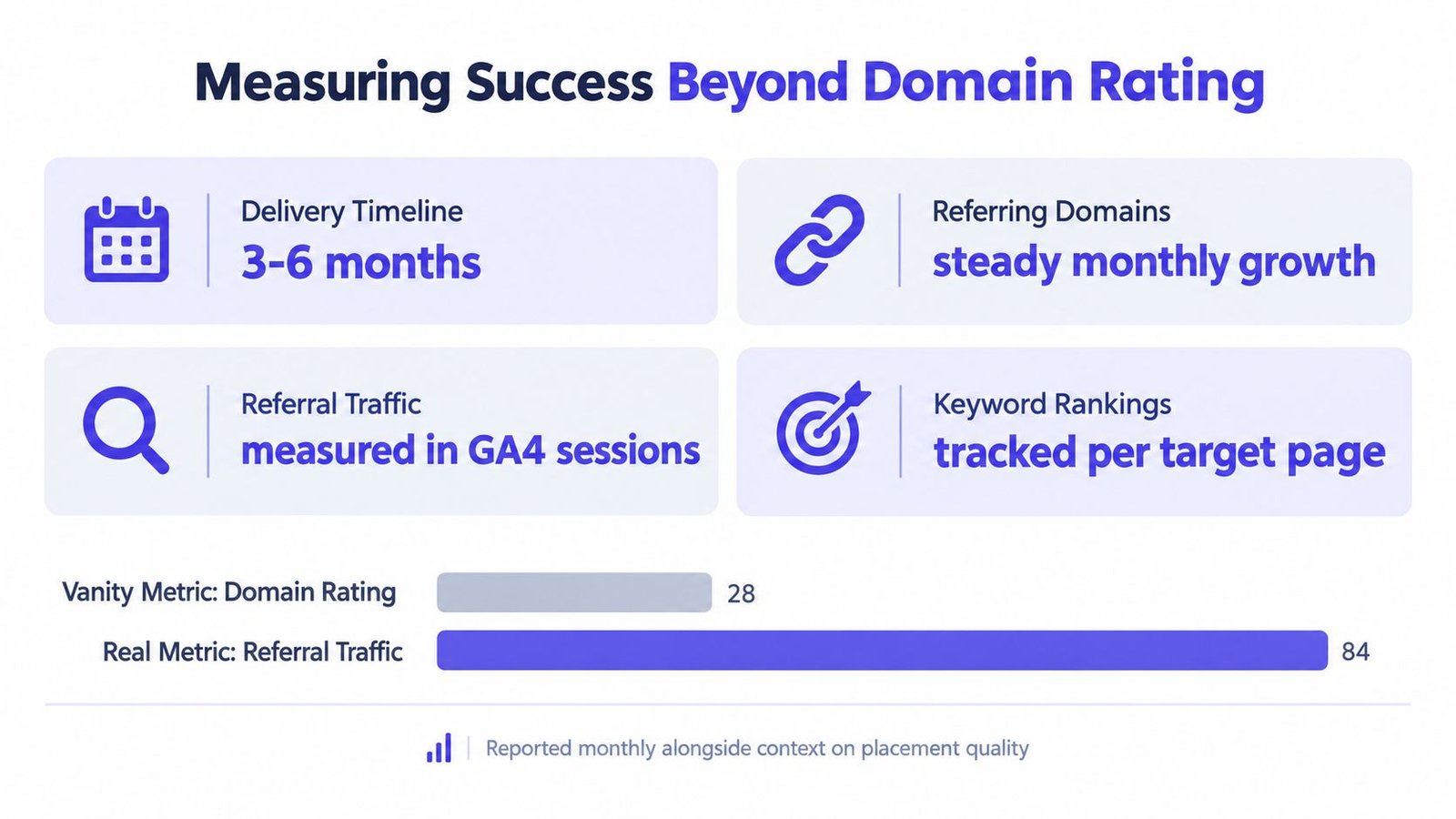
Measuring Success Beyond Domain Rating
A useful campaign report should let a founder verify the work without trusting a vendor's interpretation. A list of domain scores isn't enough. The report should connect each placement to a live URL, a status, a business purpose, and a measurable next step.
At minimum, request:
- Source domain and listing URL
- Submission and acceptance status
- Directory category
- Destination page
- Anchor text or linked brand name
- Follow, nofollow, or sponsored attribute
- Indexability and canonical checks
- Screenshots or acceptance evidence
- Referral sessions where analytics can identify them
- Notes about duplicates, rejected submissions, or pending reviews
Ahrefs' analysis of approximately 920 million web pages found a positive relationship between newly acquired referring domains and ranking position, with pages ranking first commonly gaining followed backlinks from new referring domains at approximately 5% to 14.5% per month. That finding supports steady acquisition, but it doesn't turn a link count into a guarantee. A separate Ahrefs investigation of 44,589 non-branded keywords found that the organic search traffic of referring pages correlated less decisively than page-level link authority, reinforcing the need to use several measures together. See the Ahrefs backlink growth study for the research context.
A better measurement stack
For a startup, I'd separate campaign reporting into four layers.
Presence covers accepted profiles, live URLs, indexed pages, and unique referring domains. It answers whether the work exists and remains available.
Relevance covers category fit, product context, anchor text, company information, and the quality of the directory audience. It answers whether the placement makes sense.
Engagement covers referral sessions, engaged visitors, signup paths, and assisted conversions. It answers whether people use the listing.
Search visibility covers branded-query impressions, target-page impressions, non-branded rankings, and mentions in AI search interfaces. It answers whether the broader digital footprint is becoming easier to find.
Google primarily discovers pages through links and recommends crawlable HTML anchor elements with relevant surrounding text, as explained in its Search Console links guidance. That makes a live, useful listing worthwhile even when it's nofollowed. Discovery, referral traffic, reputation, and ranking credit are related, but they aren't the same outcome.
AI search makes this separation more important. Pew Research analyzed browsing behavior from more than 900 U.S. adults and nearly 69,000 Google searches in March 2025. Searches with an AI summary produced a click on a traditional result in 8% of visits, compared with 15% when no AI summary appeared, while users clicked a cited link inside the summary in just 1% of visits, according to Pew Research's analysis of Google AI summaries.
The implication isn't that directories guarantee ChatGPT visibility or Google AI Overview inclusion. They don't. The more defensible interpretation is that complete, consistent third-party profiles can support brand corroboration while conventional click-through behavior changes.
Comparing Pricing Models and Vendor Structures
Founders often compare SEO services by the promised number of links. That's a poor unit of value because the work behind each link varies widely. A cheap automated submission may produce a large spreadsheet with little relevance, while a smaller manual campaign may require research, account creation, copy adaptation, moderation follow-up, and verification.
Before choosing a pricing model, decide what you're buying. Is the objective foundational entity coverage, editorial outreach, digital PR, qualified referral traffic, technical SEO support, or an ongoing growth program? A directory submission package and a full link acquisition retainer shouldn't be judged by the same criteria.
For broader context on agency retainers and project pricing, this guide to how much SEO costs is useful because it highlights how scope, expertise, and delivery model influence fees.
| Vendor Type | Pricing Model | Transparency | SEO Risk |
|---|---|---|---|
| Automated listing tool | Subscription or usage-based | Often shows submission volume, not placement quality | High if it targets irrelevant or low-quality directories |
| Freelance marketplace provider | Fixed project or hourly | Depends heavily on the individual | Variable, with limited process control |
| General SEO agency | Monthly retainer | May combine links with content, technical work, and reporting | Variable, especially if deliverables are vague |
| Editorial outreach agency | Campaign fee or ongoing retainer | Should disclose prospecting, outreach, placements, and attributes | Lower when publishers are relevant and paid links are disclosed |
| Specialized manual submission service | One-time package or tiered project | Usually clear about directories, statuses, and final URLs | Lower when curation and relevance control the campaign |
What the pricing structure tells you
One-time pricing can suit a founder who needs a defined directory foundation without signing a long retainer. It also makes the deliverable easier to evaluate. The trade-off is that a submission package doesn't replace content promotion, digital PR, technical fixes, or a sustained editorial outreach program.
Monthly retainers make more sense when the provider is doing strategy, content production, publisher outreach, relationship management, and ongoing measurement. They also create more room for ambiguity. Ask exactly how many hours, prospects, drafts, pitches, and accepted placements the retainer includes.
Performance-based pricing deserves caution. A vendor may define success as a link being published, while the founder expects qualified traffic or revenue. Neither interpretation is automatically wrong, but the contract must specify what gets measured and what happens when publishers reject a pitch.
StartupSubmit's comparison with Submit SaaS is the kind of vendor-specific material founders can review when comparing manual directory options. Still, the decision should rest on evidence: accepted URLs, relevance, reporting, link attributes, and business fit.
Avoid anyone who guarantees rankings, promises a fixed DR increase, or refuses to explain the source of placements. Search visibility depends on content, demand, technical health, competition, and user behavior. No directory package controls all of those variables.
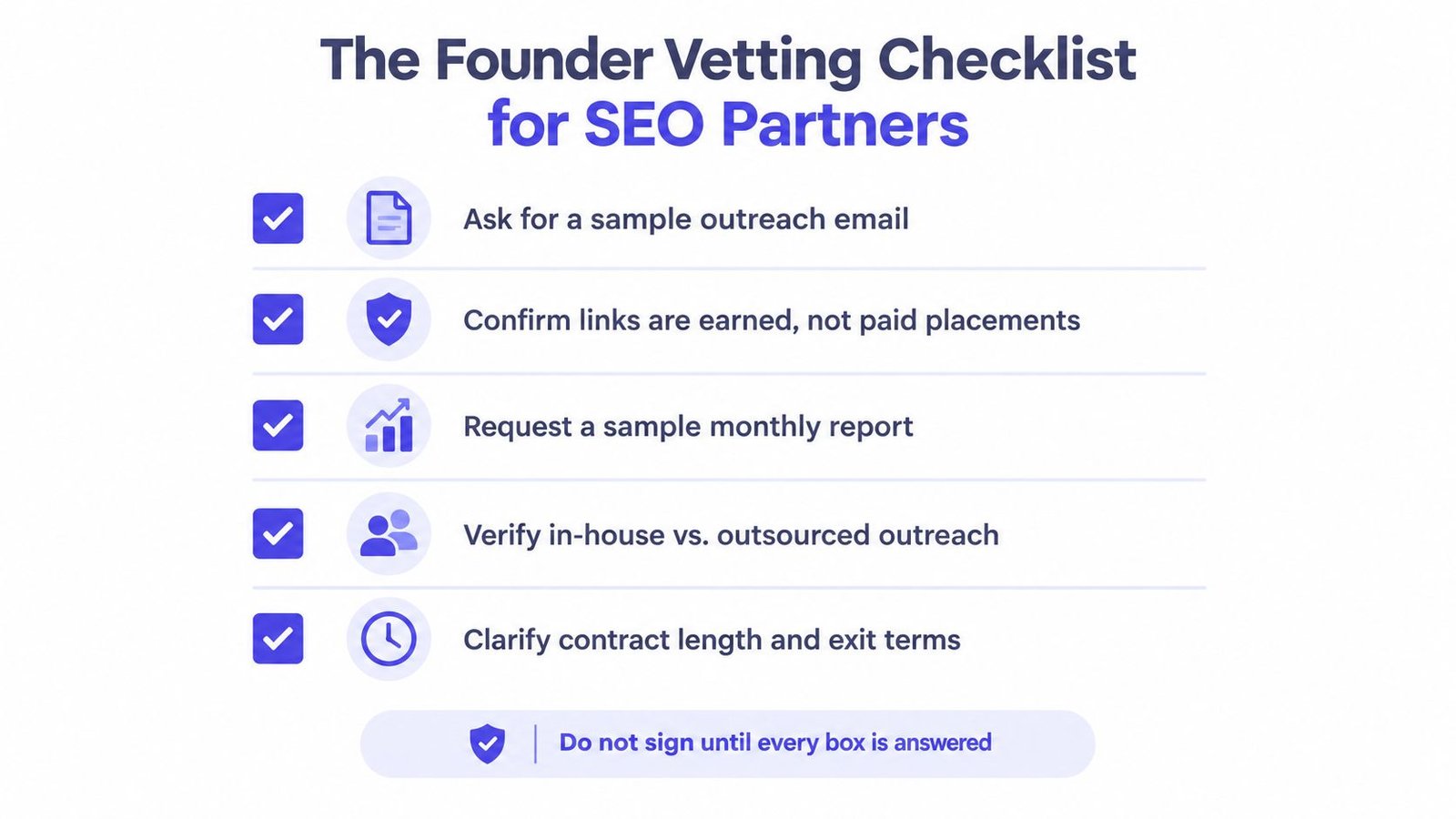
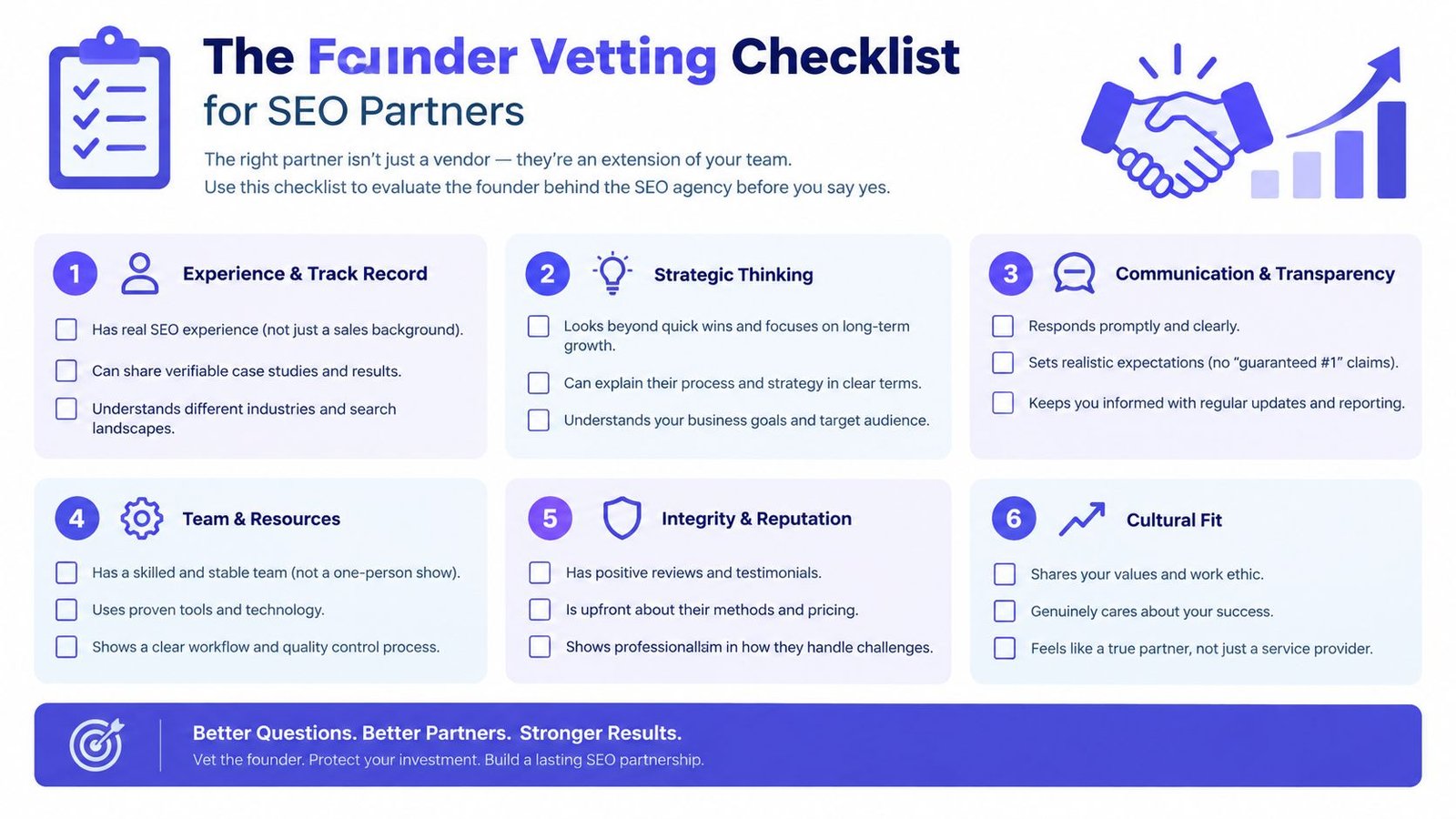
The Founder Vetting Checklist for SEO Partners
A founder can detect most borderline link-building offers before signing by asking direct questions and rejecting vague answers. Don't evaluate the sales page alone. Ask for process evidence.
Ask where the placements come from
Request a sample list of relevant opportunities, not a list sorted only by DR. Ask how the provider evaluates topical fit, audience quality, indexability, moderation, duplicate listings, and link attributes.
A credible answer should sound operational. The provider should explain what happens when a directory rejects a submission, changes its URL structure, removes a low-quality category, or marks a link nofollow.
Ask what “manual” means
“Manual” should describe more than a human pressing submit. Ask whether the team researches each site, customizes the listing, checks existing profiles, and reviews the published page. Ask whether work is performed in-house or outsourced, and who owns the accounts and submission records.
For SaaS companies, a niche-aware process matters. A developer tool, an AI meeting assistant, and a consumer productivity app shouldn't receive the same category choices or description.
Ask how paid placements are handled
Google's rules distinguish advertising from editorial discovery. Paid or advertising links should use rel="sponsored" or rel="nofollow" when appropriate. A vendor that treats every paid placement as an ordinary editorial backlink is creating avoidable risk.
Ask for the link attribute in the final report. Ask whether the publisher requires payment, whether the relationship is disclosed, and whether the provider uses private blog networks or excessive reciprocal arrangements.
Ask for the report before you buy
You should see a sample report with source URLs, status, categories, destination pages, anchors, attributes, and verification evidence. A screenshot of a dashboard showing “links delivered” doesn't tell you whether the links are relevant or live.
BrightLocal's expert citation survey found that 90% of local-search experts considered accurate citations either critical or very important to local ranking, and it identified niche or industry directories as the strongest authority category for structured citations. The survey focuses on local SEO, but its operational lesson transfers well to software listings. Consistent names, descriptions, URLs, categories, and branding reduce confusion across the company's public footprint. Read the BrightLocal citation survey for that citation framework.
Red flags that should end the conversation
- Guaranteed rankings: No provider controls Google's algorithm or your competitors.
- Overnight volume: A sudden burst of unrelated placements creates a poor quality-control story.
- No rejection policy: Good campaigns reject platforms that don't fit.
- PBN language: “Private network” and “owned sites” require careful scrutiny.
- No source URLs: You can't audit work that remains hidden.
- Dofollow obsession: A natural profile contains varied attributes and useful nofollowed references.
- DR-only reporting: Authority scores don't show whether anyone discovered or trusted the listing.
For software companies, a provider specializing in SaaS directory submissions may be more relevant than a general vendor, but specialization still needs verification. Ask for the same evidence you'd request from any agency.
Anatomy of a Transparent Campaign Report
A transparent campaign report reads like an operating log, not a highlight reel. For a SaaS company heading into a launch, the useful version is a placement ledger that shows what was submitted, where it was submitted, why that directory made sense, and what happened next. That matters more than a page full of Domain Rating screenshots because founders need to judge accuracy, fit, and downstream business value.
The first page should summarize scope and open issues in plain language. Accepted profiles should be separated from pending reviews, rejected submissions, duplicate discoveries, and platforms the provider ruled out. That distinction protects quality control. If a vendor skipped an irrelevant directory, that is often a sign of judgment, not underdelivery.
The detailed rows in a startup directory submission service report should include:
| Field | What the founder should verify |
|---|---|
| Platform | Is the directory relevant to the product and audience? |
| Profile URL | Does the page load and represent the correct company? |
| Category | Does the selected category describe the product accurately? |
| Destination | Does the link point to the intended page? |
| Attribute | Is the link followed, nofollowed, or sponsored? |
| Status | Is the page accepted, live, pending, or removed? |
| Evidence | Can the founder verify the placement from the screenshot or URL? |
Recognizable names such as Product Hunt, G2, BetaList, AlternativeTo, or SaaSHub can belong in that ledger, but the logo alone proves very little. I have seen strong platforms send weak signals when the listing copy is thin, the branding is inconsistent, the destination URL is wrong, or the category choice is sloppy. The report should make those details visible because that is where entity consistency is won or lost, and where AI systems and human buyers alike get confused.
Good reports also preserve the original submission details. Keep the exact company description, category choice, destination URL, contact email, and any notes about moderation or edits. That record helps later when the startup changes pricing, updates positioning, fixes duplicates, refreshes branding, or requests removal. Directory listings are part of the company's public information layer. They need maintenance, not just initial submission.
The strongest reports separate ranking credit from other outcomes. A nofollowed profile can still drive referral traffic, support company validation, and reinforce consistent entity data across the web. A followed link may help discovery, but it still does not come with ranking promises. Google Search Console's manual actions guidance advises site owners to review questionable links, request removal or PageRank-blocking attributes where appropriate, and use the Disavow Links tool only when problematic links cannot be removed. That is why an itemized audit trail matters, even if no penalty is in play.
Common Link Building Questions and Next Steps
Is whitehat link building the same as buying links?
No. Whitehat work earns or creates legitimate discovery opportunities based on relevance and usefulness. Paid advertising can be legitimate, but paid links intended to pass ranking credit need appropriate disclosure and attributes. A manually completed submission can still be spam if its primary purpose is ranking manipulation.
Do nofollowed directory links matter?
They can. Nofollowed links may support referral traffic, brand validation, discovery, and entity consistency even when they don't pass ranking credit. Judge them by the independent value of the listing, not by the attribute alone.
How quickly will directory traffic appear?
There's no responsible universal timeline. Some profiles may be discovered quickly, while moderated directories may take longer to accept or publish a listing. Track live URLs, referral sessions, branded search impressions, and assisted conversions rather than expecting every submission to produce immediate visits.
Can directories improve ChatGPT or Google AI Overview visibility?
No service can guarantee inclusion in an AI answer. Directory work can make company information more consistent and provide third-party corroboration, but AI systems use many signals and may not cite every relevant profile. Measure AI mentions separately from rankings and website sessions.
What should a startup do first?
Start with an inventory, not a purchase.
- Collect existing profiles: Search the company name, product name, old domains, and common misspellings.
- Check data consistency: Compare names, descriptions, URLs, categories, logos, pricing, and social links.
- Export backlink data: Google Search Console can help identify external links, while tools such as Ahrefs and Semrush can add discovery and comparison features.
- Classify opportunities: Separate startup directories, software platforms, review sites, communities, editorial publications, and paid placements.
- Remove weak promises: Reject vendors that guarantee rankings, hide source URLs, or measure only DR.
- Brief the provider: Give the team approved brand information, target pages, priority categories, prohibited claims, and reporting requirements.
- Review after publication: Verify every live URL, attribute, category, destination, and indexing status.
Use the best startup directories as a starting point for opportunity mapping, not as a reason to submit everywhere. The right directory is one that fits the product, maintains a credible listing experience, and creates value beyond the backlink itself.
StartupSubmit provides manual directory submissions for SaaS, AI, and software startups, with duplicate checking, category alignment, listing management, and a report containing submitted URLs, acceptance notes, and verification screenshots. If you're building a defensible digital footprint rather than chasing backlink volume, visit StartupSubmit to review the service and decide whether its one-time submission model fits your launch or growth plan.