
Directory Submission in 2026: What Still Works for SaaS
The most popular directory submission advice is still to collect as many backlinks as possible. That's the wrong objective for a SaaS startup. A profile nobody can find, understand, or use isn't much of a marketing asset, even if a reporting tool counts the link.
Treat directories as company-data infrastructure and a referral channel. Your job is to put accurate product information where buyers research software, then measure whether those profiles produce discovery, trust, or qualified visits.
Table of Contents
- What Directory Submission Means Today
- Which Directory Types Deserve Your Time
- How to Submit a Product Step by Step
- Spam Tactics That Cost You Rankings
- Making Listings Work for AI Search Visibility
- How to Measure Directory Results Honestly
- Directory Submission Questions Answered
- Your Next Steps This Month
What Directory Submission Means Today
Modern directory work starts with a product record, not a spreadsheet of websites willing to accept links.
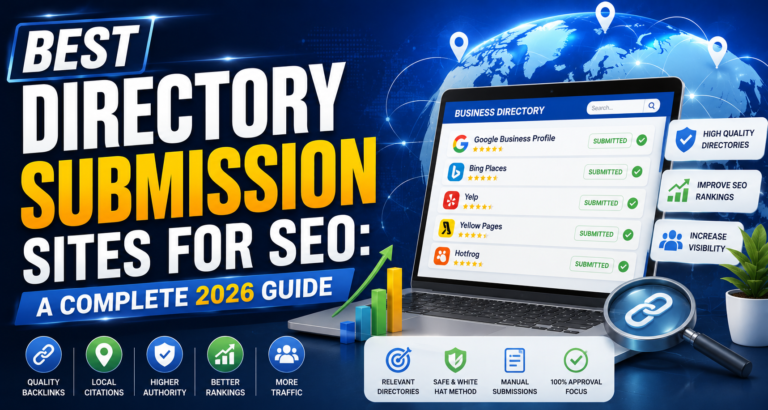
Directory submission is manually listing a product on curated, category-matched directories so search engines and AI assistants can verify and discover the brand.
That definition has practical consequences:
- Manual means a person completes each form and checks that the profile reflects the actual product.
- Curated means the directory reviews or moderates submissions rather than publishing anything indiscriminately.
- Category-matched means the product appears where a prospective buyer would reasonably look for it.

Human curation came before link building
Yahoo began in 1994 as Jerry and David's Guide to the World Wide Web, a hand-built list; DMOZ later developed into a volunteer-edited index that peaked at 5,169,995 listed sites in April 2013, before declining to 3,996,412 by October 2015, according to SearchEngines.net's directory history. Those directories helped people discover websites through categorization, not through backlink packages.
Blasting identical submissions into automated link farms reverses that purpose. Instead of helping someone find a product, it creates pages primarily to manufacture links.
The useful modern asset is a consistent company identity: name, destination URL, category, and factual description. Consistency gives search systems and language models a clearer set of references to reconcile, although it doesn't guarantee recommendations.
For businesses with a geographic presence, how local citation building works provides a useful parallel. Accurate business records matter more than the number of forms completed.
Which Directory Types Deserve Your Time
| Directory type | Examples | Best for | Main risk |
|---|---|---|---|
| Software review platforms | G2, Capterra | Buyer research and review proof | Needs real customer reviews to look credible |
| Launch platforms | Product Hunt | Launch-day traffic and early backers | Traffic fades within days unless the profile keeps working |
| Founder and early-stage communities | BetaList, Indie Hackers | Early users and product feedback | Audience skews toward other founders |
| Alternative and comparison sites | AlternativeTo, SaaSHub | Catching competitor-switch searches | Value depends on accurate category tags |
| Company profile databases | Crunchbase, Trustpilot | Trust checks on the brand name | Facts must match founder and company records exactly |
Free basic listings should be your default. Platforms including G2, Capterra, AlternativeTo, and Product Hunt offer basic participation without buying featured placement, though eligibility and commercial options can change. Check the current submission terms before preparing assets.
Paid placement is a media purchase, not an SEO shortcut. I'd only pay to amplify a directory profile after its unpaid presence has demonstrated relevant referrals.
Match the platform to the buying moment
Review platforms work best when customers can explain why they chose your software and what they use it for. An empty profile can establish a presence, but it won't provide the same buying reassurance as detailed, authentic reviews.
Launch platforms serve a different purpose. Plan for concentrated attention around publication, then make sure the surviving profile has current positioning, useful screenshots, and a working destination.
Founder communities are useful for testing explanations and finding early adopters. However, feedback from another indie hacker isn't automatically evidence that your intended enterprise buyer wants the product.
Comparison sites reach people considering a switch. Say you sell meeting transcription software: accurate language support, export options, and integrations matter more than describing the product as an all-purpose AI platform.
Company databases support brand verification. Crunchbase and Trustpilot aren't interchangeable, though: company information and customer reputation answer different questions.
Apply these selection filters
Use these checks before adding a platform to your shortlist:
- Topical fit: Can you identify a category and audience that match the product?
- Editorial standards: Does someone review submissions, enforce rules, or maintain useful moderation?
- Public visibility: Can a visitor access the finished profile without signing in, and can search systems index it?
For an early-stage B2B SaaS tool, a balanced starting shortlist could include G2, Capterra, Product Hunt, BetaList, AlternativeTo, SaaSHub, and Crunchbase. Add Indie Hackers when you have something useful to contribute beyond a launch announcement.
For AI products, use where to list your AI startup to develop candidates, then apply the same filters. A recognizable platform name doesn't excuse a poor category match.
How to Submit a Product Step by Step
Before submitting anything, record branded-search impressions in Search Console, referral sessions in GA4, and indexed pages on your website. Save the date ranges and filters, not just screenshots of totals. Without a comparable baseline, a later traffic change is difficult to interpret.
Keep this snapshot alongside the canonical product record. Assign an owner to maintain it when pricing, positioning, or the product name changes.
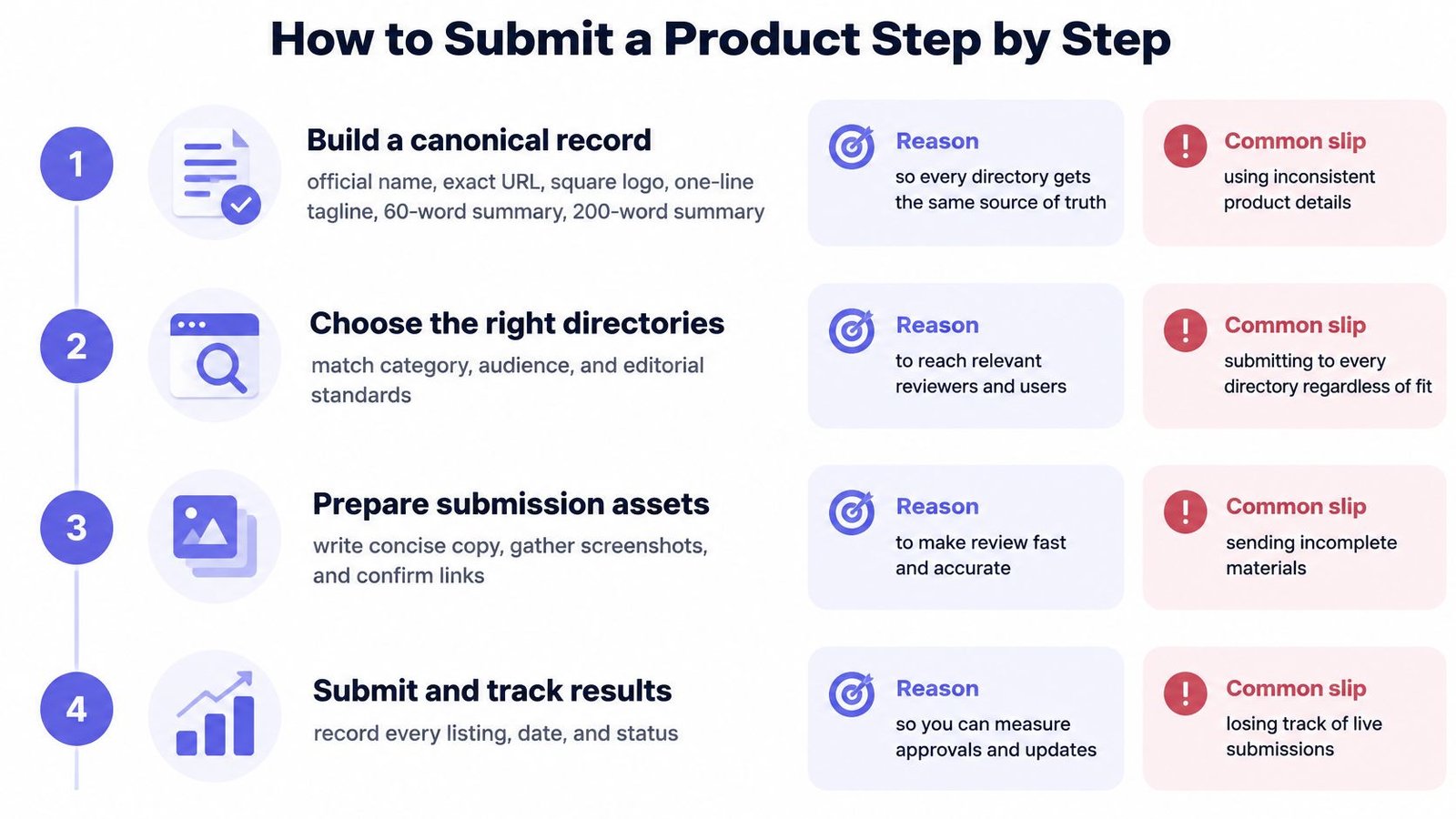
Build and submit from a single source of truth
Build a canonical record. Include the official name, exact URL, square logo, one-line tagline, a 60-word summary, a 200-word description, category, pricing model, and social profile links. Every submission draws from this sheet, so don't populate it with a temporary launch-week tagline you already expect to replace.
Audit existing profiles. Search each directory for both the brand name and domain, checking for duplicates, obsolete prices, and incorrect founder details. Fixing a record is usually preferable to creating another; our process checks each directory first and, when the business is already listed, skips it for another relevant directory where available.
Choose the narrowest accurate category. Specific categorization helps a buyer understand where the product belongs. If an AI support tool only fits by selecting an unrelated marketing category, skip that directory rather than forcing a match.
Adapt the copy without changing the facts. A founder community may welcome the problem behind the product, while a comparison platform needs concrete capabilities and limitations. Don't turn those different presentations into conflicting claims about integrations, pricing, or availability.
Submit each listing by hand. Follow the platform's rules, attach the requested assets, and preview everything you can before sending it. The usual mistake is treating required screenshots, verification emails, or category questions as administrative details rather than part of editorial review.
Log the submission and evidence. Record the directory, submission date, submitted profile URL when available, status, account owner, and screenshot. Keep pending, accepted, rejected, and published statuses separate so a receipt doesn't become a claimed live backlink.
Recheck after two to three weeks. Confirm that the profile is public, its links resolve, and its information survived moderation correctly. Searching the exact profile URL can reveal indexed results, but absence from that search alone isn't definitive proof that Google hasn't indexed it.
Check the finished profile as a buyer
Open the listing in a private browser window and follow its main link. A healthy profile has the correct logo, a precise category, current product facts, and a description a stranger can understand in ten seconds.
Start this routine with free startup directories rather than buying distribution before you've tested your assets. A rejected free submission can expose unclear positioning before you spend money amplifying it.
Operational rule: Keep account ownership with the company. Store credentials securely, and make sure a departing contractor can't take your product profiles with them.
Spam Tactics That Cost You Rankings
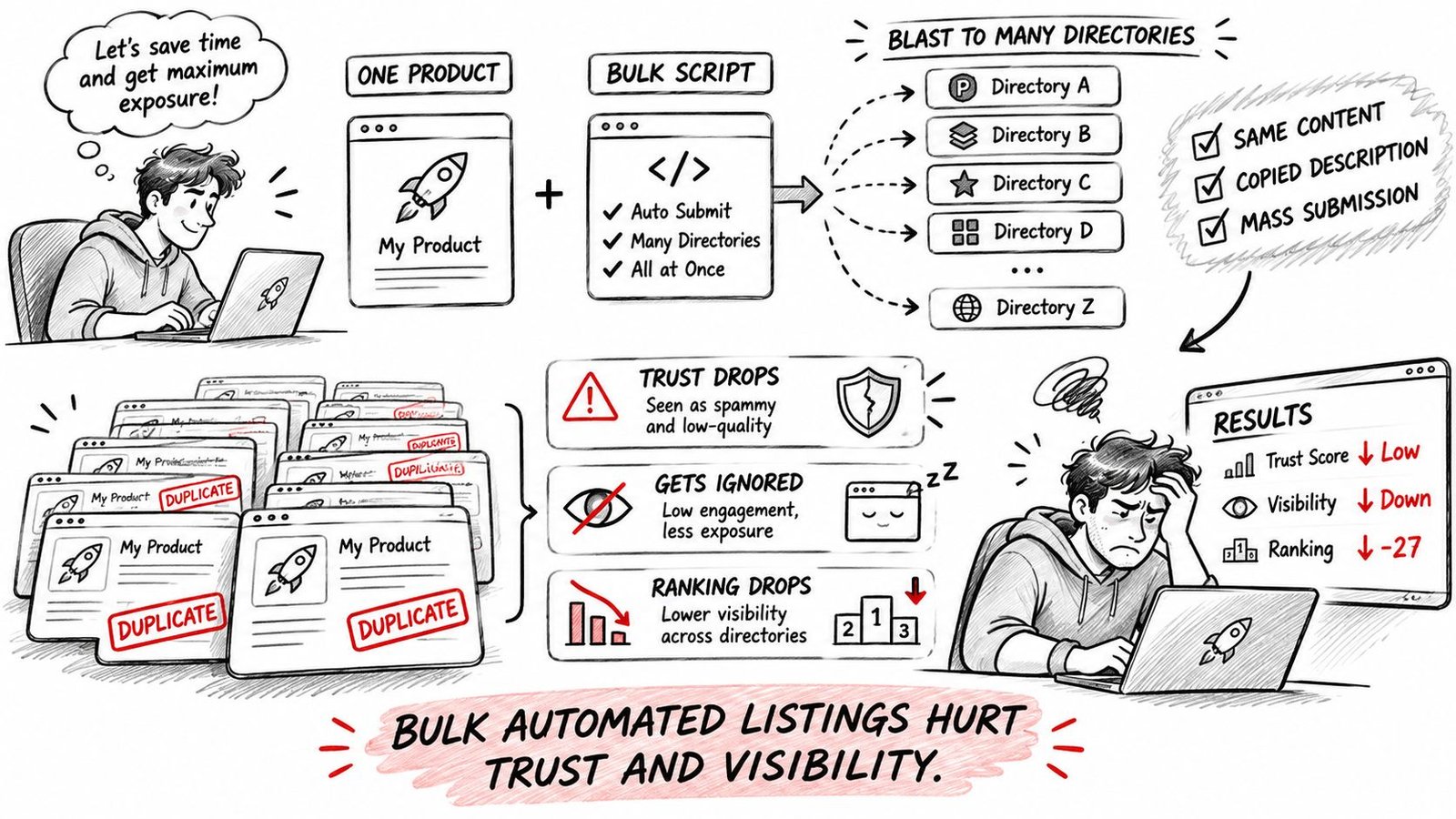
The familiar failure mode is a script pushing one product into hundreds of directories in an afternoon. The report looks productive, but the underlying pages may have unrelated categories, no readers, and no editorial purpose.
Identical wording alone isn't the central problem. The problem is creating links primarily to influence rankings rather than publishing useful references.
Recognize the manipulation pattern
Google's spam policies classify links from low-quality directories or bookmark sites as link spam when created to manipulate rankings, and also identify automated link-generating services as a prohibited tactic. Paid commercial links should use appropriate attributes such as rel="sponsored" or rel="nofollow" rather than being sold as ranking credit.
Check a prospective directory for these warning signs:
- No meaningful review: Anything gets published, including obvious junk and unsupported claims.
- Unrelated categorization: Accounting tools, gambling pages, and consumer products appear together without a useful taxonomy.
- No accountable editor: The site displays unrelated companies but offers no practical correction or moderation route.
Would this listing exist if SEO didn't?
That test separates a useful product catalog from a page whose only purpose is selling links. A directory can be small and valuable; an impressive-looking domain can still host a useless listing.
Reduce the list before submitting
Illustrative scenario, not a client result: A founder cuts a 400-site prospect list to 60 relevant, reviewed directories. They replace irrelevant placements with buyer-facing profiles and, in this hypothetical example, receive more real referrals from the smaller set.
The improvement comes from selection and execution, not from a magical directory count. Each remaining profile gives someone a reason to click.
Use natural brand-name anchor text and factual descriptions rather than repeating commercial keywords in every field. For a practical review checklist, the directory submission tips from StartupSubmit can help organize the work without turning volume into the objective.
Paying for a clearly disclosed sponsorship can be reasonable. Paying for guaranteed ranking power from a directory that publishes anything is a different proposition.
Boost Your Startup's Traffic & SEO with up to 200+ Directory Listings
Skip the grind. Our team manually submits your product to relevant, high-authority directories, with screenshot proof for every submission, so you get real users, feedback and lasting backlinks without lifting a finger.
Get Listed TodayMaking Listings Work for AI Search Visibility
There's no special Google AI submission process, schema type, or AI-specific tag. Google's AI Overviews guidance says supporting pages must be indexed and eligible for ordinary Search with a snippet; Google selects supporting links automatically.
Use these checks before treating a profile as part of your AI search optimization strategy.
| Check | Where to verify | Why it matters |
|---|---|---|
| Googlebot can crawl the product page | robots.txt and URL Inspection in Search Console | Search systems need access to the destination page; crawling alone doesn't guarantee indexing |
| No noindex tag or login wall on the profile | Page source and a private browser window | A hidden or excluded profile can't serve as ordinary indexed search content |
| OAI-SearchBot allowed in robots.txt | Your robots.txt file | Blocking it excludes the site from ChatGPT search answers, with a navigational-link exception |
| Organization markup validates | Rich Results Test or Schema Markup Validator | Accurate structured information helps describe the organization consistently |
| Name, URL, logo and category match everywhere | Canonical record compared with each listing | Conflicting details make the company harder to identify reliably |
Eligibility isn't a citation guarantee
The search crawler documentation states that sites blocking OAI-SearchBot aren't shown in ChatGPT search answers, although they may still appear as navigational links. Allowing access establishes eligibility, not a promise of visibility.
You control your website's access settings, but generally not a directory's. Evaluate third-party profiles accordingly, and don't confuse a publicly visible page with a technically indexable one.
For your own site, validate markup and inspect how Google accesses the page. Google's structured-data guidance emphasizes accurate, accessible content and checking for access restrictions; valid markup doesn't override a login wall or exclusion directive.
Give search systems useful context
Google describes query fan-out in its AI features documentation: a system may run related searches across subtopics and sources. In practical terms, a buyer's question can lead to several searches rather than a single exact-match query.
That makes accurate category descriptions useful. A profile explaining that your tool transcribes multilingual customer interviews offers more relevant context than a generic claim about transforming productivity.
Our recommendation is to build directory submissions as the foundational entity layer, then add guest posts and press placements for contextual authority. Those formats have different jobs: profiles establish product facts, while substantive articles can explain applications, expertise, and trade-offs.
To assess channel relevance before allocating budget, you can browse ChatGPT adoption data from FruitPunch. Adoption context can inform prioritization, but it doesn't establish that a particular directory produces citations.
If you plan to submit your AI tool to directories, start by running the checks on your own website and fixing the first failure. LLM SEO won't compensate for an inaccessible product page.
How to Measure Directory Results Honestly
Submission counts, accepted listings, and rising Domain Rating are activity or proxy metrics. None proves that buyers discovered your product, signed up, or became customers. Treat a directory profile as entity data and a referral channel, and measure it like one.
Google's crawlable-links guidance explains that links help it discover pages and understand relevance. That's a reason to care about accessible links, not a basis for assigning every ranking improvement to directory work.
Use a baseline and a decision window
I recommend a 60-to-90-day review window as an operating choice, not a promised SEO timeline. Compare equivalent date ranges and annotate launches, paid campaigns, content releases, and other work that could explain a change.
| Metric | How to check it | Review cadence |
|---|---|---|
| Indexed-profile rate | Share of live listings found indexed, using exact-URL searches as an initial check | Monthly |
| Branded-search impressions | Search Console filtered to the brand name, compared with the pre-launch baseline | Monthly |
| Referral sessions by directory | GA4 referral report, one line per directory domain | Monthly |
| Qualified signups from directory referrals | Signup source tagged with the directory name | Monthly |
| Comparison-page visibility | Rankings for alternatives pages where the directory profile appears | Quarterly |
| Incorrect-profile corrections | Count of wrong names, prices or links found and fixed | Quarterly |
| Nofollow or sponsored share | Share of links marked nofollow or sponsored, per listing | Once, at audit |
Read these together. Referral sessions indicate visits; qualified signups indicate whether those visitors resemble your customers. Branded-search growth is useful context, but you usually can't attribute it to an individual directory.
Interpret reported results cautiously
DR and organic traffic changes after a submission campaign vary widely and depend on many factors beyond the placements themselves: content shipped, press coverage, seasonal demand, and technical fixes all move the same numbers. Treat any before-and-after figure, whether from a vendor or your own dashboard, as directional rather than proof that submissions alone caused it.
StartupSubmit's report includes every submitted backlink URL and a screenshot proof for each directory. Use that as the campaign's audit file, while keeping your pre-submission analytics snapshot as the performance baseline. The submissions produce a mix of dofollow and nofollow backlinks, so don't treat a nofollow placement as a failure if it brings relevant visitors.
For answer-engine checks, AY Rank's guide to AI search monitoring tools can help you choose a repeatable testing method. Track the same prompts and record cited pages rather than interpreting an isolated answer as a durable result.
Stopping rule: After the review window, drop directories from further investment when they show no indexed profile, no referral activity, and no plausible discovery benefit.
Branded-search lift can support the campaign-level assessment, but it rarely identifies the responsible directory. Stop renewing or expanding ineffective placements; you don't need to delete an accurate, harmless profile because it hasn't produced measurable traffic.
Directory Submission Questions Answered
Value and scope
Is directory submission still worth it in 2026?
Yes, when it improves entity consistency, buyer research, and referrals. It's a poor investment when the entire proposition is increasing a third-party authority score without evidence that the profiles serve real users.
How many directories should a SaaS startup submit to?
I'd start with six to ten relevant, reviewed listings, then expand when indexed visibility or referral quality justifies the work. That's a manageable pilot, not a universal ranking threshold, and a narrow developer tool may warrant fewer placements than broad business software.
Do directory links need to be dofollow?
No single link attribute determines whether a profile is commercially useful. Evaluate nofollow and sponsored links in context, particularly whether the directory attracts qualified buyers and represents your product accurately.
Timing and AI discovery
How long until a listing shows up in Google?
There's no reliable universal timeline, and being published doesn't mean a profile has been indexed. Schedule a check around three weeks after submission to catch stalled approvals, inaccessible pages, and obvious technical problems rather than assuming indexing should already have happened.
Does a listing get my product into ChatGPT or Google AI Overviews?
A listing may support discovery, but it doesn't guarantee a citation in either system. Google eligibility and ChatGPT crawler access are separate considerations, so avoid any provider that bundles them into a guaranteed AI placement claim.
If your team needs help distinguishing assistant features from search behavior, browse the AI assistant FAQ from 1chat. Keep product-usage questions separate from your visibility audit: what an assistant can do and why it cites a particular business aren't the same question.
Your Next Steps This Month
Keep the first batch small enough to inspect properly. You are testing a marketing process, not proving that you can fill a large spreadsheet.
- Record the baseline this week. Save branded-search impressions, referral sessions, and indexed-page counts with their date ranges and filters.
- Choose six to ten directories across at least three platform types. Favor places where buyers evaluate products over places that accept submissions.
- Submit the first five manually. Plan an early check for stalled approvals and a full review at 60 to 90 days.
- Decide whether to outsource. Weigh the research, moderation follow-up, corrections, and reporting time, not just the form-filling.
If the pilot produces no indexed profiles and no qualified referral visits by the 90-day review, stop expanding coverage and fix the listings themselves before buying more placements.
Know what outsourcing guarantees
If hand-submitting across hundreds of directories exceeds your team's capacity, StartupSubmit offers manual submission for SaaS and AI startups, handled by SEO specialists rather than bots. The Authority plan costs $299, covers 200+ directories, and includes a DR 30+ guarantee. That commitment covers the number of submissions in the plan, not acceptance by every directory.
After purchase, an intake form collects your product details and work begins shortly after onboarding. The team submits each listing by hand to curated, editorially reviewed directories over a typical window of about 5 to 14 days. If your product already appears on a directory, that one gets skipped and swapped for a relevant alternative where available. The itemized report lists every submitted backlink URL with a screenshot of each submission.
That delivery window describes the submission workflow, not when Google indexes the profiles or when customers arrive. Keep editorial acceptance, technical visibility, and business results as separate outcomes.
StartupSubmit handles the research, manual submissions, and itemized reporting so your team can maintain accurate product profiles without managing every form. Visit StartupSubmit to review the options, then pick coverage based on category fit and your ability to measure the results.
Ready to build high-quality backlinks?
We'll manually submit your product to 60 to 200+ directories in 5 to 7 days, with screenshot proof for every submission. No bots, no boring forms, just more time for selling and building.
See pricing & get started →