
10 Free Business Listings for SaaS and AI Startups in 2026
Most guides to free business listings tell you to submit everywhere. That advice costs you weeks. Every directory has its own signup flow, verification email, category tree, and description limit, and the hours add up fast while most of those profiles never send a single visitor.
The return rarely matches the effort. BrightLocal's 2025 SMB Marketing Report found that 89% of small and medium-sized businesses invest in local SEO, yet only 17% report using business directories. That gap isn't laziness. It's what happens when a channel gets treated as a volume game instead of a placement decision.
Directories do rank, which is the reason to bother at all. According to BrightLocal's Business Listings Visibility Study, business directories accounted for 31% of the top-ten organic results across local-intent searches in 2024. A buyer searching your category can meet your product on a directory page without ever typing your domain.
So the question isn't how many sites will accept you. It's what each one gives back for the afternoon you spend on it. I run three checks before I open a signup form:
- Editorial review: a human approves or rejects submissions. If anyone can publish anything instantly, you're filling a database, not earning a placement.
- Real traffic: the site earns search traffic, referrals, or an active community you can see for yourself.
- Category relevance: your product has a genuine home in the taxonomy, not a catch-all "software" bucket.
Ten platforms pass those checks for a software brand. In my judgment, the rest of the long directory lists circulating online aren't worth the signup: weak review, thin traffic, or no category where your product belongs. A few more sites are defensible for specific niches, but the ten below are where the hours pay back.
While you're cleaning up your presence, make sure the click has somewhere to land. A profile that sends a warm visitor to a page with no form, no chat, and no clear next step is worse than no profile. Fix that first so you never miss a customer inquiry once the traffic starts.
Table of Contents
- 1. StartupSubmit
- 2. Product Hunt
- 3. G2
- 4. Capterra
- 5. SaaSHub
- 6. AlternativeTo
- 7. Peerlist Launchpad
- 8. DevHunt
- 9. Uneed
- 10. Apple Business Connect
- How the ten listings compare on cost, best fit, claim route, and main limitation
- Claim the Three Profiles That Matter Before You Submit Anywhere Else
1. StartupSubmit
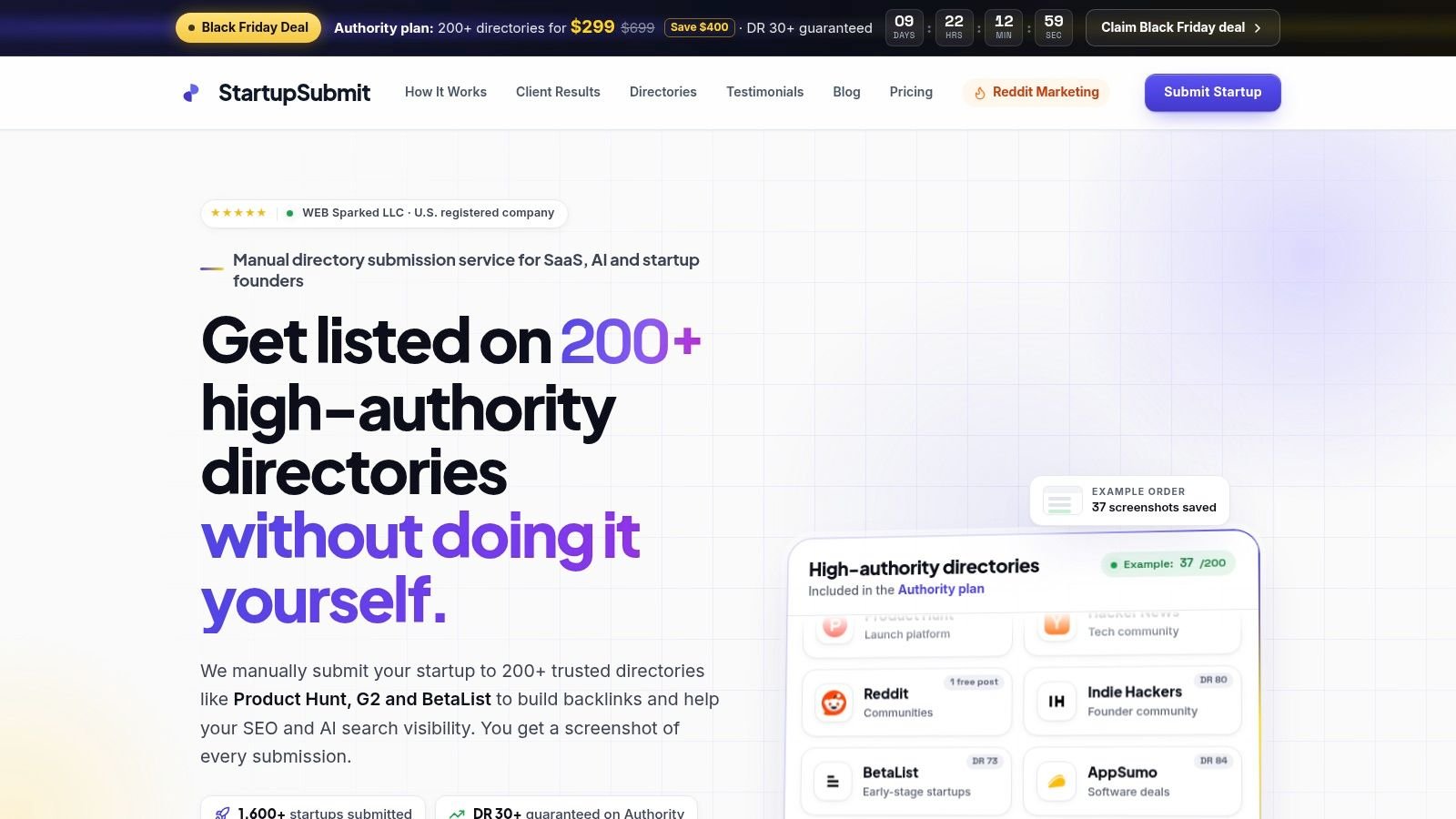
If the honest answer to “when will I do 200 submission forms” is “never,” this is the spend I'd consider instead. StartupSubmit is the paid exception in a free-listing lineup: a manual directory submission service for SaaS, AI and early-stage startups. A team of about 20 SEO professionals submits each listing by hand across 200+ startup and software directories, including Product Hunt, G2, Capterra, BetaList, Indie Hackers, AlternativeTo and SaaSHub.
Pricing is one-time through Stripe, with Growth and Authority tiers chosen by coverage goals and budget. The stated execution window is roughly 5 to 14 days, with work targeted to begin within 24 hours after onboarding. The final report is the part to audit: submitted backlink URLs, acceptance notes and screenshots for each placement.
Where the hours actually go
Submission is not one form repeated 200 times. Every platform has its own fields, category tree, description limit and moderation queue, and a mismatched category can park a listing indefinitely. The useful part of the service is routing: an AI product goes to AI-specific directories, a local business gets citation and map-style listings, and an ecommerce store gets product and marketplace directories.
Consistency is the second job. StartupSubmit keeps the business name, address and phone number in exactly the same form on every listing, website and business profile, and keeps the URL, categories, description, hours, service areas, logo and social profiles aligned wherever a platform asks for them. That is the detail most DIY batches break by week two.
“If you want to rank higher in Google & LLMs, they manually submit your startup to 250+ directories. Pretty cool!” Florin, X
Pros
- Manual work, no bots: submissions are built to pass platform moderation and avoid automated footprints.
- Category fit: duplicate checks come first, existing listings get skipped, and another relevant directory is used where available.
- Verifiable output: URLs, screenshots and acceptance notes make the work auditable rather than a summary email.
- Trust surface: profiles on places like Product Hunt, G2, Crunchbase and Trustpilot can fill out page-one results for a young brand.
Cons
- Submitted is not approved: directories set their own review timelines, and eligibility varies by platform.
- No ranking promise: treat any Domain Rating movement as something to measure in a third-party tool such as Ahrefs, not as a guaranteed outcome.
- Wrong moment, wasted money: skip it if your name, address, phone or positioning is about to change, or if you need immediate Google Maps rankings.
You are buying back the hours, not buying a position. Reddit support exists as an optional extra, but it should not be the reason to choose a tier.
Website: startupsubmit.app
2. Product Hunt
Product Hunt is the launch platform most founders already know, and submitting is free. You get a public product page with maker details, a comment thread, category tags, and a 24-hour event that concentrates the attention of tech founders and early adopters into a single day.
The catch is the shape of that attention. It's a spike, not a slope. A good launch day doesn't compound, and the page tends to go quiet once voting closes. Founders who treat it as a one-off event and nothing else usually get a great Tuesday and a flat November.
- Prepare the assets first: gallery images, a tight tagline, and a first comment that states the problem you solve.
- Launch Tuesday to Thursday: the community is awake and moderators are working.
- Live in the thread all day: replies in the final hours move visibility more than extra votes do.
What you keep afterwards is a permanent, indexed URL that states what the product is, who built it, and where to go next. That page keeps earning its keep long after the votes stop, which is why it sits at the top of the top directories for startup launches.
If you want channels that keep working between launches, the same audience clusters in these online communities for entrepreneurs, and a thread there can send referrals for months.
3. G2
Review platforms are where B2B buyers argue with themselves before they book a demo. BrightLocal's 2025 survey of 1,026 U.S. adults found that only 4% of consumers said they never read online business reviews, while 40% said they typically consult at least two review websites before choosing a business, per the Local Consumer Review Survey.
G2 slots straight into that behaviour for software. Claim the free profile, fill in product details and media, choose your categories carefully, then collect reviews from customers who already renew. Category placement decides which comparison pages you show up on, and those pages are where buyers shortlist.
Features
- Free company and product profile: enough to be present, findable, and linkable.
- Customer review collection: the asset that persuades a buyer.
- Category and comparison presence: you appear beside the tools buyers already know.
The trade-off
Reviews take months. There's no shortcut worth taking, since a cluster of five-star reviews posted in one week reads as fake to anyone who buys software for a living. Basic profiles also give you far less analytics and merchandising control than paid tiers, so treat the free profile as a credibility floor, not a lead engine.
Practical rule: if you can't name ten customers who'd leave an honest review this quarter, G2 is a two-hour setup and nothing more. Do the setup anyway. It's cheap.
If you're deciding where each platform fits in your first month, StartupSubmit's directory submission guide lays out the sequence.
4. Capterra
Capterra works like a research library: buyers arrive in a category, compare three or four products, then leave. A vendor account lets you publish a listing, manage reviews, and sit inside those comparisons. The free listing is a real one, and it reaches people who are already shopping.
The thing to understand before you start is that Capterra's organic results share a page with sponsored placements. That's not a scandal; it's the business model. It does mean your listing competes for attention with competitors who paid for the slot above yours, so a thin description loses out.
- Write for the comparison view: short feature lists beat paragraph descriptions because buyers scan across columns.
- Pick the categories your buyers browse: two accurate categories beat five aspirational ones.
- Answer review prompts fully: reviewers who fill every field produce the structured detail that feeds comparison pages.
There's a second reason to keep these category pages tidy. Google's documentation on AI features says a page is eligible to appear as a supporting link only when it's indexed and eligible for a normal snippet, and that these systems issue related queries across subtopics before generating a response, as described in Google's AI features guidance. Software category pages are exactly the kind of page that gets pulled in.
Confirm current listing terms during vendor signup, since the vendor page doesn't state a universal fee.
5. SaaSHub
SaaSHub is a directory built specifically for SaaS products and online services, and that focus shows in what it asks for. Submissions include product details, categories, and the competitors you replace, which is unusual and worth the extra ten minutes.
Why bother with competitor fields. Because "alternative to" and "X vs Y" queries are how switching buyers search, and a directory that maps you to established tools puts your page in front of people who've already decided their current tool is wrong.
Accuracy is the whole game here. In a 2025 survey of 1,000 U.S. consumers, 56% said they often or always verify that business information matches across online mentions, and 85% considered contact information important, per BrightLocal's consumer search behavior research. A directory profile with stale pricing or a dead trial link is a trust leak, not a citation.
- Approval isn't automatic: submissions go through review, so write the description as a human would.
- Released products only: waitlist pages and unreleased concepts aren't accepted, so wait until you can show the product.
- Missing competitors slow you down: fill them in or expect a back-and-forth.
The submission page doesn't state a fee, so check current terms before you plan around it. If you want the whole category covered properly, launch visibility for early-stage founders explains how the SaaS-specific set fits together.
Boost Your Startup's Traffic & SEO with up to 200+ Directory Listings
Skip the grind. Our team manually submits your product to relevant, high-authority directories, with screenshot proof for every submission, so you get real users, feedback and lasting backlinks without lifting a finger.
Get Listed Today6. AlternativeTo
AlternativeTo is community-maintained and organised around one idea: what can I use instead of the thing I'm quitting. That makes it a poor fit for a novel product and an excellent fit for a startup with a credible, recognisable competitor.
The listing itself is straightforward. App pages carry descriptions, tags, platforms, and licence information, users can submit alternatives, and approved developers can request editing access to maintain their own page.
Where founders go wrong is treating every listing as an SEO vote. Google's spam policy explicitly classifies low-quality directory or bookmark-site links as link spam, alongside buying links for ranking purposes and using automated services to create them, per Google's spam policies. Directory submission earns its place through referral traffic and brand validation, not through link count.
Editorial review is the signal. A moderated queue means somebody is curating. An instant-approval directory that accepts anything with a URL is telling you what your listing is worth.
- Expect a backlog: new apps can sit in review for a while, so submit and move on.
- Placement isn't guaranteed: being listed and being suggested as an alternative are different outcomes.
- Write a real description: the comparison context is what makes the page useful to a visitor.
A paid priority review option may appear. Pay it only if this specific audience is where your buyers already are.
7. Peerlist Launchpad
Peerlist runs a weekly launchpad inside a professional community weighted toward developers and designers. You get a defined launch window, a builder audience that reads product posts, and feedback from people who've shipped something themselves.
For developer tools and technical SaaS, that audience is a better match than a general launch site. The weekly format also helps: you know when your slot lands, so you can prepare rather than watch a queue.
How I'd use it. Treat it as a feedback channel with distribution attached. Ask one specific question in your post, like which part of onboarding confused them, and you'll get answers worth more than the upvotes.
- Capacity is limited: weekly slots are finite, so book early and don't plan a launch around a slot you haven't got.
- Visibility clusters around launch week: like every launch platform, the traffic tapers.
- Check eligibility first: account requirements change, and the reviewed page doesn't display a price.
Small platforms get skipped because the audience looks small. For a developer tool, ten actual developers reading your page beats a thousand drive-by visitors who'll never open a terminal.
8. DevHunt
DevHunt scores highest on the one check most launch platforms fail: category relevance. Everyone on it builds or buys developer tools, so an API, a CLI, or infrastructure software lands in front of people who can use it.
The product page stays live after launch week, which gives the submission a longer payoff than a single spike of attention. There is optional paid promotion, including a newsletter slot, but the free listing is the part worth evaluating first.
One caveat on the link. Ahrefs analyzed 44,589 non-branded keywords and found that the combined organic traffic of referring pages correlated more strongly with rankings than the raw count of referring pages, per Ahrefs' links-with-traffic study. So treat a DevHunt listing as distribution and a pull-quote for your own site. A directory link of this kind is unlikely to move a Domain Rating score on its own; a relevant profile that sends three trial signups beats twenty listings nobody visits.
What you get
- Permanent product page: stays live after launch week ends.
- Developer-only audience: the filtering happens upstream, for free.
- Launch-week voting: a defined window of attention you can prepare for.
- Optional newsletter placement: paid, and only worth the spend if the product fits the audience.
The time math works here. The submission is short, and the return is a durable page in front of the right reader rather than a bigger audience that scrolls past.
Broader products fit this platform poorly. A productivity app aimed at operations teams belongs wherever that community already gathers. If your product sits in the language-model category, pair the submission with work to get listed in AI directories so the dev-tool and AI-specific profiles ship together.
9. Uneed
Uneed mixes a product page, daily launches, and community upvotes. It's one of the few platforms that explains the difference between submitting and scheduling, which tells you the founders have thought about how launches go.
The free route needs careful consideration before you plan on it. The free waiting line has reportedly been closed to new products or involves long waits, so treat the paid, scheduled launch as the practical path if timing matters. Publication and backlink terms are also linked to launch performance, so a quiet day yields less than the submission page implies.
- Check the queue before you commit: submission routes change, and the free line may not be open.
- Price the paid route with care: a scheduled launch is a slot you control; a free wait is not.
- Read the backlink terms before launch day: you want to know what a mid-table finish gets you.
Does any of this help with AI search? Only indirectly. Google's help page on AI Overviews says the system selects supporting information through existing Search systems, including quality and ranking systems and the Knowledge Graph, per Google's AI Overviews documentation. Your product page is one more consistent fact about the company. It's not a lever you can pull.
10. Apple Business Connect
Apple Business Connect is the odd one here, and I'm including it on purpose. It's a free tool for managing how your brand appears across Apple services, with business details, brand imagery, and a claim flow for an existing presence.
It is not a software directory. It won't generate product reviews, and it won't appear in comparison pages. What it does is keep your identity accurate on a surface most founders forget, which matters for any startup with a physical address, a storefront, or customer-facing hours.
Audience trust is worth being careful about. A 2025 consumer study found that 93.2% of respondents trusted Google more than AI assistants for local business discovery, and that 39.1% said more accurate, up-to-date information would be necessary before switching, per Rio SEO's 2025 local search consumer behavior study. Accuracy is the lever. Volume isn't.
- Free registration: stated in Apple's official materials, with phone verification.
- Official Apple-owned surface: brand details you control, not scraped guesses.
- Not a discovery channel for software: eligibility and value depend on your business circumstances.
Skip it if you're a pure remote SaaS with no location. If you have a studio, a shop, or a physical HQ, local citation plans from StartupSubmit cover the map-style listings that share the same underlying facts.
How the ten listings compare on cost, best fit, claim route, and main limitation
Cost here means hours as well as money. A free listing with a long review backlog can eat more founder time than a paid route, so weigh each claim route against the audience named in the best-fit column.
| Item | Cost to list | Best for | Claim or submission route | Main limitation |
|---|---|---|---|---|
| StartupSubmit (recommended) | One-time plan pricing; tiers vary by coverage | Startups seeking done-for-you submissions to 200+ startup and software directories | Provide business details; the team submits by hand and reports listing URLs | Each directory decides approval; rankings are not guaranteed |
| Product Hunt | Free | Coordinated launches for technology products | Submit a product page and engage with the community on launch day | Visibility is time-bound; homepage featuring is not guaranteed |
| G2 | Free profile; paid plans available | B2B software discovery and customer reviews | Claim and manage a vendor profile | Reviews take effort; listings do not guarantee leads |
| Capterra | Free vendor listing; sponsored placement available | Software buyers comparing products by category | Submit and manage a listing through the vendor portal | Organic visibility may compete with sponsored placement |
| SaaSHub | Free submission | Released SaaS products seeking comparison discovery | Submit product details, categories, and competitors for review | Approval is not automatic; unreleased products are not accepted |
| AlternativeTo | Free submission; paid priority review may appear | Products with credible alternatives to established tools | Submit an app for review; request editing access after approval | Review backlog and inclusion are not guaranteed |
| Peerlist Launchpad | Free submission; weekly slots are limited | Developer tools and technical SaaS seeking community feedback | Submit a project to a weekly launch cycle | Limited capacity and launch-period visibility |
| DevHunt | Free basic listing; paid launch promotion | Developer tools, APIs, and technical products | Submit a product listing; optionally purchase launch promotion | Free listing link is nofollow |
| Uneed | Free queue; faster launch options available | Products seeking daily launches and community upvotes | Submit a product or choose a faster or scheduled launch route | Free queue may be closed or involve a long wait |
| Apple Business Connect | Free | Eligible businesses managing their presence across Apple services | Claim or manage an existing business presence | Not a software-review or startup-discovery directory |
Claim the Three Profiles That Matter Before You Submit Anywhere Else
Start with three. Product Hunt for the launch page. G2 or Capterra if your buyers compare software before they buy. SaaSHub or AlternativeTo if your positioning is "we replace a tool they already know." That trio covers discovery, credibility and comparison, and claiming all three costs about an afternoon each.
Then keep the facts identical everywhere: company name, URL, category, one-line description, pricing status. Google's own reporting on Business Profiles shows why the details matter more than the count. It separates profile views from concrete customer actions like website visits, calls, direction requests and bookings, and it shows which search terms surfaced the listing, per Google's Business Profile performance documentation. Copy that model for every directory: measure actions per platform rather than profiles created.
The reach argument for wider coverage is real. SOCi's consumer behavior data as compiled by Shno reports that 80% of U.S. consumers search online for local businesses weekly and 32% do so daily, and that businesses in Google's local three-pack get 126% more traffic and 93% more actions than those ranked fourth through tenth. Prominence and completeness move behavior. Neither comes from submitting to two hundred sites in one weekend.
Expect friction. Some directories confirm listings with the business owner by phone, email or post, so watch for the verification step and answer it fast. Some will reject you outright. Treat a rejection as information: wrong category, wrong stage, or wrong platform.
Know what to skip. Any directory that approves every submission instantly and publishes your description unedited, because no one is reviewing what goes live. Any network selling 500 submissions for the price of lunch. Any profile you will never revisit when your pricing changes. A stale listing is worse than a missing one: it is a live page telling buyers something untrue.
Maintain the ones you keep. Put a calendar reminder 60 days out and re-check the name, the URL, the category and the price. Add reviews where the platform supports them and answer every one. Five accurate profiles you maintain outperform two hundred you abandon, and they keep working while you ship.
That is the whole strategy. Fewer profiles, better chosen, kept accurate, measured in actions rather than submissions.
If the hours are the blocker, StartupSubmit handles the manual side: every listing is submitted by hand to curated startup and software directories, from Product Hunt and G2 through BetaList, Indie Hackers, AlternativeTo and SaaSHub, with the same name, category and pricing details on each profile. Plans are one-time payments starting at $99, and the final report lists submission URLs and screenshots so you can verify each placement yourself. Visit StartupSubmit when you are ready to stop filling in directory forms and get back to building.
Ready to build high-quality backlinks?
We'll manually submit your product to 60 to 200+ directories in 5 to 7 days, with screenshot proof for every submission. No bots, no boring forms, just more time for selling and building.
See pricing & get started →