
SaaS SEO Strategy for Founders in 2026
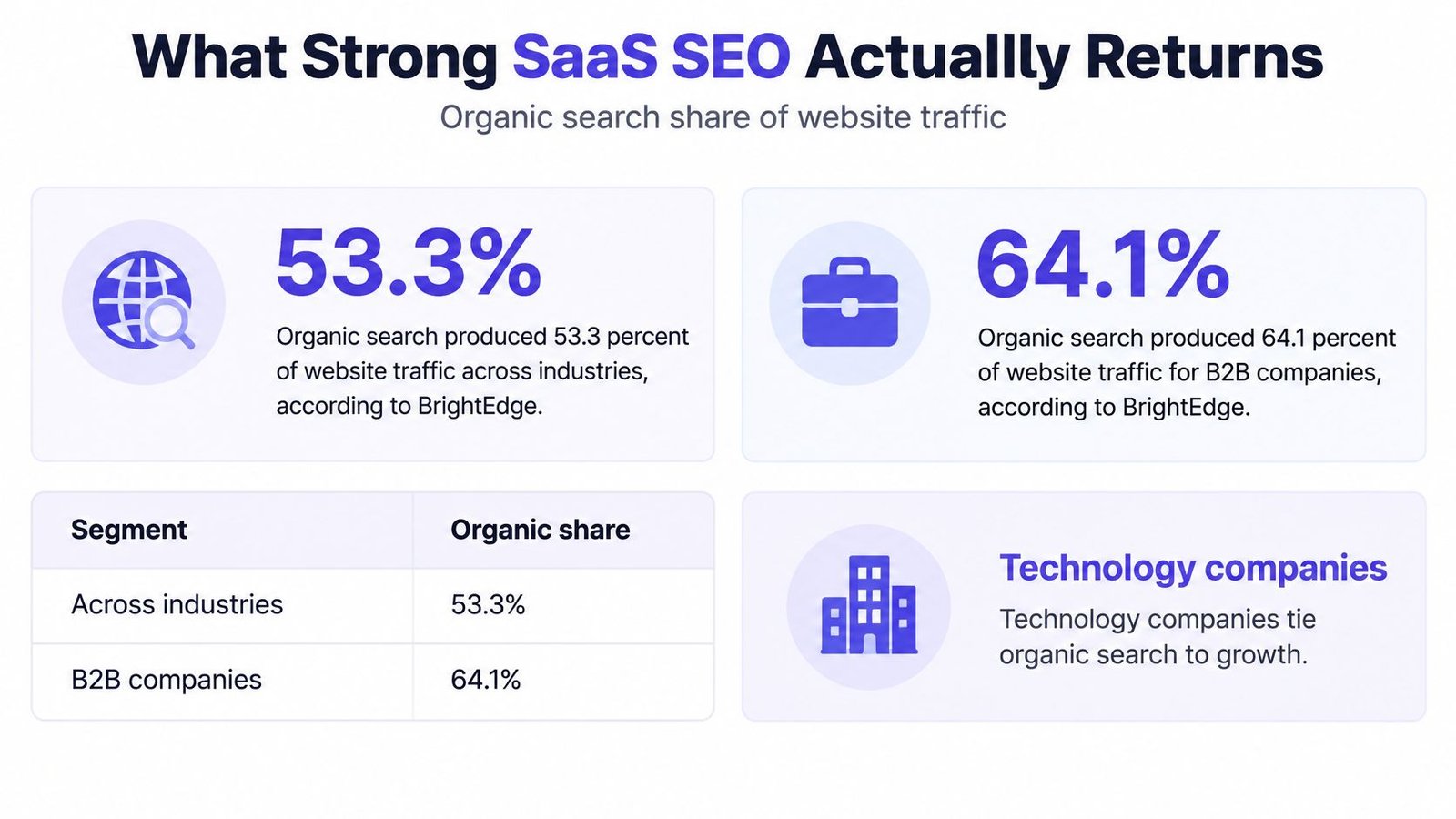
Organic search generated 64.1% of website traffic for B2B companies, compared with 53.3% across industries, according to a BrightEdge analysis summarized by Digital Snowstorm. That makes search a serious acquisition channel, but it doesn't mean publishing a blog will produce customers.
For a small team, SaaS SEO is a prioritization problem. You need pages that help buyers choose, a site crawlers can access, and credible references that confirm what your company does. Reputable directory profiles provide that entity layer, not a substitute for a useful product website.
Table of Contents
- What Strong SaaS SEO Actually Returns
- The Four Layers Under a SaaS Search Program
- Pages and Queries Worth Building First
- Technical Access for JavaScript Product Sites
- Directory Profiles That Help and Listings That Hurt
- Metrics That Predict Growth Including AI Answers
- Your 90-Day SaaS SEO Sequence and Next Steps
What Strong SaaS SEO Actually Returns
Strong SaaS SEO returns qualified discovery: the right buyer finds your product, understands its fit, and takes a useful next step. Traffic is an input, not the outcome.
The BrightEdge benchmark also associates organic search with 58.8% of revenue-generating traffic for technology companies. That isn't a forecast for your startup, but it explains why comparison pages, documentation, and category visibility deserve attention alongside paid acquisition.
SaaS search benchmarks that change the plan
The same Digital Snowstorm compilation includes the following traffic and click-through benchmarks. Treat the click figures as search-result averages, not expected conversion rates for your product.
| Signal | Figure | What it tells a founder |
|---|---|---|
| Organic share of traffic, all industries | 53.3% | Search is a primary acquisition channel, not a side project |
| Organic share of traffic, B2B | 64.1% | Buyers research before they talk to a vendor |
| Technology revenue-generating traffic from organic | 58.8% | Evaluation content deserves commercial attention |
| Position 1 CTR, U.S. desktop, July 2026 | 20.02% | The first result remains a valuable asset |
| Position 2 CTR, U.S. desktop, July 2026 | 10.36% | Second place gets about half the first result's CTR |
| Position 3 CTR, U.S. desktop, July 2026 | 3.89% | A page-one ranking alone isn't a pipeline forecast |
| Position 1 CTR, 2015 | 29.3% | Historical top-result CTR was higher |
| Position 1 CTR, 2025 | 25.8% | Top-result CTR had declined before the latest reading |
Don't interpret the historical decline as proof that a particular search feature caused it. The practical lesson is narrower: ranking position and the search-result layout both affect the opportunity.
Read the scoreboard together
Track referring domains, Domain Rating, organic keywords, and organic traffic together. Referring domains describe the breadth of external references; Domain Rating is a third-party backlink metric, not a Google score.
Keyword coverage shows where you're becoming discoverable. Traffic shows whether that coverage earns visits. None proves business value without signup, demo, and customer-quality checks.
Practical rule: A metric earns dashboard space only if a change in it could change your next decision.
If you're evaluating outside help, use BeatAPI search optimization services as a resource to review alongside your own requirements. Ask for concrete page, technical, and measurement deliverables rather than accepting a promise to increase visibility.
The Four Layers Under a SaaS Search Program
A useful SaaS website can resemble a well-stocked shop on an unsigned street. The product might be excellent, but buyers still need a way to find it and confirm they're in the right place.
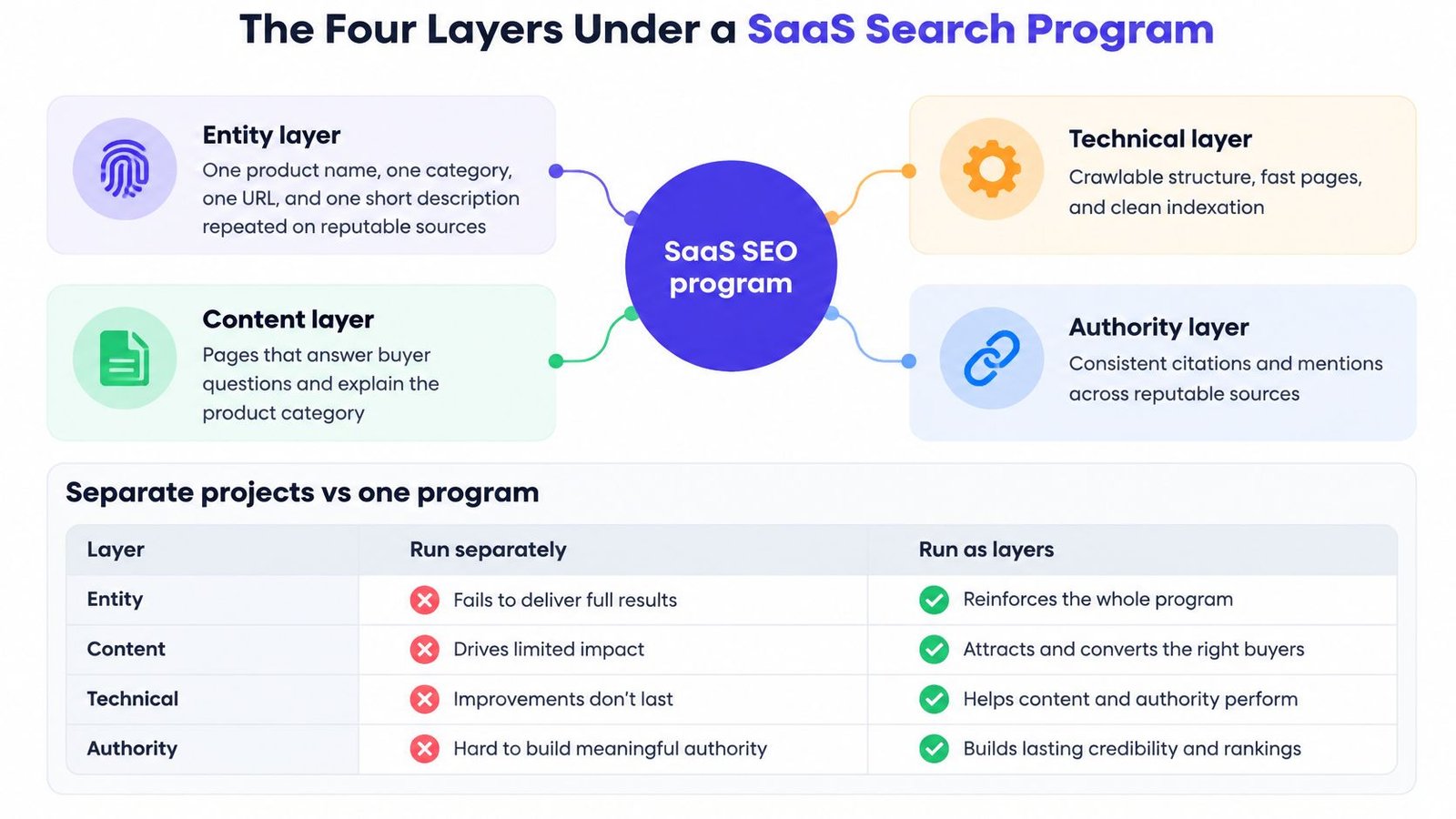
Treat search as connected layers rather than separate content, engineering, and link-building projects.
Entity and page layers establish the offer
The entity layer starts with consistent facts: one product name, a canonical website, a clear category, and an approved short description. Use those facts across company pages, software profiles, partner listings, and launch materials.
Consistency doesn't require copying identical promotional text everywhere. Adapt descriptions to each platform while preserving the product's audience, capabilities, and identity.
The page layer gives buyers somewhere useful to land. Category, alternatives, comparison, integration, and use-case pages should explain specific decisions. A directory profile can't demonstrate your onboarding workflow or explain a migration limitation as well as a dedicated product page can.
Access and demand make the offer discoverable
The access layer covers crawlable links, stable canonical URLs, indexable content, and usable templates. Engineering owns much of the implementation, but marketing must identify which public URLs matter commercially.
The demand layer includes the recognition earned through product usage, community participation, partnerships, and launches. A new domain can't manufacture demand for an unfamiliar product by publishing definitions alone.
Authority supports these layers. An Ahrefs search-traffic study found that 96.55% of pages in its index received no organic Google traffic, while 1.94% received only 1–10 monthly visits; among roughly 20 million pages with no referring domains, only 2,997 attracted more than 1,000 monthly organic visits.
Those observations aren't proof that adding a backlink causes traffic. They are a warning against assuming publication is enough.
- Build relevant references. Pursue legitimate software profiles, integration partners, and useful industry resources.
- Connect ownership. Give marketing and engineering a shared list of priority URLs and blockers.
- Keep expectations conditional. Directory profiles don't guarantee rankings or referral clicks, and a directory's high Domain Rating doesn't establish the value of every profile.
Understanding how manual listings build backlinks helps founders distinguish a public business reference from a promise of ranking power. The nearer job is corroboration: helping someone verify the company behind the product.
Pages and Queries Worth Building First
Only 5% of ranking keywords reached the top three positions in a January 2026 sample of leading B2B SaaS websites, despite an average of 9,700 U.K. ranking keywords, according to the B2B SaaS SEO benchmark. Branded queries supplied an average of 70% of organic traffic in that sample.
The benchmark also recorded 20.1% organic-traffic growth among sites publishing at least nine posts monthly, versus 5.6% among those publishing one to four. That's observational, not evidence that a publishing quota causes growth.
For a founder with limited writing time, coverage should follow buyer decisions rather than a calendar.
Find the query before commissioning the page
Export relevant competitor keywords from Ahrefs or Semrush. Then inspect your Search Console query report for existing impressions and terms where your pages already appear within striking distance of useful visibility.
Read the actual results before choosing a format. If buyers see product comparisons, a general explainer probably won't satisfy the same need.
Record the query, intended page, available proof, and next action in a spreadsheet. Drop terms that have no credible connection to a product decision.
SaaS page types and the query each one should win
| Page type | Query it should win | Proof on the page | Next action |
|---|---|---|---|
| Category | best [category] software | Who it's for and which jobs it covers | Trial or demo |
| Alternatives | alternatives to [known product] | Honest differences, not a disguised homepage | Trial or demo |
| Comparison | [product] vs [product] | Decision criteria a buyer can check | Trial or demo |
| Integration | [your product] [tool] integration | What syncs, what doesn't, and setup | Connect or docs |
| Use case | [product] for [role or workflow] | A specific outcome and the steps to get it | Signup |
| Documentation | how to [task in the product] | The same labels the product uses | In-app action |
For a generic workflow tool, the category page might target approval software for small operations teams rather than workflow software broadly. That narrower framing gives the writer something concrete to prove: request intake, approval routing, permissions, and audit history.
Publish in a commercially useful order
- Start with a category page. Explain the buyer, the job, and what the product replaces.
- Add alternatives and comparisons. Choose products prospects evaluate, and acknowledge where another tool fits better.
- Document real integrations. Don't create pages for connections that exist only on a roadmap.
- Build focused use cases. Show a complete workflow and a relevant signup path.
- Publish task-based documentation. Reuse interface labels so readers can follow instructions without translating marketing language.
Link these URLs from the homepage and from relevant supporting pages. For a practical architecture reference, use TheContentMap on cluster-based content structure to organize related pages without turning every keyword variation into another URL.
You can develop directory listings for early-stage startups alongside this work, using the same category language. Don't let submission work become an excuse to postpone the pages that explain the purchase.
A page that can't name its query, its proof, and its next action isn't ready to publish.
Boost Your Startup's Traffic & SEO with up to 200+ Directory Listings
Skip the grind. Our team manually submits your product to relevant, high-authority directories, with screenshot proof for every submission, so you get real users, feedback and lasting backlinks without lifting a finger.
Get Listed TodayTechnical Access for JavaScript Product Sites
A pricing page that passes a lab test can still feel slow to real buyers. Manage performance using field experience, especially on pricing, comparison, integration, and signup templates.
Google's Core Web Vitals documentation defines good performance at the 75th percentile using Largest Contentful Paint at or below 2.5 seconds, Interaction to Next Paint at or below 200 milliseconds, and Cumulative Layout Shift at or below 0.1, evaluated separately for mobile and desktop.
Fix shared templates before polishing isolated URLs
Start with the components your commercial pages share. A heavy navigation bundle, autoplay product animation, or early-loading chat widget can affect every page built from the same template.
- Improve LCP. Reduce render-blocking JavaScript and prioritize the main above-the-fold asset. Don't lazy-load the image users need to see first.
- Improve INP. Split expensive client-side work and defer nonessential widgets so interaction handlers can respond.
- Improve CLS. Reserve space for images, embeds, banners, and interface previews before they load.
Use Search Console's field reporting by device rather than declaring victory after a single PageSpeed Insights run. Where Angular is involved, MakeAutomation's guide to optimize Core Web Vitals in Angular offers a framework-specific reference for implementation planning.
Keep the public marketing site as simple as the job permits. An interactive product demo might justify its weight on a demo page; it doesn't automatically belong on every comparison page.
Verify what Google can discover and render
Google's JavaScript SEO guidance explains that Googlebot parses links from the HTML response and queues discovered URLs. JavaScript-injected links can work, but they still need ordinary crawlable link practices.
Use descriptive <a href> links for public feature, industry, integration, comparison, documentation, and customer-story pages. Don't rely exclusively on click handlers, hash navigation, or authenticated application routes.
Run a template-level audit with Search Console URL Inspection and a crawler such as Screaming Frog:
- Compare HTML and rendering. Confirm that headings, product explanations, and navigation survive rendering.
- Check canonical consistency. The canonical, internal links, and sitemap should identify the intended public URL.
- Inspect access rules. Review robots directives, response status, and accidental indexing exclusions.
- Test structured data. JavaScript-generated JSON-LD is possible, but verify that Google can process it and that it matches visible content.
Don't add unsupported ratings or claims to structured data. Markup describes the page; it doesn't repair missing evidence or inaccessible content.
Directory Profiles That Help and Listings That Hurt
For a brand-new SaaS site, accurate profiles on G2, Capterra, Product Hunt, SaaSHub, and AlternativeTo are sensible early candidates. They're recognizable places where people discover or evaluate software, but product eligibility and category fit still matter.
The distinction is intent and utility. Google's spam policies define link spam as creating links primarily to manipulate rankings, so a useful business profile and a manufactured link placement aren't equivalent.
How to score a software directory before you submit
| Check | Asset | Neutral | Liability |
|---|---|---|---|
| Audience | Buyers compare this kind of software | General startup readers with some overlap | No real users, built for links |
| Moderation | Editors or review guidelines | Basic account checks | Instant acceptance of any URL |
| Duplicates | One profile per product, edits allowed | Occasional repeats | Mass pages with the same blurb |
| Completeness | Category, features, and URL match | Short but accurate listing | Wrong category or conflicting claims |
| Reviews | Identifiable users | No reviews yet | Fake or undisclosed incentivized review rings |
| Indexation | Profile is indexed and can rank for the brand | Indexation is pending | Noindex, orphaned, or blocked |
| Referral value | Category browsers can find and click | Occasional navigational visits | No plausible human visit |
Use this as a triage tool, not an automatic penalty detector. A noindex profile might still send relevant buyers, while an indexed profile on a spam network isn't suddenly useful.
A neutral listing is something to deprioritize, not necessarily remove. Reserve the liability label for deceptive, manipulative, or materially inaccurate placements.
Maintain facts instead of maximizing totals
Keep an approved company-information file with your canonical URL, category, short description, feature boundaries, and current visual assets. Tailor the wording to the directory, but don't let one profile describe an enterprise platform while another promises a free consumer app.
Track submission status, live URL, profile ownership, moderation feedback, and required corrections. Acceptance isn't the same as indexation, and indexation isn't the same as qualified discovery.
For practical form preparation, use these submission tips for indie founders. The useful work often happens before submission: choosing the correct category, removing outdated claims, and checking whether an existing profile already belongs to the company.
Selection test: If you wouldn't want a prospective customer to inspect the listing, don't submit it merely for the backlink.
If repetitive forms are the bottleneck, StartupSubmit offers manual submission support. Our SEO strategist matches the full directory list to the product's exact category, and every submission is made by hand by our team of 20 SEO professionals. We never use bots.
Delegation shouldn't remove founder review of product facts. The founder or product marketer should approve positioning, especially limitations, pricing language, and integration claims, because directory editors can't resolve ambiguity in your offer.
Metrics That Predict Growth Including AI Answers
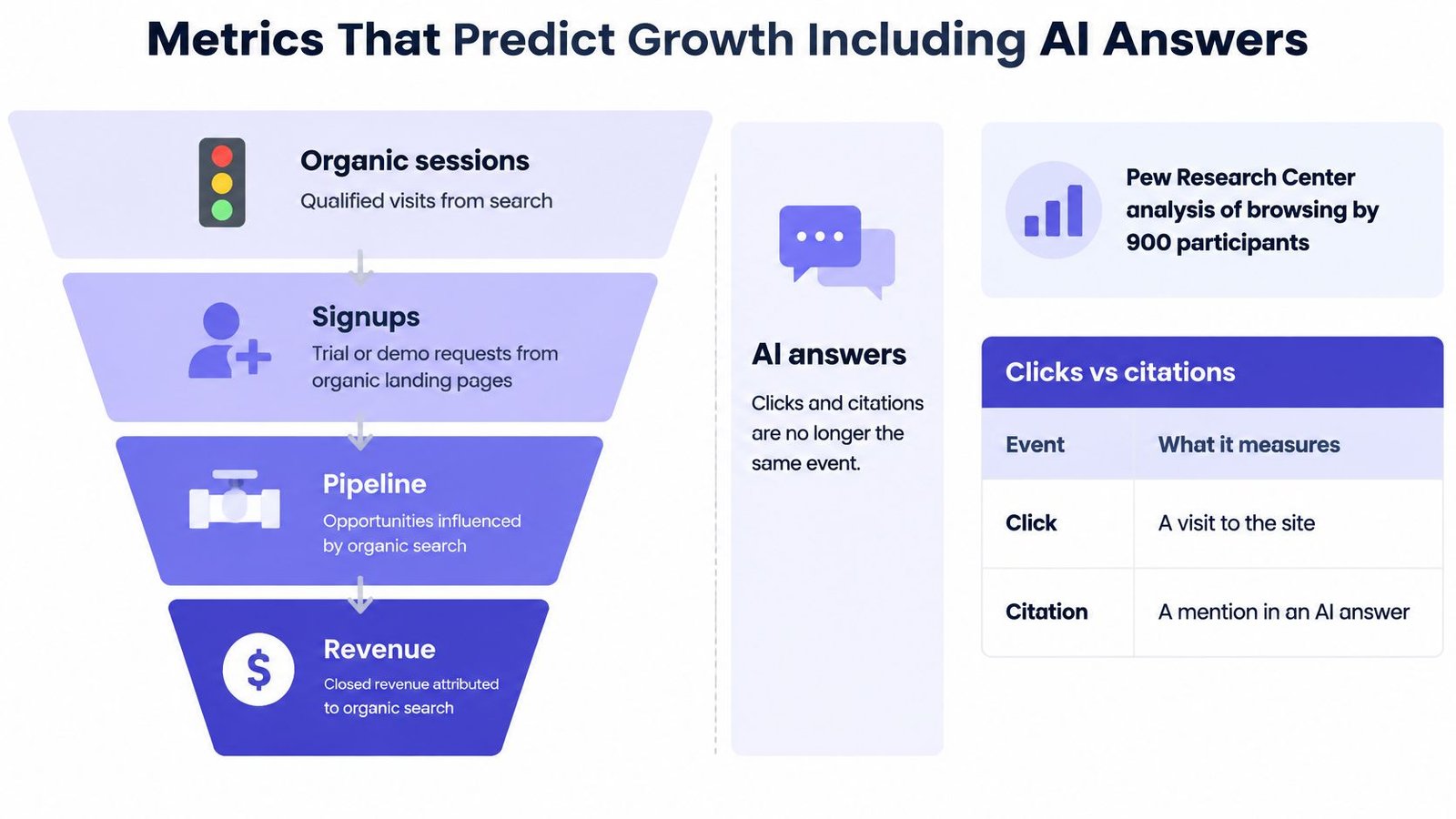
Users clicked a traditional result in 8% of Google searches displaying an AI summary, compared with 15% without one, in a Pew Research Center analysis of 900 U.S. adults' browsing during March 2025, summarized by Search Engine Land; links inside summaries received clicks in just 1% of visits.
That changes the measurement job. A citation isn't a visit, and a visit isn't a signup.
Three-outcome log for AI-answer visibility
Keep a monthly observation log separate from conventional rank tracking.
| Outcome | Where to check | What counts as a win |
|---|---|---|
| Brand named in AI answer | Same prompt set, same wording, logged monthly | Company name appears in answer text |
| Page cited as source | Source list where citations are shown, plus manual check | Your URL appears among cited sources |
| Post-answer action | Branded queries, direct visits, signup and demo tracking | Branded or direct visit followed by signup or demo request |
Record the date, tool, exact prompt, answer, and cited URLs. Split informational prompts from comparison and best-software prompts, because they represent different buyer tasks.
Post-answer actions are directional evidence, not clean attribution. A rise in branded searches after more answer mentions is worth investigating, but it doesn't prove the mentions caused the increase.
Know what the reporting tools cannot establish
Google's AI-features documentation says AI Overviews and AI Mode impressions and clicks appear in Search Console's standard Performance report under the Web search type. There's no separate AI Overview traffic bucket to use as proof of a citation.
Segment branded and non-branded queries, then compare impressions, clicks, and landing-page conversions. Keep your backlink and keyword metrics, but don't let their improvement hide weaker signup quality.
For ChatGPT visibility, test repeatable prompts rather than treating one generated response as a fixed ranking. Maintain accessible product documentation, current company facts, and third-party profiles that describe the same product.
AI Search Optimization and LLM SEO don't require inventing a new company description for each assistant. They require verifiable information and disciplined observation of what systems return.
Protect the value of the click
A staggered-rollout study using Wikipedia clickstream data estimated that default AI Overview availability reduced monthly English search traffic by approximately 5.45% relative to German pages and 4.82% relative to French pages. That isn't a SaaS traffic forecast, but it supports reducing dependence on informational visits alone.
Give arriving buyers proof, product detail, and an appropriate next action. Founders looking to boost AI startup visibility through directories should measure discovery and business outcomes, not assume a profile earns assistant inclusion.
StartupSubmit cannot control whether any search engine or AI assistant mentions, recommends, or cites a business. No reporting dashboard changes that boundary.
Your 90-Day SaaS SEO Sequence and Next Steps
A B2B workflow tool for small operations teams is the running example for this plan. Customers use it to collect requests, route approvals, and keep a record of decisions. The founders still handle most marketing themselves, so the schedule has to fit around shipping product.
The following 90-day sequence is a working plan, not a performance forecast. Its purpose is to finish a coherent search foundation without committing the team to a publishing calendar it can't sustain.
Days 1 to 14 establish a reliable baseline
Export referring domains, Domain Rating, organic keywords, and organic traffic from your chosen tools. Record the tool and export date. Switching providers mid-quarter can make a reporting change look like business growth.
Set up Search Console and analytics conversion events. Test the actual signup or demo journey, including the confirmation state, because a button click is not a completed conversion.
Create a product-facts file with a single approved name, canonical website, and a short approved product description of about 80 words. Include exclusions, such as unsupported integrations or unavailable permissions, so nobody fills gaps with optimistic marketing copy. Every directory profile, comparison claim, and partner listing you create later should match this file.
- Select the initial profiles. Assess G2, Capterra, Product Hunt, SaaSHub, and AlternativeTo against eligibility and audience fit.
- Resolve duplicates. Claim or update an existing profile instead of creating another version.
- Inspect commercial URLs. Check pricing and signup canonicals, public access, and mobile behavior.
- Assign ownership. Put a named person next to every unresolved technical issue and profile correction.
Use a documented process for safe directory submission for SaaS founders. Store account access securely and keep enough records that someone else can maintain the listings later.
Days 15 to 45 build the buying path
For the workflow-tool example, publish the category page and two alternatives pages before adding a recurring blog commitment. Choose alternatives based on genuine buyer overlap, not the largest brands in a keyword tool.
The category page should demonstrate request intake, routing, and approval history with current product evidence. The alternatives pages should explain trade-offs such as setup effort, customization, and whether the tool suits complex enterprise approvals.
Link these pages from the homepage and relevant documentation. Then test each path as a prospective customer who knows the competitor but hasn't heard of your product.
Add a lightweight evidence review before publication:
- Check product truth. Every capability mentioned should exist in the current product.
- Check comparison fairness. Verify competitors' public information and distinguish facts from your recommendation.
- Check the conversion path. Offer the next action that matches the buyer's readiness.
- Check maintenance ownership. Assign responsibility for updating claims when the product changes.
This is also the time to collect customer questions from sales calls, onboarding, and support. Use them to sharpen decision pages rather than turning every question into a blog post.
Days 46 to 90 expand only where the product supports it
Add integration pages for tools customers connect. Show the setup, data direction, permissions, and failure conditions instead of publishing a logo and a signup button.
Recheck shared templates using field performance and rendering evidence. A new analytics script or product animation can undo earlier engineering work, so treat each release as a reason to inspect important pages.
Log newly appearing branded queries and review which commercial URLs earn qualified actions. If visitors arrive but don't proceed, inspect positioning, proof, and onboarding friction before buying more content.
Treat a launch-day community spike as feedback and initial awareness. The preventable post-launch mistake is leaving comparison pages unfinished while waiting for another spike.
Frequently asked questions
How fast do directory profiles go live?
Timing depends on moderation, eligibility, and whether a platform requires verification. Some profiles appear quickly; others remain pending. Track live placement status per directory instead of assuming a universal publication date.
Rankings are a separate outcome. Submission doesn't guarantee approval, indexing, or search performance.
Do more directories help?
Only when they add relevant discovery or an accurate reference buyers check. Expand the list after reviewing category fit, profile quality, and maintenance workload, not because a larger submission total looks better in a report.
Can anyone guarantee AI citations?
No provider controls what an assistant answers. Evaluate them on work they control: accurate submissions, documented placements, and corrections when a listing goes wrong.
Should an early-stage SaaS publish a weekly blog?
Start a calendar when you have a defensible topic list, access to product expertise, and a working route from useful content to a relevant commercial page. Until then, maintained decision pages beat skipped publishing deadlines.
Your immediate next step is the baseline and the first accurate profiles, then an inspection of the buying path before you expand publication. A small, maintained set of trustworthy pages is a better operating commitment than a calendar your team can't support.
StartupSubmit offers manual, category-matched directory submissions for SaaS and AI products, with a team that writes a unique description per directory and sends two screenshots per directory as proof. It helps founders build accurate external profiles without spending their launch week filling out forms. Visit StartupSubmit to put that entity-layer work alongside your commercial pages and technical SEO priorities.
Ready to build high-quality backlinks?
We'll manually submit your product to 60 to 200+ directories in 5 to 7 days, with screenshot proof for every submission. No bots, no boring forms, just more time for selling and building.
See pricing & get started →