Best Directories for Backlinks in 2026: 7 Vetted Picks
Dumping a new SaaS or AI product into a few hundred directories is the advice that still gets repeated, and it is the advice that wastes the most founder time. A long list feels like progress because the spreadsheet fills up. Search engines and AI assistants do not rank you for the size of that spreadsheet. They weigh whether a real page, on a site people use, describes the product in a way that matches what buyers search for.
A directory backlink only earns its place when the listing is accurate, relevant, and indexable. In 2024, 93.8% of link builders said link quality was more important than link quantity, according to Authority Hacker's survey as reported by LinkDoctor. That split matches what I recommend to early-stage teams. Ten category-matched profiles beat two hundred cloned submissions on sites that exist to sell links.
Raw link counts are a weak scoreboard. Assistants and classic search both look at the citation graph around a product: the same name, the same URL, and the same category showing up on sites buyers already trust. A profile that never gets approved, sits behind a login, or repeats a spun description does not join that graph. It just creates cleanup work later.
Set expectations before you submit anything. A listing request is not an approval. A live profile is not automatically a followed link. No directory, and no submission service, can promise rankings, traffic, or a mention inside an AI answer. The seven picks below are judged on three things founders feel: how hard approval is, whether a buyer or an assistant can find the product from the page, and what a realistic cost per useful listing looks like.
Table of Contents
- 1. StartupSubmit
- 2. Product Hunt
- 3. G2
- 4. Capterra
- 5. SaaSHub
- 6. AlternativeTo
- 7. BetaList
- How the Seven Directories Compare on Cost, Audience, and Review Requirements
- Your Next Seven Days of Directory Work
1. StartupSubmit
Paying around $1.33 per submitted backlink beats spending a week learning each platform's form, moderation rules, and category tree. StartupSubmit is a manual submission service built for that first pass. It takes a SaaS, AI tool, or startup and submits it by hand to directories that match the product, rather than blasting one description across a spam network.
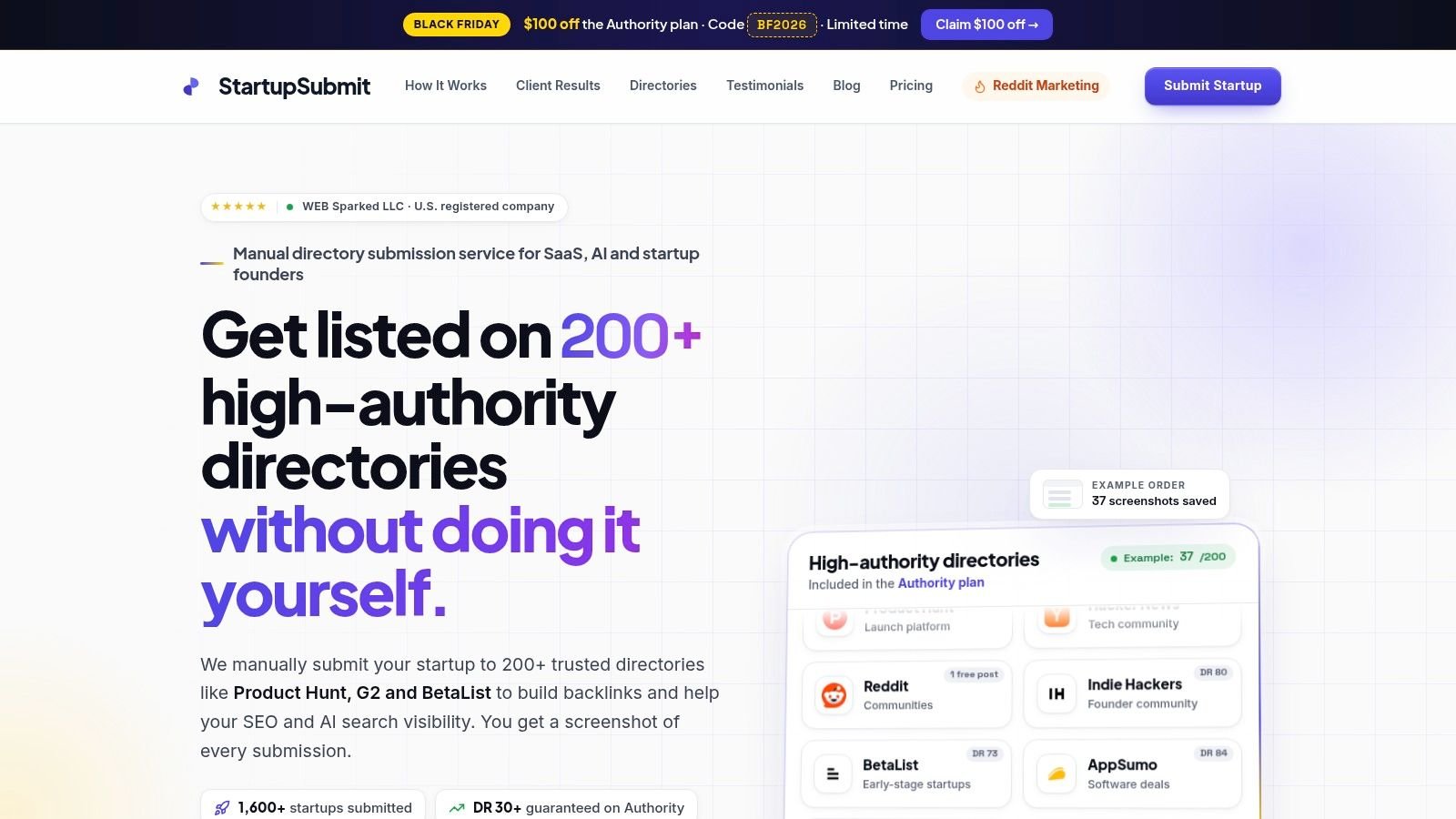
A team of 20 SEO professionals writes a unique description for each directory, picks the category by hand, and checks for duplicates before anything is sent. The pool is a database of 500+ curated, editorially reviewed directories. Your product does not go to all of them. An SEO strategist cuts the list to sites that fit the category and each site's own rules, so a dev tool and a consumer app end up on different platforms. Typical names in that mix include Product Hunt, G2, Capterra, BetaList, Indie Hackers, AlternativeTo, and SaaSHub, plus niche boards when the product calls for them. All of it is manual, with no bots, which matters because automated submission footprints are what get listings rejected at moderation.
What the plans actually buy
Pricing is one time, not a retainer.
- Growth: $199 for 150+ directories, about $1.33 per submitted backlink.
- Authority: $299 for 200+ directories with a stated DR 30+ guarantee. The plan keeps building backlinks until the target DR is hit, runs on express delivery in 8 days, and adds bonus platform recommendations on top of the standard report.
The report lists every submitted backlink URL with screenshot proof for each directory, so you can open each page and verify the placement yourself. At roughly a dollar and change per submission, Growth is the lowest per-link entry on this list. Cheap only counts if the page goes live and stays indexable, which is why the audit trail matters more than the raw count.
In 2024, 67% of link-building professionals identified Ahrefs Domain Rating as their preferred link-building metric, according to a 2024 industry survey reported by Superlinks. That is why the Authority plan talks about DR at all. Domain Rating is a third-party score, not a Google ranking. The useful part of the guarantee is a target you can check in Ahrefs once the live URLs exist, not a promise that buyers will show up.
Practical rule: Count a listing as useful only after you can open the URL, see your real product name, and confirm the page is not a duplicate of a profile you already own.
The trade-off
Submission count is what the service covers. Approval is not. Directories decide whether a profile goes live, how long review takes, and whether the link is dofollow, nofollow, or sponsored. The links that do go live are a mix of those types. Rankings, traffic, and citations inside AI answers sit outside the promise. If you need one followed link from one named site by Friday, this is the wrong tool. If the job is a category-matched first wave with proof you can audit, it is the one I would start with.
2. Product Hunt
Product Hunt is a launch stage, not a quiet citation. You get a public product page with your details and a link to the site, comments from people who showed up that day, a time-boxed ranking, and a page that stays up after the homepage moves on. For consumer tech, SaaS, and AI tools, that page is often the first place a stranger meets the product.
The launch is free. The cost is preparation. You need a personal account, and a new account may have to wait about a week before it can post. You also need a hunter or a founder who will reply to comments while the ranking window is open. A page submitted and then ignored rarely becomes the kind of profile people link to later.
I would not book Product Hunt for the backlink. Exposure and feedback are the main product. Reach is not guaranteed, and a quiet launch still leaves a thin page. The teams that get value show up with a clear tagline, a working URL, and someone assigned to answer questions for the full day.
Pew Research Center's analysis of browsing activity from 900 U.S. adults found that users clicked a traditional search result in 8% of visits when Google showed an AI summary, compared with 15% of visits without one, as reported by Pew Research Center. A launch page will not fix that click drop. It can still put a stable, crawlable description of the product on a site assistants and journalists already know. Measure branded search and referrals after launch day, not just the upvote chart.
If you want a wider map of where a launch profile sits next to review sites and startup boards, the StartupSubmit directory ranking guide sorts those platforms by the job they do, not by a single authority score.
Verdict: Use Product Hunt when you can promote the launch. Skip it as a silent profile task.
3. G2
G2 is where a lot of B2B buyers compare software, read reviews, and shortlist vendors. Eligible companies can claim a profile that holds the description, category, screenshots, pricing, and reviews. A free tier covers basic profile management. Paid plans add branding, lead gen, and analytics. You do not need the paid tier to exist on the site.
This is a buyer directory first and a backlink second. The page helps when your customers already shop in software categories. It helps less if you are a pre-revenue consumer app, a local service, or a product G2 will not categorize. Some products and duplicate submissions are ineligible. Plan on a rejection, not a fight, if the product does not look like B2B software.
Reviews are the hard part, and they are the part that matters. An empty profile is a business card. A profile with real customers on it is a trust page that can show up when someone searches your brand plus “reviews.” You cannot invent those reviews, and you should not paste them onto your own site as if you collected them there.
Google's SoftwareApplication structured-data documentation requires software publishers who want review-related eligibility to include either an aggregateRating or an individual review, and it tells you to validate markup in the Rich Results Test, as explained in Google's Software App structured data docs. That markup belongs on pages where the reviews are visible. It is not a trick to borrow G2's stars.
Who should claim it
- B2B SaaS: Claim the free profile, pick one primary category, and ask real users for reviews after they have used the product.
- AI tools sold to teams: Same path, as long as the category exists and you can describe pricing without hand-waving.
- Local businesses: G2 is the wrong shelf. Citation work for map results is a different job, which is why we wrote how many citations a local business needs as a separate guide.
Paid marketing features get expensive fast, and they are optional. I would claim the free profile, fill every public field, and only buy leads after the review base is real.
Verdict: Best software-review profile on this list for B2B. Weak fit for everyone else.
4. Capterra
Getting listed on Capterra is free. Getting reviewed there takes a real product. Vendors create and manage the profile without paying, and sponsored profiles plus lead programs sit on top when you want paid placement. Approval is stricter than on a generic submit-your-URL directory, and that friction is exactly why the listing carries weight.
The audience is buyers already comparing software. Businesses browse categories, stack products side by side, and read reviews before they talk to sales. That intent matters more than the metric attached to the domain (Capterra sits around 88 on the usual authority scale). A complete profile also gives AI assistants a concrete page to cite when someone asks for alternatives in your category.
Poor fits: a local plumber, a marketplace with no software category, a startup that is still an idea without a product page. A listing here does not hand you qualified leads, and it does not guarantee a measurable ranking change.
Write the profile for the comparison page. Name the category the way buyers search it. Put pricing in plain language. Add screenshots of the actual interface. Leave the description as a slogan and you lose the click to a competitor who showed the workflow.
Google's spam policies single out low-quality directory links as link spam and treat paid placements as sponsored links that should use rel="nofollow" or rel="sponsored". Capterra clears that bar because real categories and editorial review stand behind each listing. The directories worth skipping are the ones that promise hundreds of followed links overnight, auto-post the same blurb, or sell placement with no audience behind the category.
If the directory would accept any URL in any category for a fee, it is not one of the best directories for backlinks. It is a list you pay to join.
On cost, the free listing makes your price the setup time: an hour or two to write the profile, choose categories, and upload screenshots. Sponsored spend only makes sense after that foundation exists and the profile is live.
Verdict: Worth the effort for any software vendor with a live product. Pay for placement only after the free profile is complete and getting views.
Boost Your Startup's Traffic & SEO with up to 200+ Directory Listings
Skip the grind. Our team manually submits your product to relevant, high-authority directories, with screenshot proof for every submission, so you get real users, feedback and lasting backlinks without lifting a finger.
Get Listed Today5. SaaSHub
SaaSHub is a software marketplace built around discovery and alternatives. You submit a product, it goes through review, and a verified listing can appear on competitor and category pages. Basic submission and verification are free. Featured placement is a paid subscription, so check SaaSHub's current pricing before you commit.
The free path is the one I would test first. Alternative pages match a real query pattern: someone is unhappy with a known tool and wants a replacement. If your product belongs there, the listing puts you in a comparison a buyer already started.
Approval is not automatic, and the exact eligibility requirements can change. Review them before submitting, especially if the product has not launched or does not yet use a branded domain. A temporary page or default platform subdomain is worth fixing before you spend time on the form.
Complete verification once the listing is accepted. The badge and added profile visibility can help it stand out during “alternatives” browsing. If category matching, duplicate checks, and listing updates take founder time away from product work, how StartupSubmit handles directory listings shows what a managed submission covers.
Verdict: One of the better free SaaS profiles. Pay for featuring only after the organic listing is live.
6. AlternativeTo
AlternativeTo is a comparison query more than a directory. Its pages catch people searching “alternatives to” a tool they already know, usually because price, limits, or support pushed them to shop. That intent is the asset.
Submissions are community-driven and reviewed. You can suggest an application after verifying an email, then request developer access to edit an approved listing. Take that second step. The first pass is rarely perfect, and you will want control over platforms, license, description, tags, and the screenshot set before the page starts collecting comparisons.
Timing is the annoyance. The review backlog means you cannot promise a founder that the page will exist this week. Treat AlternativeTo as a queued task, not a launch dependency. It also needs an incumbent. If buyers are not already searching for replacements to a named competitor, the alternatives graph has little to attach your product to.
Link treatment is where forecasts get sloppy. Some profiles pass a normal link. Others do not. Do not put this site in a plan that assumes a followed backlink. Confirm the attribute after the page is live, then value the listing for the comparison traffic it can send even when the link is weak.
Use Google's spam policies as the quality floor: the page should help a shopper even if search engines ignored the link. A maintained AlternativeTo profile with accurate tags can meet that bar. A copied blurb on a dead directory cannot.
Keep the public details consistent with G2 and Capterra so the brand is not split into three spellings across the same buyer journey. When you are ready to file it without creating duplicates, submit your website to directories safely covers the checks worth doing first.
Verdict: High intent when you compete with a known tool. Slow review, and never assume the link type.
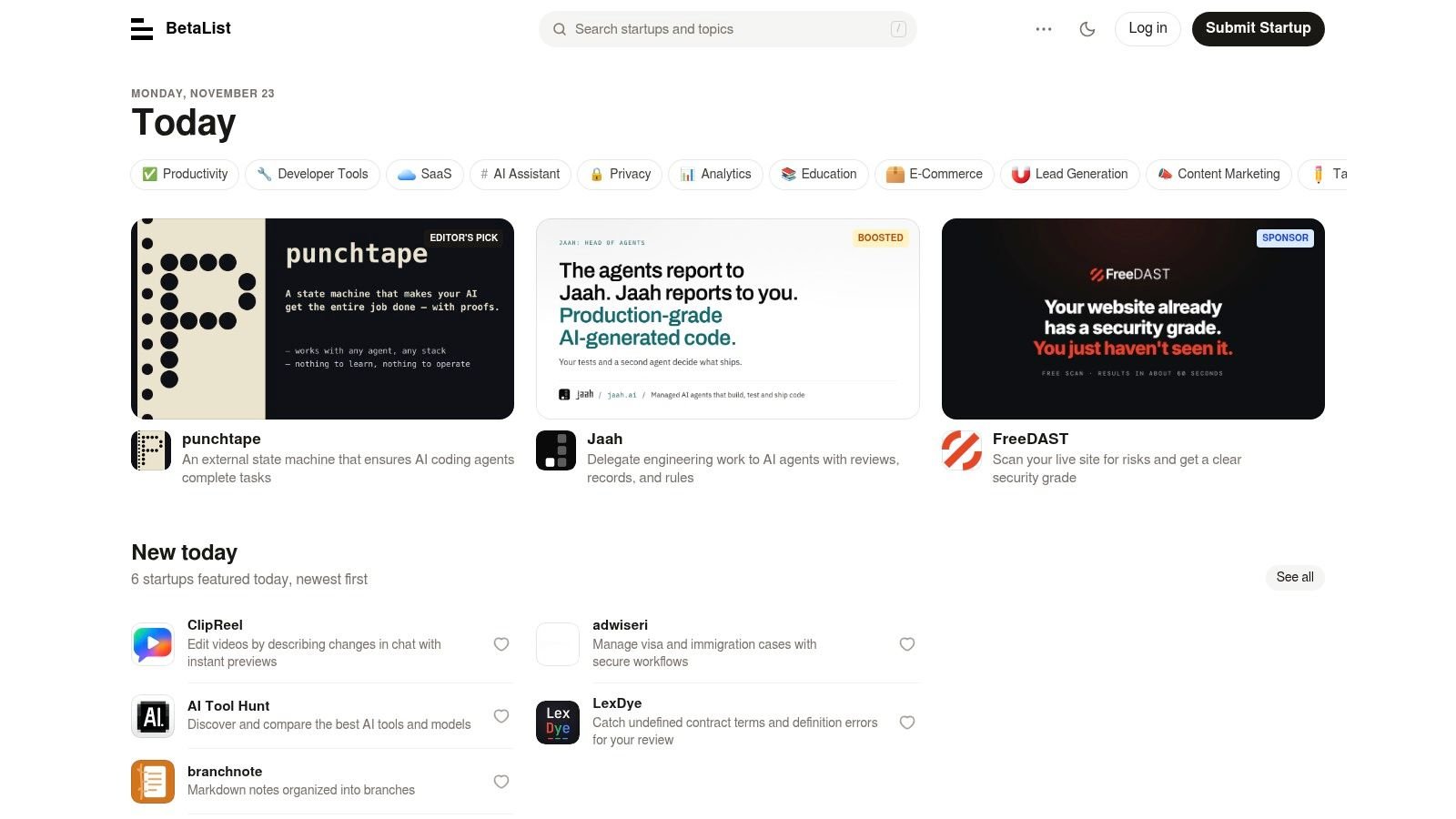
7. BetaList
BetaList introduces pre-launch, beta, and live internet startups to early adopters. It is more startup-shaped than a software marketplace. You need your own domain, and you need to meet the site's criteria. There is no free submission option. You pay for a review path, and selection is still selective.
Paid submission does not guarantee selection or exposure. That single line is why BetaList stays off the "easy backlink" lists. Your money buys a review, and your time is spent either way.
Plans differ by how fast you are reviewed or featured and by whether a newsletter mention is included. I would pay for speed only when the product is ready for strangers. A featured link pointing at a broken signup page is an expensive way to collect bounce visits.
The early-adopter audience is the reason to use it. A founder who wants feedback before a wide launch gets more from a small, curious list than from another empty profile. A founder who only wants a link can get similar citation value from free software profiles and should not start here.
In 2024, directories accounted for 15% of sources cited in ChatGPT local-search answers, based on BrightLocal's study of 800 manual searches across 20 U.S. cities, as reported by Stephen Sumner. BetaList is not a local directory, and that figure is about local answers, not SaaS prompts. I still use it as a reminder that assistants cite directory-style sources when the page looks like a real reference. A featured startup profile can be that kind of reference. An unapproved paid submission cannot.
AI-tool founders often need a second cluster of sites on top of the startup boards. That is a different submission set, which is what our AI directory submission service is for.
Verdict: Pay only if early users matter and you can afford a no. Confirm a featured listing's link type on the live page before you count it.
How the Seven Directories Compare on Cost, Audience, and Review Requirements
A directory's DA tells you nothing about whether your listing survives moderation or reaches a buyer. A more useful comparison is cost per live listing, who reads the site, and how strict the gate is.
| Item | Cost to List | Best For | Review or Approval |
|---|---|---|---|
| StartupSubmit | $199 one time for 150+ directories (about $1.33 per backlink) | Founders seeking done-for-you directory submissions | Curated, category-matched submissions; each directory approves or rejects on its own |
| Product Hunt | Free | Launching consumer tech, SaaS, or AI products | Personal account required; homepage featuring is competitive |
| G2 | Free basic profile; paid features available | B2B software seeking buyer visibility and reviews | Eligibility applies; some products or duplicate submissions may be ineligible |
| Capterra | Free vendor profile; paid promotion available | Software vendors reaching buyers comparing solutions | Vendor verification required; incomplete profiles do not rank well |
| SaaSHub | Free submission; featured listing is $99/month | Software seeking discovery through categories and alternatives | Listings are reviewed; approval is not guaranteed |
| AlternativeTo | Free profile | Software competing with established products | Community-reviewed; publication timing may vary |
| BetaList | Paid submission | Startups seeking early adopters and feedback | Selective; paid submission does not guarantee a feature |
Read the table as a funnel. The free profiles on G2, Capterra, SaaSHub, and AlternativeTo cost time and some verification effort, and they reach buyers mid-comparison. Product Hunt and BetaList ask for a product worth looking at on day one, and a "no" buys you nothing. StartupSubmit trades money for the repetitive work: a fixed fee, a category-matched list, and a report you can audit.
The rows you skip matter as much as the rows you file. Any directory with no moderation, no real audience, and a price attached belongs off the list, whatever its DA says.
Your Next Seven Days of Directory Work
Start with an audit, not a new signup. Open every profile you already have and check the product name, URL, category, and description. Fix the ones that point at a dead page or use a different brand spelling. Delete the goal of “more submissions” until the live ones are accurate.
Sort anything still on your list by category fit and by how the site reviews submissions. A buyer-side software page, an alternatives page, a launch page, and an early-adopter feature are four different jobs. Pick the ones your buyers already use. Put low-quality bookmark farms and automated networks in a skip pile. The cheapest list is rarely the best one, because the pages do not get indexed, do not get moderated, and do not help anyone choose you.
Set a budget per useful listing, not per form filed. Free profiles on G2, Capterra, SaaSHub, and AlternativeTo can be worth more than a paid blast if they go live and stay accurate. Paid options such as BetaList or a done-for-you wave only make sense when you know what “useful” means. For me that means an indexed URL, a new referring domain, and a page a buyer could stumble into.
How to verify the work
Ask for a submission report with a live URL and a screenshot for every row. Open a sample yourself. Confirm the description is unique, the category is right, and the link is crawlable. Then watch the weeks after, not the hour the report arrives.
Ahrefs' analysis of approximately 1 billion web pages found a positive relationship between unique referring domains and Google search traffic, and a separate look at roughly 14 billion pages found that 96.55% of indexed pages received zero estimated monthly visits from Google, according to Ahrefs' guide to referring domains and backlinks. Track new referring domains, branded searches, and referral visits. Submission count is the only number you fully control. Approvals, rankings, and AI citations are not.
Judge each directory by what it does for a buyer who is comparing tools, not by the domain score printed on a sales page. If you want a wider stack for monitoring what those listings do after they are live, the Web Mage guide to SEO tools is a practical next read.
StartupSubmit manually submits SaaS, AI, and startup products to category-matched directories, with a screenshot and URL for every submission so you can audit the work. If you want that first wave handled without a week inside forms, visit StartupSubmit and pick the one-time plan that matches how many useful listings you need.
Ready to build high-quality backlinks?
We'll manually submit your product to 60 to 200+ directories in 5 to 7 days, with screenshot proof for every submission. No bots, no boring forms, just more time for selling and building.
See pricing & get started →