How to Submit Your Site for Free & Get Indexed Fast
Product Hunt is only one launch channel, and it's a poor place to store your entire growth strategy. A leaderboard can create attention, but SaaS and AI founders also need category discovery, technical feedback, buyer reviews, revenue opportunities, and public profiles that keep working after launch day.
Product Hunt has grown from a side project founded in 2013 into a destination for early adopters, makers, technology professionals, entrepreneurs, investors, and product enthusiasts. Independent 2025 and 2026 traffic summaries place it at roughly 2.7 million to 4 to 5 million monthly visitors, while multiple guides note that more than 500 products launch there every day. That density helps explain why attention is intense, competitive, and brief. One 2026 analysis reported that traffic often falls 90% to 95% within 48 hours. See the broader context in this analysis of Product Hunt alternatives.
The right question isn't “What replaces Product Hunt?” It's “Which channel should do which job?” This comparison evaluates audience fit, traffic behavior, acceptance or pricing barriers, SEO and trust value, submission effort, and launch timing. It separates short-lived attention from durable profiles, backlinks, reviews, and mentions that may support Google AI Overview, ChatGPT, and other answer engines.
StartupSubmit can help founders manage manual directory execution across a broader network, but it shouldn't replace choosing the right community personally. If you're building a coordinated plan to scale your SaaS launch strategy, the platforms below are best understood as different parts of one distribution system.
1. AlternativeTo
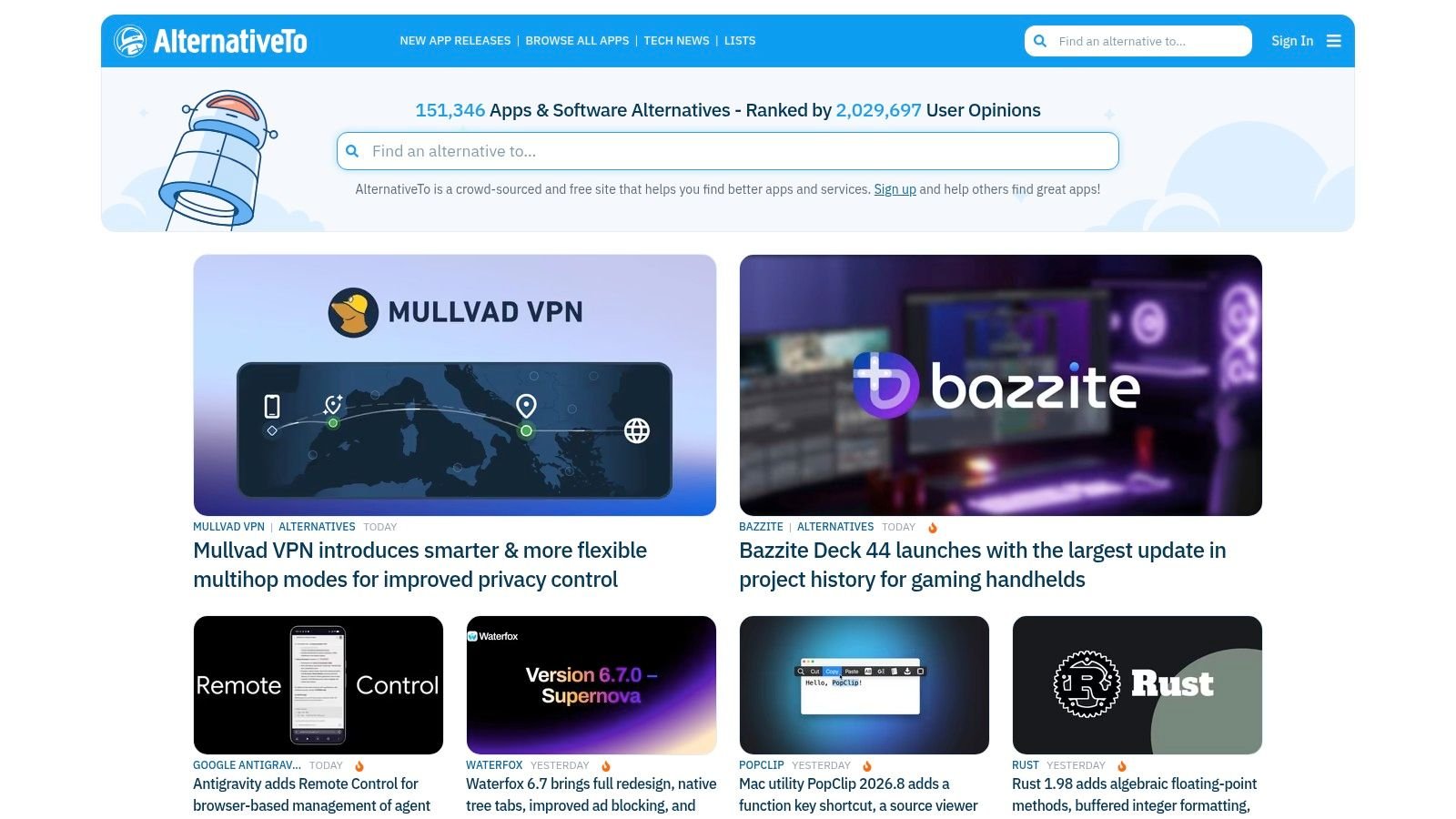
AlternativeTo is one of the strongest choices when your product replaces a known app, software platform, or workflow. Its core value isn't a launch-day leaderboard. It captures comparison intent from people already looking for a substitute, which makes it more useful for evergreen software discovery than for a concentrated burst of votes.
The platform's community can improve listings through its Contribute flow, and founders can keep product information accurate as features, pricing, and positioning change. An optional fast-track route can move a submission toward the front of the review queue, but the basic listing process is accessible and free.
Third-party benchmarks show the difference between recurring discovery and launch browsing. SEMrush reports 4.02 million visits for AlternativeTo in a recent month, with an average session duration of 5:43, while Ahrefs reports 641,000 visits for Product Hunt in the same comparative dataset. Those figures come from SEMrush's AlternativeTo overview and indicate a materially larger, more engaged software-evaluation audience in that benchmark.
Best role in a launch system
AlternativeTo is a strong fit for SaaS SEO, competitor positioning, and branded search coverage. A listing can support searches such as “alternative to [competitor]” and give prospects another place to validate your product before visiting your site.
It won't create the same launch-day excitement as Product Hunt. That's the trade-off. Its value accumulates through category relevance, comparison pages, community edits, and continued indexing.
Practical rule: Submit when you can describe the product honestly against established alternatives. Weak category placement or exaggerated feature claims can attract the wrong visitors and undermine trust.
For founders with limited bandwidth, a manual AI directory submission service can handle the repetitive work while you focus on the highest-value communities and customer conversations.
2. SaaSHub
SaaSHub fits founders who want a permanent software profile, category placement, and an indexed destination that prospects can revisit. It operates more like a software marketplace and alternatives directory than a launch event, so its contribution is usually recurring discovery, not a dramatic first-day spike.
The free Submit a Product flow gives founders a practical starting point. Domain verification can improve submission priority, while category and competitor tags help place the product in relevant browsing and comparison contexts. Public product pages also include a prominent Visit website button, making the listing more than a static citation.
What the listing needs
SaaSHub works best when the profile is complete. Use a precise product description, accurate categories, clear competitor references, current screenshots, and a destination URL that matches the promise made in the listing. A vague tagline may get a page published, but it won't give buyers enough context to click.
The manual review queue can delay visibility. Domain verification is also worth completing because the platform uses it as part of its prioritization process. Those requirements add friction, but they also discourage careless submissions and make the profile more credible.
- Strong fit: SaaS products with clear categories and recognizable alternatives.
- Useful asset: A public, maintainable profile with a direct website path.
- Main limitation: It isn't designed to create the same social urgency as a launch board.
- Founder task: Update the profile when pricing, positioning, or core features change.
SaaSHub belongs early in a directory workflow because it creates a durable base layer before you invest time in review platforms or paid acquisition. Founders who want help with repetitive submissions can consider a SaaS directory submission service, then personally handle the communities where discussion quality matters most.
3. G2
G2 exists outside the launch-board model. B2B SaaS buyers use it to compare vendors, read reviews, and check whether a product fits companies like theirs. The profile therefore functions as a buyer-trust asset, while any backlink value remains secondary.
Founders can create or claim a product profile for free, customize the page, and use review-collection tools and calls to action. Paid tiers provide advanced analytics and promotional options, but they do not fix an empty profile. A category page without meaningful customer feedback rarely persuades a cautious buyer.
Reviews are the product
G2 becomes more useful when review collection follows a clear process. Ask customers after a meaningful success moment, make the request specific, and follow platform rules. Do not pressure customers to submit only positive reviews or manufacture feedback. A smaller set of genuine, detailed reviews is more defensible than a sudden wave of generic praise.
Sales and customer success teams should own the timing because they see when customers achieve a measurable outcome. Product teams can also identify feature milestones that justify a request.
G2 supports SaaS SEO and reputation management as prospects, investors, candidates, and partners search for your brand. They may encounter the profile beside your website, giving an early-stage company an external trust signal while its own domain authority is still developing.
Paid visibility can help in competitive categories, but measure it against qualified pipeline. If the profile does not convert relevant visitors, extra placement may increase spend without creating demand.
Use StartupSubmit's directory submission service for listing execution if needed, then manage customer reviews internally. The platform can support buyer trust, but credible feedback depends on customer relationships, not submission speed.
4. Capterra
Capterra serves buyers who are researching software, comparing categories, and narrowing a shortlist. Its broader directory network includes GetApp and Software Advice, so an accurate vendor profile can support discovery in more than one research environment.
Treat the free profile as foundational infrastructure. Keep the category, capabilities, integrations, deployment model, support details, and positioning current. The page gives prospects a reference point before they contact sales, especially when your product fits a defined software category.
A buyer-intent channel, not a launch stage
Capterra works best after the offer is clear and customers can explain the value they received. Visitors typically arrive with requirements, then compare vendors on team fit, pricing structure, implementation, and feature coverage. That makes Capterra more relevant to SaaS SEO and revenue than to launch-day attention.
The commercial programs require discipline. Capterra offers paid PPC and PPL options for sponsored visibility or lead distribution, but extra exposure does not guarantee qualified opportunities. Define a sales-ready lead before spending, connect the source to your CRM, and judge leads by fit, conversion, and pipeline contribution rather than volume alone.
Use this sequence:
- Complete the free profile with specific product information and honest limitations.
- Check whether the listing converts relevant visitors before testing paid promotion.
- Compare paid leads with other acquisition sources through the full funnel.
- Pair the profile with credible review coverage on G2, without treating reviews as a substitute for customer relationships.
Capterra belongs in the buyer-trust and revenue stage of a SaaS or AI launch system. It can capture demand from prospects already comparing solutions, while Product Hunt alternatives built around communities or technical discussion serve different moments. Allocate founder time accordingly. Keep the listing maintained, but do not expect it to create the initial conversation for a product with an unclear category or immature offer.
5. Hacker News Show HN
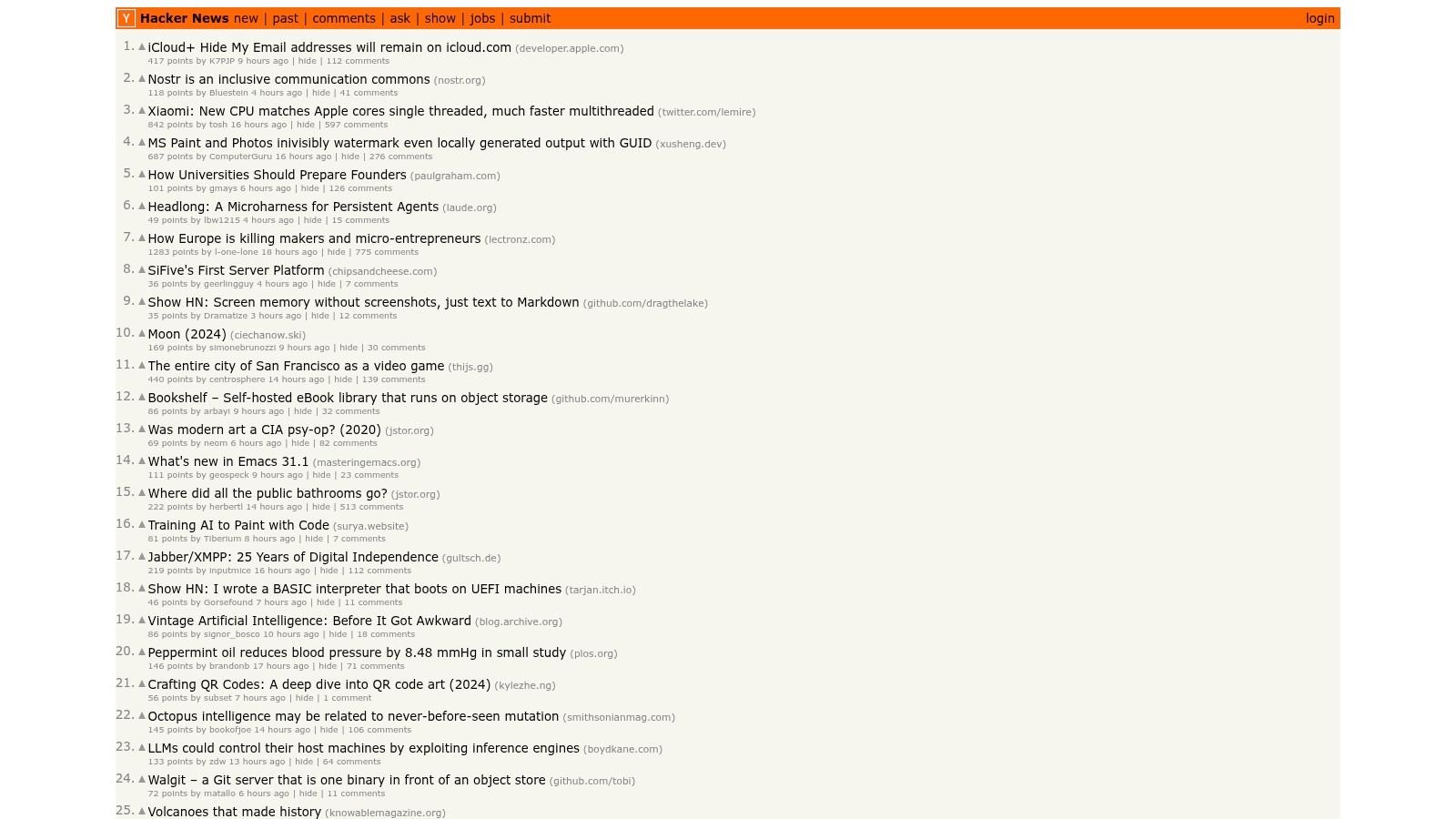
Hacker News, particularly the Show HN format, is a technical feedback channel with a launch mechanic attached. It works for developer tools, infrastructure products, APIs, open-source projects, and AI products with an interesting engineering angle.
The submission flow is simple. The discussion is not. Readers expect substance, transparency, and a clear explanation of what you built. A polished marketing slogan without technical context usually gives the community little reason to engage.
Earn attention with specificity
A strong Show HN post explains the problem, the implementation, the intended user, and the parts that remain unfinished. Founders should stay available in the comments and answer direct questions without turning every reply into a sales pitch.
The upside is targeted technical attention and feedback from people who can identify usability issues, architecture weaknesses, unclear documentation, and mismatched positioning. The downside is that traction isn't guaranteed, and public criticism can be blunt.
Show HN works when the product itself is interesting. The post should explain the build, not imitate a campaign announcement.
Use it when you want technical learning, not just clicks. A developer-focused SaaS may gain more from a thread that exposes a real implementation decision than from a broad launch page full of social proof. If the product isn't relevant to technical readers, choose another channel rather than forcing an audience mismatch.
6. Indie Hackers
Indie Hackers fits a SaaS or AI launch when the goal is founder feedback and durable discovery, not a launch-day traffic spike. Add the product, then use milestone posts, build logs, and focused discussions to show how the business is developing.
A concrete format that works here is a post such as, “I changed onboarding after five users abandoned setup. What would you test next?” It gives members a product decision to examine. A post that only says “we launched, try it” gives builders nothing specific to debate and rarely earns sustained replies.
Turn product decisions into useful threads
Share the decision, the evidence behind it, and what remains uncertain. For example, explain why you chose a market, what user feedback changed, or which pricing assumption failed. Include a link to the product, but make the lesson useful to readers who never sign up.
Product pages and evergreen discussions can keep sending referral visits after publication. They also create a public record of progress that supports founder credibility. The trade-off is founder bandwidth. Writing a thoughtful update and answering follow-up questions takes more work than submitting to a directory, while the resulting traffic is less predictable.
Use Indie Hackers for:
- Validation: Ask for reactions to one real product choice.
- Credibility: Show the work behind a change, without inflated claims.
- Referral traffic: Build a discussion that stays useful after launch week.
- Trust: Address criticism directly and explain what you will change.
Indie Hackers should sit after initial product testing, then support ongoing distribution through updates and conversations. Choose it when feedback, relationships, and durable referral discovery matter more than immediate exposure.
7. BetaList
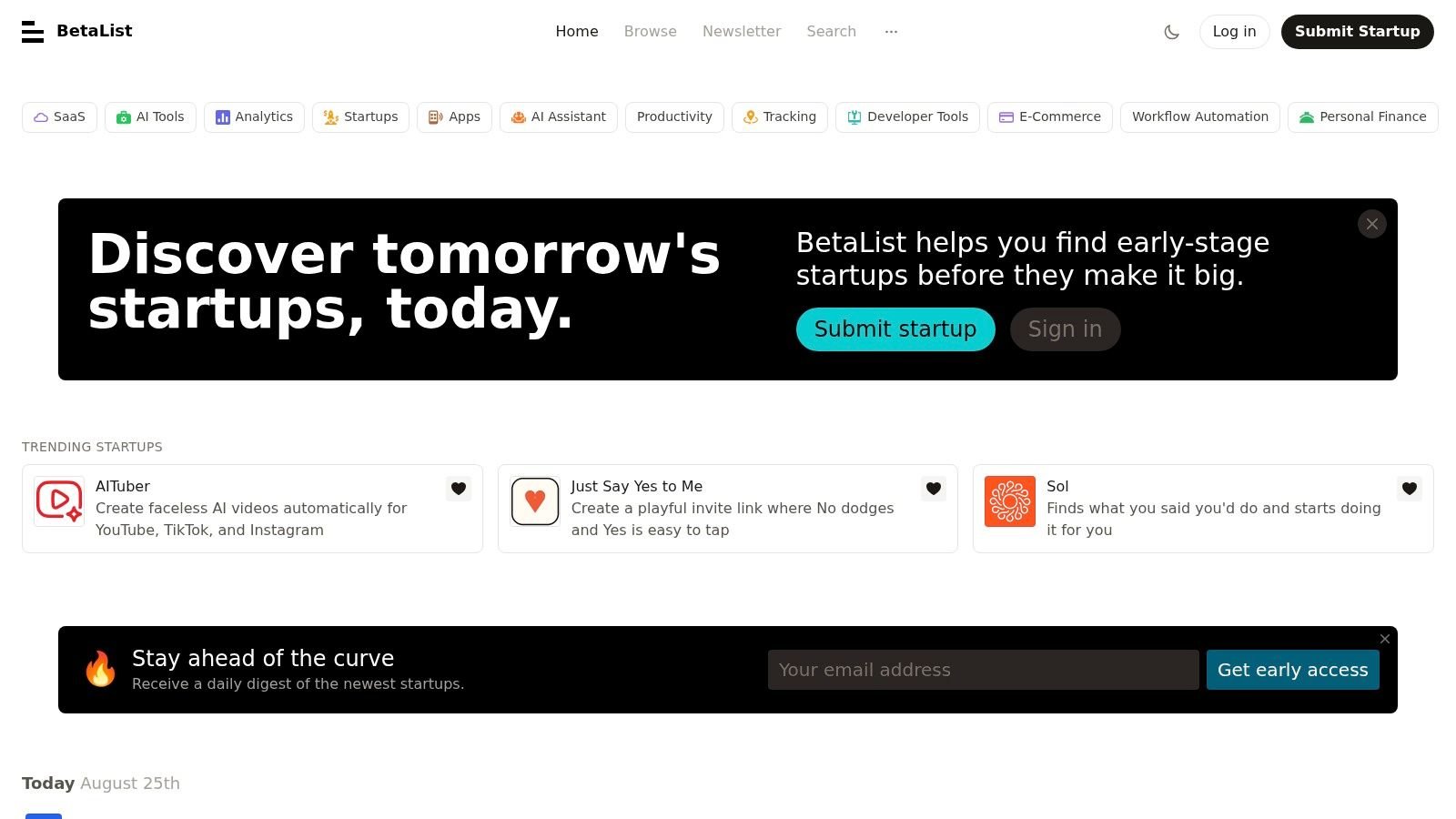
BetaList requires editorial review before accepting submissions, so it is selective rather than publishing everything automatically. Its strongest role is pre-launch discovery, helping early-stage teams reach early adopters, collect feedback, build a waitlist, and gain a public listing with a tracked Visit Site path.
All submissions are paid, and the timeline and benefits depend on the selected plan and whether the product is accepted. That cost makes BetaList a poor fit for casual directory volume. It can still suit a startup with a clear early-adopter proposition and a launch window worth supporting.
Give the audience a reason to join early
A pre-launch page needs more than a logo and a promise. Explain what the product does, who should request access, and why joining before general availability is useful. Early adopters may accept unfinished software when the exchange is clear, such as access to a new workflow in return for informed feedback.
BetaList can provide an authoritative listing and backlink, but that link is only one part of an off-page SEO profile. Send visitors to a focused landing page that captures interest instead of routing everyone to a generic homepage. Durable discovery depends on the page, offer, and follow-up flow, not the listing alone.
Pre-launch exposure only helps when you have a real next step ready, such as a waitlist, beta invitation, or onboarding flow.
Founders coordinating several reputable placements can compare the best startup directories, then decide which submissions deserve personal outreach and which can be handled through a manual service. Use BetaList before a broader launch, while the team can still act on early feedback and convert attention into qualified beta users.
8. Peerlist Launchpad
Peerlist places Launchpad inside a professional network for engineers, designers, product managers, and other builders. That positioning suits technical products where the founder's credibility, product quality, and clarity of the use case all affect adoption.
The submission flow includes launch guidelines, structured updates, and feedback threads. Since the launch appears alongside professional identities and portfolios, readers assess both the product and the team building it. That makes Peerlist useful for technical feedback and founder credibility, rather than raw launch-day volume.
Match the launch to the audience
Peerlist reaches a narrower audience, which works in your favor when your target users are technical professionals. Developer tools, design workflows, collaboration products, and productivity utilities can attract more relevant comments here than on a general startup directory.
Bring a working demo that shows the core workflow clearly. A concept-stage product may receive feedback about missing functionality, while a usable product can reveal friction in onboarding, positioning, and day-to-day adoption.
- Best audience match: Developers, designers, product teams, and technical founders.
- Best content: A concise product explanation with a concrete use case.
- Best follow-up: Reply to feedback and publish meaningful updates.
- Main trade-off: Narrower reach than mass-market launch platforms.
Use Peerlist after preparing a functional demo and before investing heavily in buyer-review programs. It can expose product and positioning issues early enough for the team to address them, while also creating a professional profile that supports ongoing discovery.
For broader coverage, this free startup directories resource can help identify additional profiles. Treat those listings as supporting distribution, and choose placements based on audience relevance rather than submission volume.
9. AppSumo Marketplace
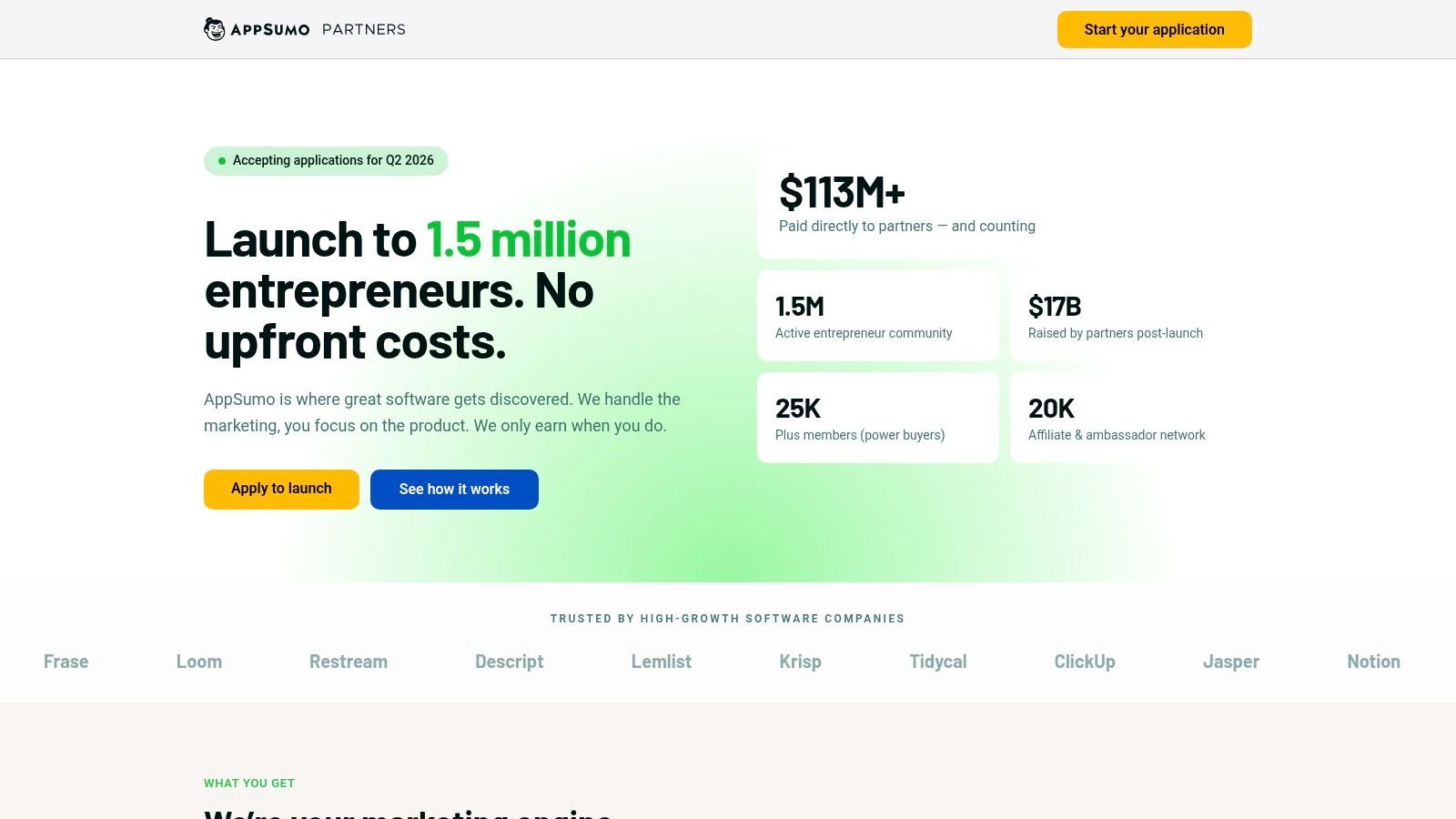
AppSumo functions as a commerce channel rather than an announcement board. Its marketplace combines deals, buyer feedback, and immediate transactions, so it suits SaaS products, plugins, and digital tools that can support a concentrated wave of new customers.
The partner process includes product vetting and quality checks. Founders may enter through a self-serve Marketplace route or pursue the more curated Select program. Deal terms and revenue sharing shape the economics, so model the offer before accepting it.
Treat the deal as an operating commitment
AppSumo can produce users, cash flow, and direct customer feedback when the offer matches buyer demand. The same demand can expose weak onboarding, incomplete documentation, slow support, and unclear product limits within a short period. A small team should assign support ownership and estimate service capacity before launch.
A lifetime deal also affects how future customers perceive pricing. That trade-off may be acceptable when paid-user validation and near-term revenue matter more than votes or launch badges. It is a poor fit for an unstable MVP that changes from week to week.
Before submitting, confirm four operating details:
- Support capacity: Prepare onboarding, documentation, and response ownership.
- Deal economics: Include revenue share, service costs, and long-term usage.
- Offer limits: Define seats, usage, integrations, and support boundaries clearly.
- Feedback process: Turn recurring requests into product decisions instead of promises made under pressure.
AppSumo works best after the core product and offer are stable enough for real transactions. Use it as the revenue and buyer-validation stage of a broader launch system, not as a substitute for durable discovery or technical feedback.
10. DevHunt
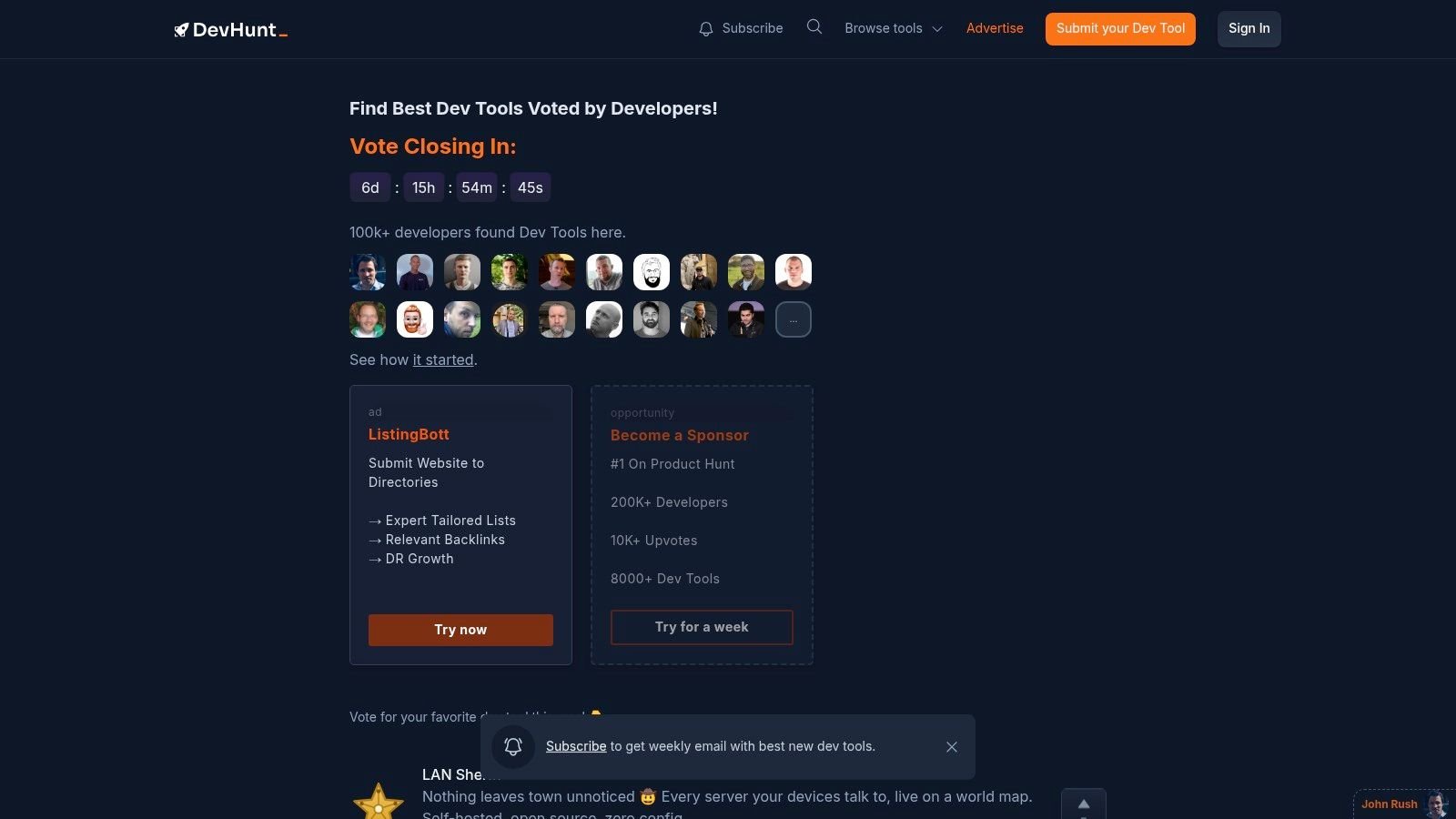
DevHunt serves a narrower role than a general launch directory. It is built for developer tools, open-source projects, and technical utilities, with GitHub sign-in supporting submissions and authentication. Weekly leaderboards and featured placements can create a launch-day discovery spike among people already interested in technical products.
That audience changes the quality of feedback. Technical founders can test whether their positioning makes sense to developers who understand APIs, repositories, infrastructure, and engineering workflows. The platform's open-source model also offers a visible contribution path, which suits teams that want community participation around a GitHub-centered product.
DevHunt is a poor fit for a general consumer app without a developer workflow. A submission should give developers a clear reason to care, such as an SDK, command-line tool, deployment utility, code assistant, testing product, or open-source project.
Use it when the product is ready for technical scrutiny:
- Audience: GitHub-centric developers and technical builders.
- Primary role: Developer discovery and early technical signal.
- Best launch asset: A working product, clear technical use case, and usable documentation.
- Weak fit: Consumer products with no developer-facing workflow.
The trade-off is reach. A smaller, relevant audience may produce better qualification than broad traffic, but DevHunt is unlikely to replace platforms aimed at buyer research, revenue, or long-tail search. Submit once the product can withstand real technical questions, then pair the launch with Hacker News for discussion and with SaaSHub or AlternativeTo for a more durable directory presence.
Top 10 Product Hunt Alternatives Comparison
| Directory | Primary use case | Target audience | Key features | SEO / trust impact | Cost / access |
|---|---|---|---|---|---|
| AlternativeTo | Capture comparison/replacement intent and long‑tail discovery | Users searching for alternatives, switchers | Alternatives model, community contributions, fast‑track option | Strong SEO for “[tool] alternative”, durable organic traffic | Free to list, easy to update |
| SaaSHub | Permanent product profile and indexed backlink | SaaS buyers & researchers | Submit flow with domain verification, category & competitor tags, “Visit website” CTA | Steady referral traffic when verified; indexed backlink value | Free submit; full benefit requires domain verification |
| G2 | Buyer‑intent reviews and social proof for conversions | B2B buyers, procurement, investors | Claim profile, review collection tools, paid analytics/promotions | High authority; reviews rank well and boost trust/conversion | Free profile; paid tiers for visibility & features |
| Capterra | Lead generation & category research within B2B ecosystem | Buyers researching software categories | Vendor portal, PPC/PPL advertising, integrated with GetApp/Software Advice | Strong buyer intent; effective paired with G2 for SERP dominance | Listing free; paid media usually needed for meaningful leads |
| Hacker News (Show HN) | Fast launch exposure, technical feedback, press pickup | Developers, tech writers, early adopters | “Show HN” tag, discussion format, community‑driven engagement | Potential for high spikes, press/technical visibility | Free to post; highly competitive and quality‑driven |
| Indie Hackers | Community engagement and durable referral traffic | Bootstrapped founders, indie SaaS users | Product listings, milestone posts, community discussions | Lasting referral traffic if actively participating | Free; requires genuine community participation |
| BetaList | Pre‑launch discovery, early adopters & email capture | Early adopters, beta testers | Editorial review, newsletter inclusion options, do‑follow “Visit Site” | Authoritative backlink and early adopter exposure | Paid submissions only (selection/plan dependent) |
| Peerlist Launchpad | Product launches to professional tech network | Engineers, designers, product managers | Launchpad flow, structured updates, feedback threads | High‑quality, niche visibility and technical feedback | Generally free to list; best for production‑ready products |
| AppSumo (Marketplace) | Deal‑driven customer acquisition and revenue | Bargain hunters, SMB buyers | Partner application, curated listing tracks, buyer reviews | Immediate revenue & user acquisition; proof of demand | Selective acceptance; revenue share and deal terms apply |
| DevHunt | Developer‑focused launch visibility and GitHub audience | Developers, GitHub‑centric users | GitHub sign‑in, weekly leaderboards, open‑source model | Good for dev tool discovery and community signals | Free to use; smaller, niche audience |
Turn Ten Listings Into One Launch System
Ten listings won't create a launch system by themselves. The system comes from assigning each platform a job, sequencing submissions around product maturity, and reusing one accurate narrative without copying the same generic description everywhere.
Start by preparing a central launch brief. Include the product name, one-sentence value proposition, category tags, screenshots, pricing details, founder context, destination URLs, customer proof, and a short explanation of what makes the product different. Prepare variations for technical communities, buyer-review platforms, comparison directories, and revenue channels.
Sequence by maturity and audience
BetaList belongs in the pre-launch phase when you're collecting early adopters or testing a waitlist. Hacker News, Peerlist Launchpad, Indie Hackers, and DevHunt make more sense when you can answer questions, respond to criticism, and show a working product. Choose based on audience fit, not perceived prestige.
AlternativeTo and SaaSHub are durable discovery layers. They can continue supporting category visibility and referral paths after the launch spike fades. G2 and Capterra belong in the buyer-trust phase, when customers can provide genuine reviews and your product fits an established software category.
AppSumo should come later, only when the deal economics work and the team can support the resulting users. It's a revenue and validation channel, not a free awareness listing.
AI search makes this durable layer more important. One 2026 study reported that AI Overviews appeared on 25.11% of Google searches in Q1 2026, while another analysis reported that roughly 83% of searches with an AI Overview ended without a click. Those figures are cited in Contently's analysis of AI Overview traffic. A profile that is well categorized, clearly written, and mentioned by trusted sites may support visibility even when the searcher doesn't click through a traditional result.
A separate longitudinal dataset covering 53 brands, 5.47 million queries, and 2.43 billion impressions reported organic click-through rates on AI Overview queries falling from 1.76% to 0.61% before a partial rebound, as documented by OmniBound's AI Overview statistics. The practical lesson is simple. Don't measure launch success only through direct traffic. Build branded search coverage, referring domains, reviews, and profiles that strengthen the wider discovery footprint.
Use this submission checklist
- Check for duplicates: Search each platform before creating a new profile, then claim or update the existing listing when possible.
- Verify categories: Choose the most accurate category and competitor tags. Misclassification attracts the wrong audience and weakens conversion.
- Follow review rules: Request honest customer feedback without incentives, scripting, or selective pressure.
- Use tracking links: Add platform-specific UTM parameters where the platform permits them, and keep destination URLs consistent.
- Record live URLs: Maintain a spreadsheet with submission date, status, profile URL, owner, and next update.
- Schedule follow-ups: Refresh screenshots, pricing, descriptions, and feature details after meaningful product changes.
- Measure qualified outcomes: Track visits from relevant buyers, signups, reviews, referring domains, and branded search visibility.
Founders can submit manually, or use StartupSubmit's stated manual workflow across 200+ startup and software directories. Its process includes duplicate checking, categorization, reporting, acceptance notes, and screenshots. The service can reduce repetitive founder work, but the convenience should be compared with personally handling the communities where technical feedback, founder context, and ongoing participation determine the result.
Search behavior is also broadening beyond informational queries. One cited source reported that Google AI Overviews appeared on approximately 48% of tracked queries in early 2026, up from 31% a year earlier, with coverage expanding into commercial, transactional, and shopping searches. The figures and search-intent context are available in SQ Magazine's AI Overview statistics. For SaaS and AI startups, structured third-party profiles can therefore support more than awareness. They can reinforce category relevance when buyers search with commercial intent.
Choose a primary audience first. Then select three launch channels and two durable directories that match that audience. Prepare platform-specific copy, submit in a deliberate sequence, record every live URL, and review results based on qualified visits, signups, customer reviews, referring domains, and branded search visibility. Votes are useful signals, but they're not the business.
StartupSubmit provides manual submission for SaaS and AI startups across a broad network of startup and software directories, including duplicate checking, categorization, acceptance notes, and final reporting. If you want to extend your Product Hunt alternatives strategy without handing every community conversation to a third party, visit StartupSubmit and compare its directory execution with the channels you'll manage personally.