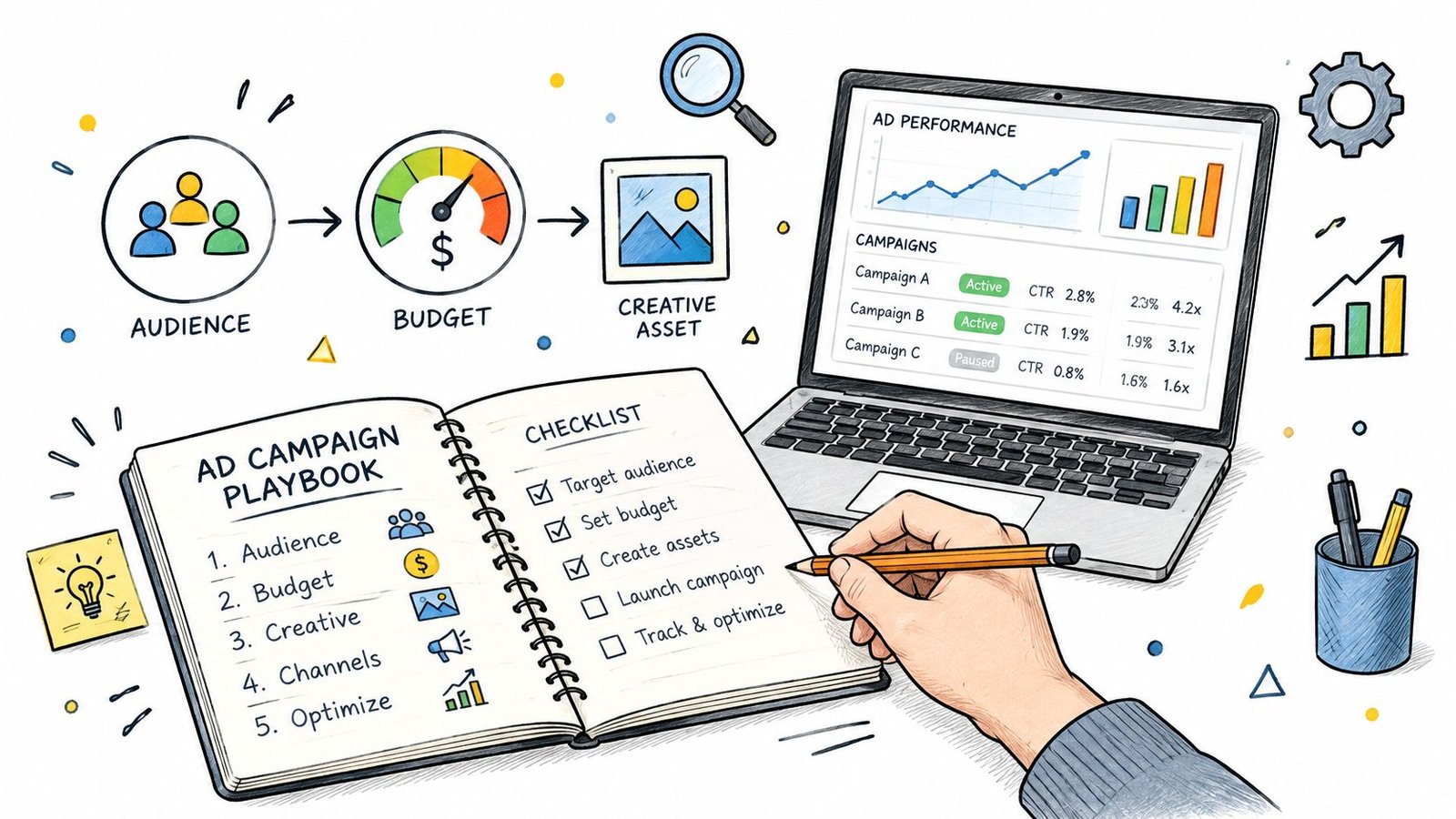
Google Ads Management Playbook for SaaS Founders
You've probably had this moment already.
You launched Google Ads for your SaaS, watched a few signups roll in, felt good for three days, then opened the account a week later and realized spend kept climbing while lead quality got weird. Search terms looked broader than expected. Performance Max claimed conversions you couldn't fully explain. Branded traffic started mixing with non-brand traffic. Your demo calendar wasn't fuller, but the platform still kept suggesting “improvements.”
That's where Google Ads management gets messy for SaaS founders. The old playbook said tighter keywords, more bid tweaks, and more manual control would solve it. That's not the environment you're operating in now.
Google Ads has 25 years of history, and in 2026 benchmarks the platform still shows highly measurable performance across industries, including an average click-through rate of 6.64%, average conversion rate of 8.18%, average cost per lead of $66.69, and average cost per click of $5.42 according to Google Ads benchmarks for 2026. Those numbers don't mean your SaaS account will hit the average. They do show why management matters so much. When clicks are expensive and conversion systems are measurable, small account mistakes get expensive fast.
For founders, the shift is this. Good Google Ads management isn't mostly about fiddling with keywords anymore. It's about building a reliable input system. Account structure. First-party data. Conversion definitions. Negative keyword guardrails. Landing pages that match intent. Clean reporting that helps you trust what the machine is doing.
Paid search also shouldn't be your only visibility layer. For early-stage SaaS and AI startups, durable discovery still comes from places outside the ad account too, including reviews, software marketplaces, startup directories, backlinks, and brand mentions that support startup SEO, LLM SEO, and ChatGPT visibility. Paid traffic can create demand now. A broader footprint helps buyers find and trust you later.
Why Google Ads Management Feels Harder for SaaS Now
A lot of SaaS founders think they have a traffic problem. Most of the time they have a systems problem.
A common pattern looks like this. The founder starts with branded search and a few obvious non-brand terms tied to demo intent. Early performance looks decent because the easiest demand gets captured first. Then the account expands into broader match types, a few automated recommendations get accepted, Performance Max enters the mix, and reporting gets harder to interpret.
Now the team can't answer simple questions with confidence.
Which campaigns are creating pipeline? Which are just harvesting existing demand? Are broader terms feeding good-fit accounts or cheap free-trial users who churn? Is Google finding useful adjacent demand or drifting into noise?
That confusion is why Google Ads management feels heavier now than it did a few years ago.
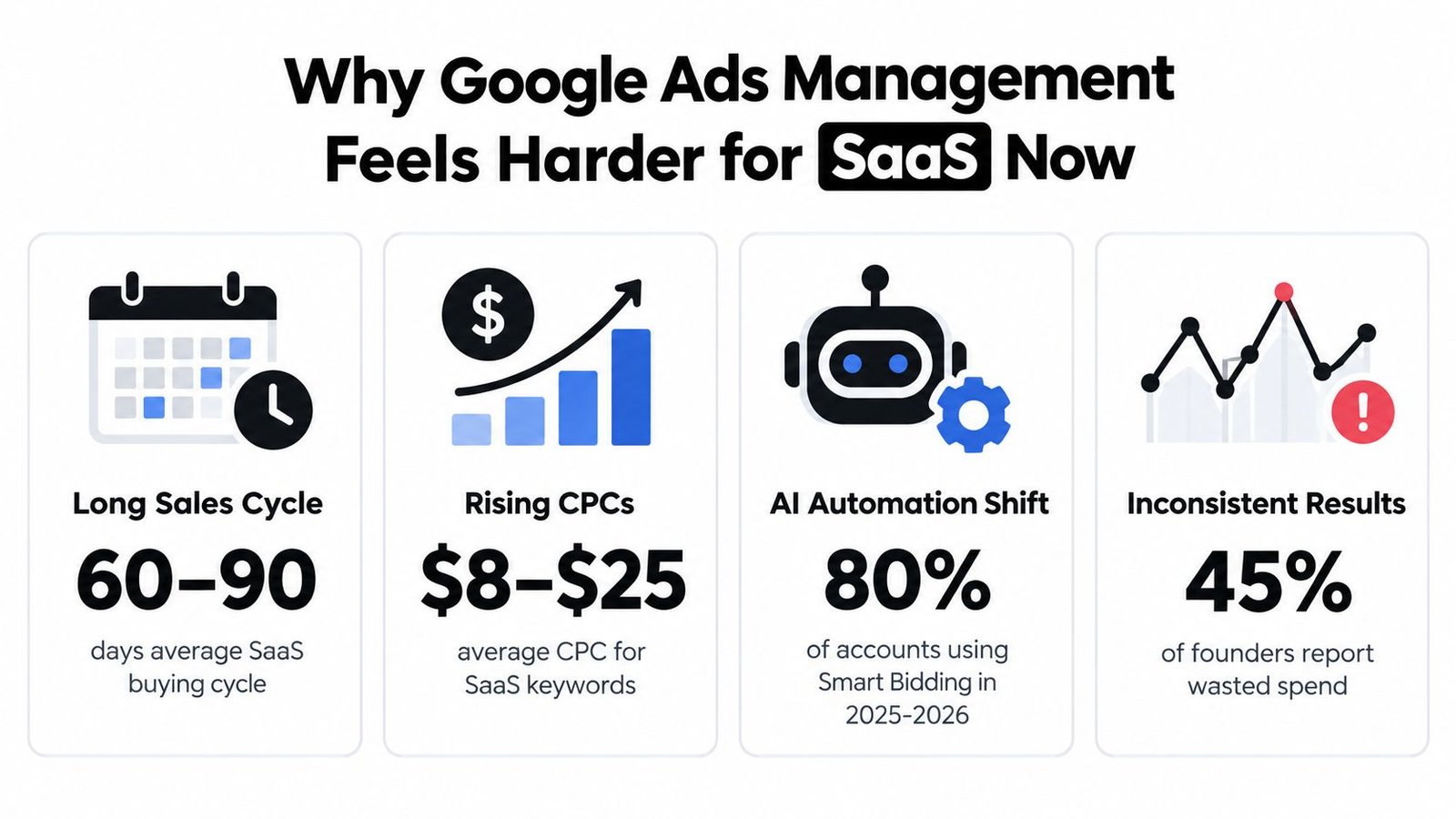
SaaS adds friction that ecommerce doesn't have
Most SaaS purchases don't happen in one session. Even product-led companies with self-serve plans still deal with comparison behavior, internal buy-in, pricing objections, and handoff between user interest and revenue.
That makes management harder because the first conversion often isn't the business outcome you care about. A free trial, booked demo, or “contact sales” form fill can be useful. It can also be a low-quality signal if your targeting and qualification are loose.
I've seen accounts look efficient at the platform level while sales teams dislike the lead flow. The ads weren't broken. The management model was. The account was optimized for what was easy to count, not what helped the business.
Practical rule: If your CRM and ad account tell different stories, trust the one tied to closed revenue and then fix the ad inputs.
AI changed the job
Google's recent direction makes that even more obvious. Coverage of 2025 to 2026 platform changes shows expanded controls like up to 10,000 campaign-level negative keywords, 50 search themes per asset group, retention goals, and the migration of Dynamic Search Ads into AI Max for Search, alongside retirement signals for older workflows and formats, as noted in reporting on Google's evolving ad controls.
That matters because management has shifted from “pick the right keyword and bid” to “decide which signals and guardrails the machine can use safely.”
In practice, that means:
- Structure matters more: You need campaign boundaries that separate intent, product line, and geography cleanly enough for reporting and budget control.
- Negative keywords matter differently: They're no longer just cleanup. They're one of the few durable ways to shape traffic quality when automation expands reach.
- Landing pages matter more than founders expect: If the machine broadens query matching, your page quality and message match become a control surface.
- Audience data is no longer optional: First-party lists, lifecycle stages, and post-signup behavior affect how useful automation becomes.
Old optimization habits break under automation
Manual keyword sculpting still has a role, especially in high-intent search. But the founder who checks bids every morning and pauses random keywords every afternoon usually makes the account less stable, not more profitable.
What works better is disciplined restraint.
You define conversion goals carefully. You organize campaigns around real business choices. You protect search intent with negatives. You give the system enough room to learn inside those boundaries. Then you review outputs with skepticism.
That's a different job than classic PPC babysitting.
It also changes how paid search fits into a wider startup marketing stack. Google Ads captures active demand. It doesn't replace the slow compounding value of authoritative brand profiles, software listings, and backlinks that support search and AI discovery. For founders building both paid and organic visibility, a directory submission service for startup discovery can complement ads by strengthening the branded footprint people and AI systems find after the click.
What disciplined management actually controls
Strong SaaS accounts usually get boring in the right places. Naming is consistent. Conversions are mapped to funnel stages. Search and PMax don't cannibalize each other blindly. Landing pages line up with what the ad promised. Reporting doesn't depend on vibes.
That doesn't sound glamorous. It's what keeps you from burning budget.
Planning Your Account Structure and Audience Strategy
Most SaaS accounts fail before the first click because the structure is wrong.
Founders often build campaigns around whatever was easiest to launch. A brand campaign. A competitor campaign. A few generic keywords. Maybe a Performance Max campaign because Google suggested it. That setup can run, but it usually creates overlap, weak reporting, and bad budget decisions.
A cleaner account starts with one question. What different kinds of intent are you buying?
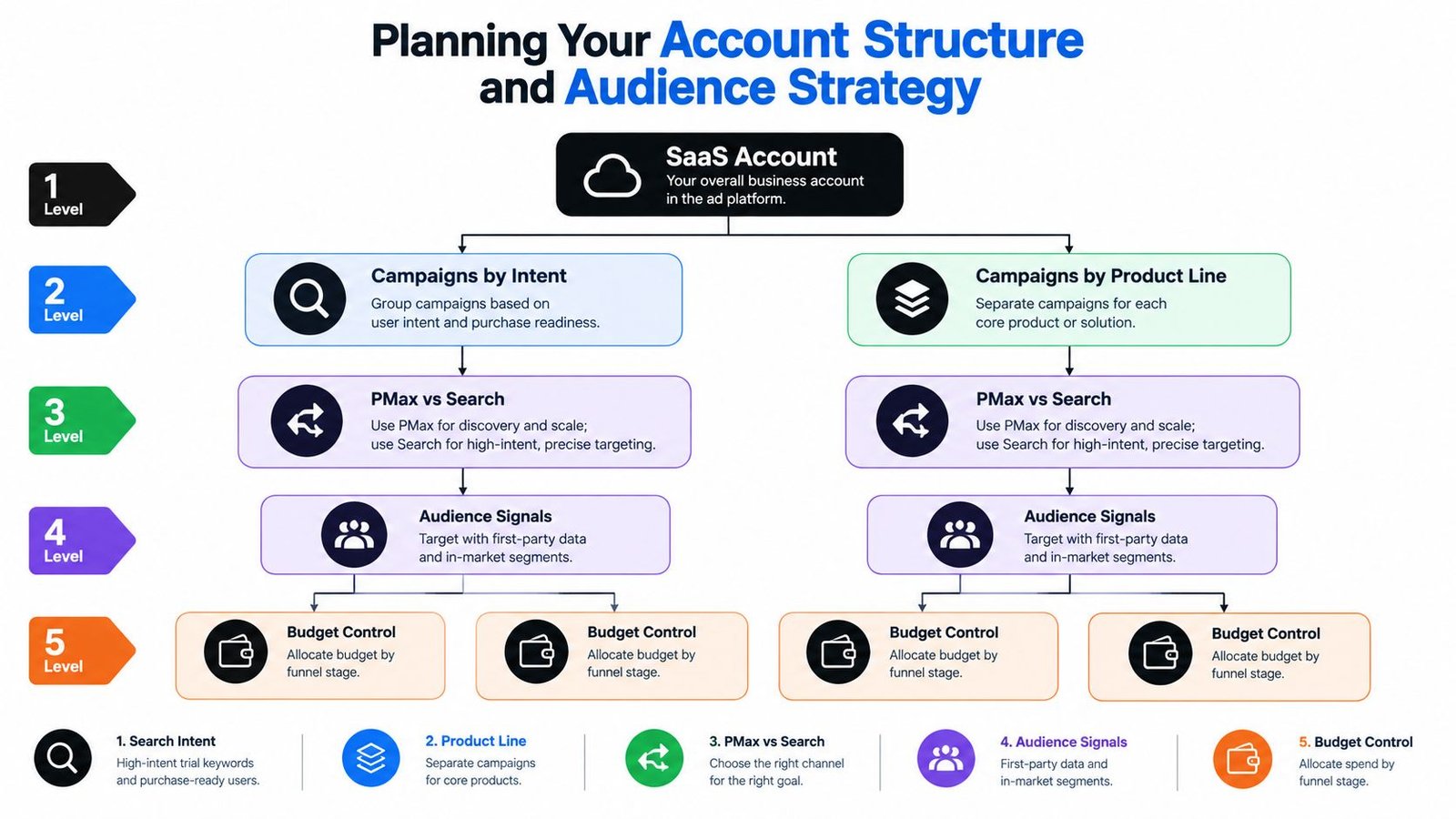
Split by intent first, then by product
For SaaS, I like simple separation at the campaign level.
A practical account often starts with these buckets:
| Campaign type | What it targets | Why it deserves separation |
|---|---|---|
| Brand search | Searches for your company or product name | Protects branded demand and keeps reporting clean |
| High-intent non-brand search | Terms tied to demos, software category, or clear commercial intent | Usually your core acquisition layer |
| Competitor search | Searches for alternatives and competitor names | Different economics, different messaging |
| Retargeting or audience-led campaigns | Returning visitors, product viewers, trial starters | Useful when first-party data is strong |
| Performance Max or broader AI inventory | Expansion and cross-network automation | Needs isolation so you can judge incrementality honestly |
If you sell more than one product, split by product line only when each line has distinct value props, keywords, or landing pages. If two products share buyer intent and page flow, over-segmentation usually hurts more than it helps.
The point isn't neatness. It's control.
Don't let Search and PMax compete blindly
Search and Performance Max can work together, but only if you know why each exists.
Search is still the clearest fit for direct intent. Use it when the user's query tells you what they want and you have a matching page. PMax is more useful when you've already built conversion tracking, audience signals, and enough creative inputs to help the system find adjacent demand.
Founders get into trouble when they treat PMax like a shortcut. It's not. It's a multiplier for good inputs and a budget leak when inputs are weak.
A simple decision rule:
- Use Search first when you need clarity on which intent themes convert.
- Use PMax later when your CRM feedback loop is stable and you can evaluate lead quality, not just platform conversions.
- Use broader audience-led inventory carefully when the goal is to support mid-funnel demand, not just harvest bottom-funnel searches.
Audience strategy should map to lifecycle, not just demographics
Demographic targeting alone is usually too blunt for SaaS.
Better audience inputs come from actual buyer behavior and first-party data. Think in stages:
- Cold category buyers searching for a solution class
- Problem-aware visitors who read use-case or comparison pages
- High-intent evaluators who visited pricing, demo, or implementation pages
- Active trials or leads who haven't converted to revenue yet
- Customers for upsell, retention, or exclusion
That audience map matters because platform automation is increasingly tied to your data quality. Coverage in the paid media space has highlighted deeper integration of Data Manager, Data Strength, customer lists, and broader automation across bidding and targeting, which reinforces that measurement, audience data, and creative can't be managed as separate projects anymore, as discussed across Search Engine Journal's paid media coverage.
The strongest SaaS accounts don't treat audience building as a remarketing side task. They treat it as account infrastructure.
Search themes and negative keywords need a real system
Google has expanded the amount of control available in some AI-driven campaign types, but that doesn't remove the need for discipline. It raises the bar for how you use the controls.
A practical setup looks like this:
- Keep keyword themes tight in Search: Group terms by intent and landing page match, not by minor wording differences.
- Use search themes strategically in AI-led campaigns: Add themes that reflect use cases, category language, and commercial language your best buyers use.
- Build shared negatives for junk traffic: Careers, support, definitions, student traffic, open-source intent if you sell paid software, and unrelated niches.
- Add campaign-specific negatives to prevent cannibalization: Especially between brand, competitor, and generic campaigns.
One mistake I see a lot is founders splitting campaigns too aggressively to “stay organized.” That usually leaves each campaign with weak learning signals and tiny budgets. If your account is young, consolidate until the campaign has a clear purpose and enough data to justify its own budget line.
A lean structure most SaaS teams can actually manage
If you're running this in-house without a large performance team, keep the first version lean.
- One brand campaign
- One high-intent non-brand campaign per product or major market
- One competitor campaign if your positioning is sharp
- One controlled automation campaign only after tracking is trustworthy
- One retargeting layer tied to pricing, demo, or trial behavior
That structure is easier to audit, easier to report on, and easier to brief to an agency later if you hand it off.
For founders also building durable startup SEO, software directory profiles can help sharpen messaging around categories, use cases, and alternatives. Reviewing strong listings in well-known startup directories is also a useful exercise for understanding how your product should be framed outside paid channels.
Bidding Budgets and Quality Controls That Protect Profit
You can survive a weak ad for a while. You usually can't survive weak bidding logic for long.
Many SaaS teams lose the plot by treating Google Ads as a lead faucet and forgetting that every bidding strategy makes assumptions about what a conversion means, how much volatility the business can tolerate, and how much trust you can place in your data.
If your data is shaky, smart bidding gets confidently wrong.
Pick bidding based on signal quality, not platform pressure
For most SaaS accounts, the choice isn't “manual vs automated” in the abstract. It's whether your current conversion setup gives automation enough truth to optimize toward.
Here's a founder-friendly decision matrix.
| Goal and Data Stage | Recommended Bidding | Budget Guardrail | When to Switch |
|---|---|---|---|
| New account, limited trustworthy conversion data | Maximize Conversions only if the primary conversion is meaningful. Otherwise stay conservative and validate traffic first. | Keep budgets at a level you can monitor closely and afford to learn from. | Switch when lead quality is consistent enough to set stronger efficiency targets. |
| Demo-driven campaign with stable qualified lead definitions | tCPA can work when the same conversion event reliably reflects pipeline value. | Don't set targets tighter than the business can support. Aggressive targets often choke volume. | Switch when offline feedback shows the campaign is producing enough quality, not just enough form fills. |
| Revenue-linked SaaS with imported value signals | tROAS is strongest when conversion values actually reflect revenue or pipeline quality. | Protect against overspending on low-value signups by validating value rules in the CRM. | Switch when value tracking is accurate enough that the algorithm isn't optimizing to vanity events. |
| Scaling a stable search campaign | Maximize Conversions can still be useful if you want volume and can absorb some CPA variance. | Watch spend pacing and search term drift closely. | Switch to tighter efficiency controls when quality starts softening or budget rises faster than business confidence. |
This is less about platform mechanics and more about business tolerance.
A founder-backed startup with a long payback window may allow more exploration if lead quality is strong. A bootstrapped SaaS selling a lower-priced product usually needs stricter quality thresholds because bad leads create support load and false optimism.
Budgeting for learning without donating money to Google
Budgets need enough room for campaigns to exit the constant restart cycle. But “give it room to learn” gets abused all the time.
Learning doesn't mean the campaign deserves infinite patience. It means you need a stable setup long enough to judge whether the core hypothesis is right.
Use a simple operating rule:
- Increase budgets when quality holds and impression opportunity is constrained
- Hold budgets when the campaign is still sorting itself out but core lead quality is acceptable
- Cut or reset budgets when spend rises faster than qualified outcomes
The worst budget behavior is emotional budget movement. Founders see one bad day and slash spend, then one good day and scale too fast. That volatility makes automated systems worse.
Ad Rank still decides whether your ad gets the good clicks
A lot of teams talk about bids as if bids alone decide outcomes. They don't.
Google says Ad Rank is determined by multiple factors including bid amount, ad and landing page quality, Ad Rank thresholds, auction competitiveness, search context such as device and location, other ads and results on the page, and the expected impact of assets and formats, according to Google's Ad Rank documentation.
That matters for SaaS because expensive categories punish weak relevance. If your landing page is vague, your assets are generic, or your ad doesn't align with the query, you can end up paying for weaker positions or missing auctions you thought you were bidding for.
Watch this closely: Founders often blame high CPCs when the real problem is poor auction fitness. Better relevance often protects profit better than another round of bid increases.
Quality Score isn't the KPI, but it points to real friction
I don't optimize for Quality Score as a vanity metric. I use it as a forensic clue.
Google says landing page experience is one of the factors used to determine a keyword's Quality Score, and it looks at usefulness and relevance of page content, ease of navigation, number of links on the page, and whether the page matches the user's expectations from the ad, based on Google's explanation of landing page experience.
For SaaS teams, that usually translates into familiar problems:
- Homepage dumping: Sending all paid traffic to the homepage because it's easier than building use-case pages.
- Message mismatch: The ad promises “CRM for agencies” and the page opens with broad product positioning for everyone.
- Navigation overload: Visitors get ten exit paths before they understand the offer.
- Weak proof: No product visuals, no implementation context, no reason to trust the claim.
Quality controls are profit controls because they shape both click cost and conversion efficiency.
What to intervene on and what to leave alone
Good managers don't touch every lever every day.
Intervene when:
- Search intent is drifting
- Branded and non-branded demand are mixing
- Lead quality from a campaign turns
- Landing page relevance is obviously weak
- Budget pacing breaks the economics of the funnel
Leave things alone when you're reacting to noise, not pattern.
A lot of bad Google Ads management comes from confusing activity with control.
For SaaS teams also investing in brand discovery outside paid media, SaaS directory submission support can help strengthen trust and category presence while paid search handles active demand capture.
How PPC Geeks Can Help
There's a point where in-house management stops being lean and starts becoming expensive founder distraction.
That usually happens when your team knows enough to launch campaigns, but not enough to build reliable tracking, creative testing, budget governance, and reporting discipline across multiple campaign types. It also happens when no one has time to audit the account properly, so the setup stays "good enough" while waste accumulates in the background.
PPC Geeks is useful in exactly that gap. Their Google Ads management offering is built around specialist PPC delivery rather than generalist digital marketing. That matters if your issue isn't “we need someone to run ads,” but “we need a team that can audit structure, tighten tracking, reduce waste, and own ongoing optimization without constant founder intervention.”
A few situations where they make sense:
- You've inherited a messy account: Campaign overlap, weak conversion tracking, inconsistent reporting, and unclear ownership.
- Your in-house marketer is stretched: They can manage channels broadly but can't give paid search the depth it needs.
- You need stronger operational rigor: Free audits, onboarding, reporting, remarketing, feed work, and landing page support are often more useful than just bid management.
- You sell into SMEs or ecommerce-adjacent segments in the UK: Their positioning is strongest for businesses that want a specialist UK team and responsive support.
What stands out is less the “award-winning” label and more the operating model. A specialist agency can be the right move when your bottleneck is execution quality, especially if you need clean tracking, regular strategic review, and someone to challenge platform defaults.
The wrong time to hire any agency is when you still haven't decided what a good lead is. Fix that first.
Creative and Landing Pages That Convert Trial Intent
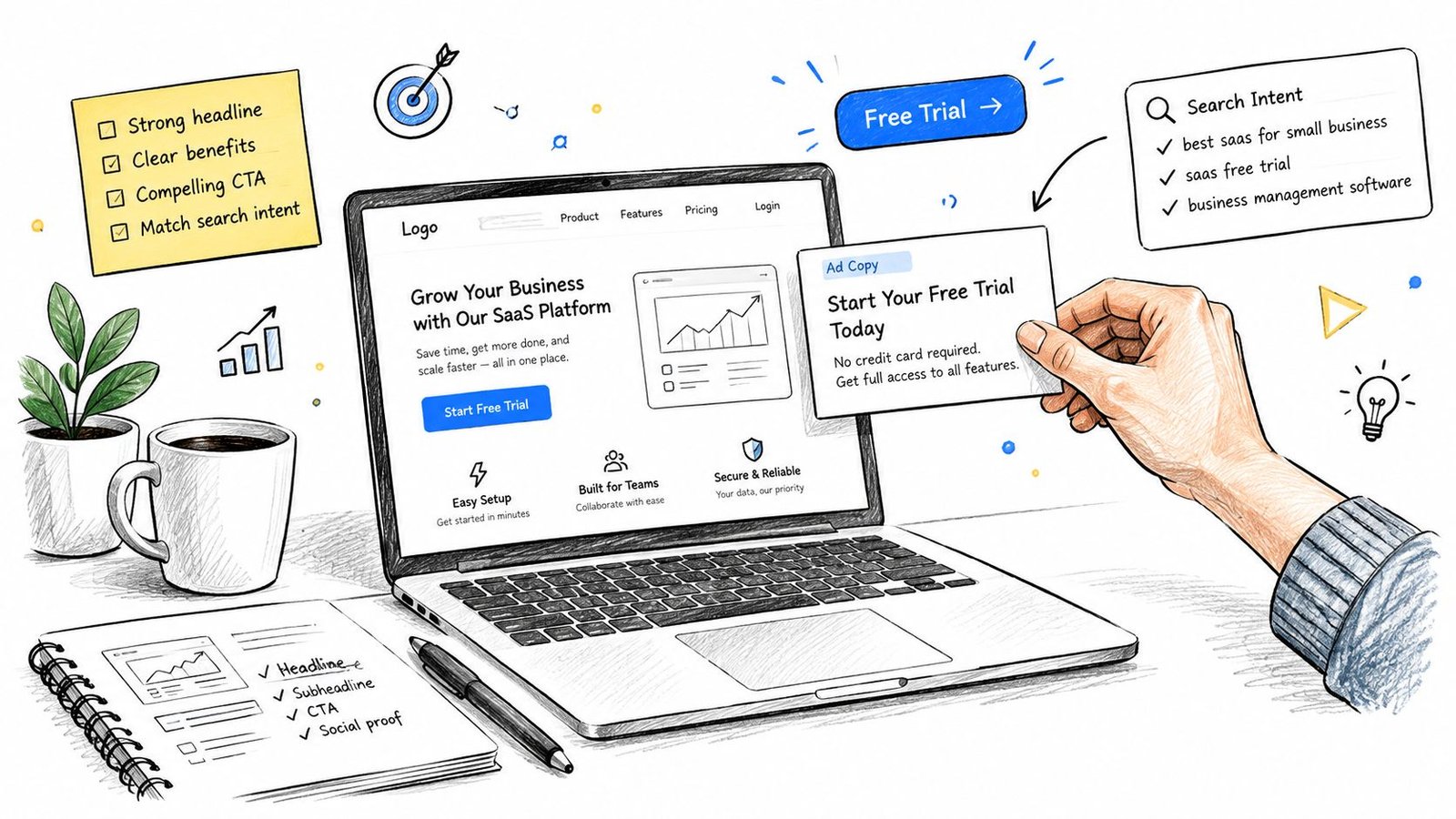
Most SaaS ad accounts don't have a bidding problem first. They have a relevance problem.
Clicks get expensive when your ads sound interchangeable and your landing pages make users work too hard. Teams waste money by trying to outbid weak messaging instead of fixing the experience after the click.
Match the ad to the buyer's job
SaaS buyers usually search with a task in mind, not admiration for your brand.
Someone searching “project management software for agencies” isn't asking for your abstract company story. They want confirmation that your product fits their operating reality. Your ad should answer that quickly.
Good ad direction often follows this pattern:
- Category fit: Name the software category clearly.
- Specific use case: Show who it's for or what workflow it solves.
- Proof signal: Mention migration help, integrations, reporting, security, or another trust point that matters to the buyer.
- Focused CTA: Demo, trial, book a walkthrough, compare plans. Pick one primary action.
Weak ads usually try to sound broad enough for everyone. Strong ads sound useful to the person making the search.
Assets matter because expected impact matters
Assets aren't decorative. Google includes the expected impact of assets and other formats in Ad Rank considerations, as covered earlier in the platform's auction guidance.
For SaaS, useful assets often include:
| Asset type | Best use | Common mistake |
|---|---|---|
| Sitelinks | Direct users to pricing, demo, integrations, or comparison pages | Sending everyone to generic top-level pages |
| Callouts | Reinforce implementation speed, support, or no-contract value props | Repeating vague slogans |
| Structured snippets | Highlight features, integrations, or product modules | Listing things buyers don't care about at search stage |
| Image and richer formats where relevant | Support recognition and product clarity in broader inventory | Using brand visuals with no product context |
If your account is shifting into more automated inventory, asset quality matters even more because the system has more freedom to mix and match what you provide.
Landing pages should remove doubt fast
Google's guidance on landing page experience is useful here because it maps closely to what good SaaS pages already should do. Relevance. Ease of navigation. Expectation match. Useful content.
What that looks like in practice:
- Comparison pages for competitor or alternative intent
- Use-case pages for role or industry-specific searches
- Interactive demo pages for users who need product confidence before booking time
- Pricing pages for high-intent traffic, but only if the pricing model is understandable
- Short-form demo pages when the query signals urgency and the sales process requires qualification
A lot of founders send all traffic to one polished homepage and call it “brand consistency.” That's not consistency. It's friction.
If the query is specific and the page is general, your conversion rate usually pays for the mismatch.
A lightweight QA loop that catches expensive mistakes
Before you push more budget, run a simple quality check.
Message match
- Does the main headline reflect the search intent behind the ad group?
- Does the CTA match what the ad promised?
Page clarity
- Can a first-time visitor tell what the product does in a few seconds?
- Are core benefits visible without hunting through the page?
Friction control
- Is the form length justified?
- Are there too many navigation exits for bottom-funnel traffic?
Proof
- Are there screenshots, customer logos, security signals, or implementation details that reduce hesitation?
Audience fit
- Does the page speak to the role searching, such as founder, ops lead, marketer, or finance buyer?
This doesn't require a huge CRO team. It requires honesty.
Founders building startup SEO and AI search visibility often find that the same messaging discipline helps outside paid search too. Category pages, founder profiles, review listings, and startup directory pages all reinforce expectation match. If you're mapping broader visibility opportunities, free startup directories for early-stage distribution can also act as messaging labs for positioning and category framing.
Tracking Attribution and Reporting Cadence for AI Automation
Automation gets blamed for a lot of problems that are really tracking failures.
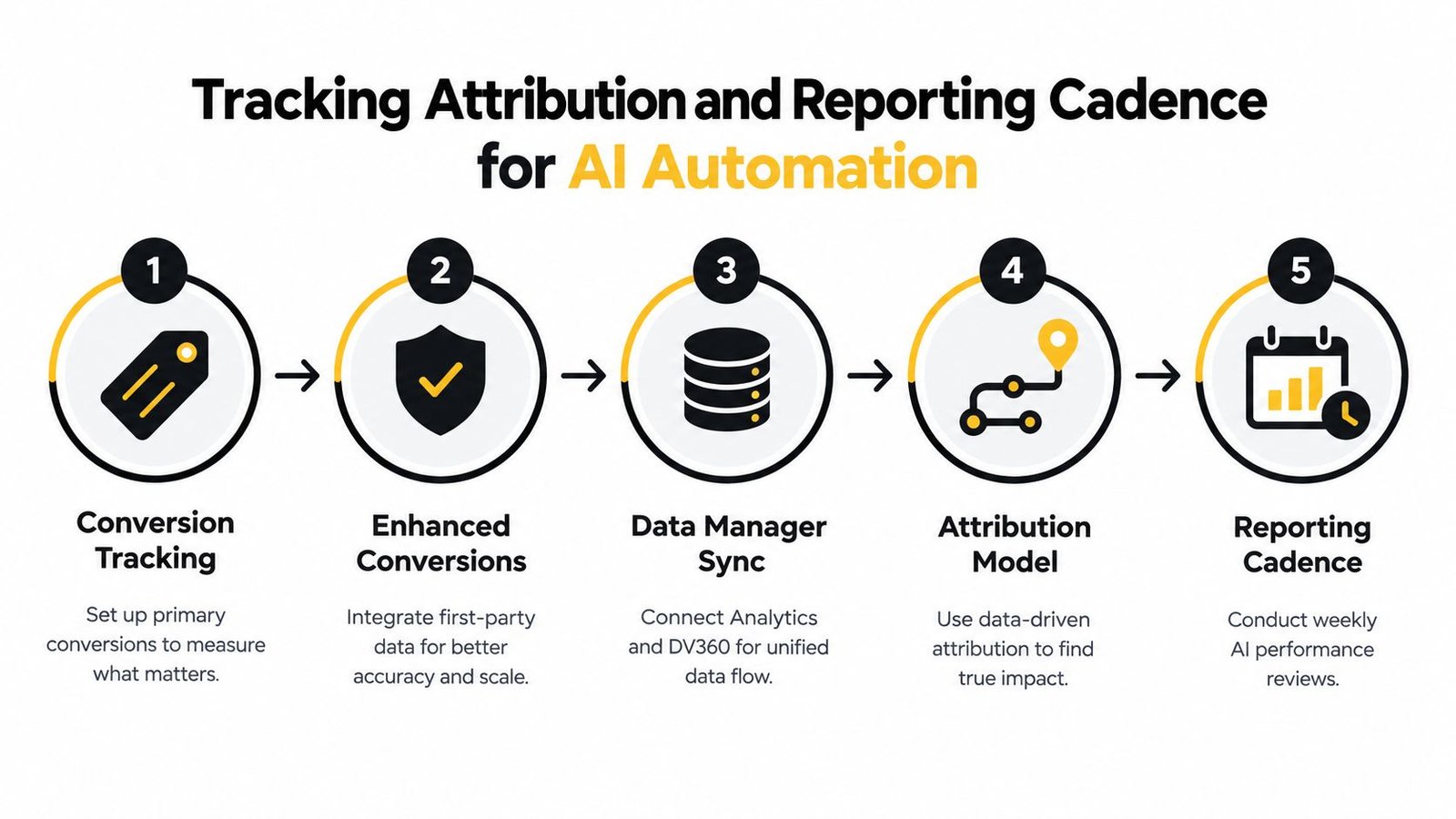
If Google Ads is acting strangely, start by asking whether the account is getting clean enough signals to make decent decisions. In an AI-first setup, conversion tracking isn't back-office plumbing. It's the steering system.
What a trustworthy measurement stack needs
For SaaS, the baseline should include primary conversion tracking for the action that matters most to the business, plus stronger first-party data flows wherever possible.
That usually means:
- Clear primary conversions: Demo booked, qualified trial start, sales call scheduled, or another event with real business value
- Secondary conversions: Newsletter signups, ebook downloads, or softer actions kept separate so they don't distort bidding
- Enhanced conversions and first-party signal use: Especially important as browser-based tracking gets less reliable
- CRM feedback: So the team can compare ad platform conversions with pipeline quality
The key shift is that measurement, audience quality, and automation now interact continuously. If low-quality events become primary optimization signals, the system learns the wrong lesson fast.
Data Manager and audience infrastructure are now part of management
Independent coverage in 2026 has highlighted Google's push to integrate Data Manager more into Google Analytics and DV360, along with broader emphasis on Data Strength and customer lists in automated systems, as discussed earlier in paid media reporting.
For founders, the practical takeaway is simple. You can't treat:
- conversion tracking,
- audience uploads,
- offline sales data,
- and creative automation
as separate workstreams anymore.
They feed each other.
A weak customer list can limit audience quality. Poor offline conversion hygiene can mislead bidding. Generic creative can reduce the usefulness of good intent signals. This is why Google Ads management has become closer to revenue operations than old-school campaign tweaking.
Use optimization score carefully
Optimization score can be helpful if you understand what it is and what it isn't.
Google says optimization score is available at the Customer and Campaign levels and is an estimate of how well an account is set to perform, and the score is not the sum of individual recommendation uplifts because Google calculates it from all available recommendations as a whole, according to the Google Ads API documentation on recommendations.
Google also states the score runs from 0% to 100%, and the recommendations page shows how much each recommendation would change the score if applied, based on Google Ads Help documentation for optimization score.
That means the score is a diagnostic input, not a management objective.
Use it to spot areas worth reviewing. Don't use it as a to-do list that gets accepted blindly. Some recommendations fit your business. Some don't. Founders lose money when they chase score improvements that conflict with actual strategy.
A higher optimization score can make the account look healthier while making the business less healthy.
Reporting cadence that works for founder-led teams
You don't need to live inside the account every day. You do need a rhythm.
A practical cadence looks like this:
| Cadence | Focus | What to check |
|---|---|---|
| Weekly | Operational control | Search query quality, conversion anomalies, budget pacing, obvious landing page issues |
| Monthly | Strategic review | Campaign role, funnel mix, lead quality by source, overlap between channels |
| Quarterly | Structural decisions | Consolidation vs expansion, new markets, new audience inputs, agency or in-house ownership |
The weekly review is where waste gets caught before it becomes a story your CFO asks about.
The monthly review is where founders usually discover whether the account is aligned to the company's actual go-to-market motion. That's also where you decide whether PMax is adding incremental value, whether branded search is masking problems, and whether trial intent pages need stronger qualification.
For AI startups especially, broader visibility matters beyond paid clicks. Buyers often search your brand after hearing about you elsewhere, and AI tools may surface external profiles and directory pages in discovery flows. That's why some teams pair paid acquisition with AI directory submission work to build a more durable footprint across search and LLM-oriented surfaces.
Ongoing Optimization Pitfalls and Your Next Steps
Three months after launch, the account can look busy and healthy. Spend is up. Conversions are coming in. Google keeps suggesting ways to expand. Then a founder asks a simple question, "Which campaigns create qualified pipeline?" and nobody has a clean answer.
That slide happens slowly. Teams approve recommendations they did not pressure-test. Campaigns get split for reporting convenience. Automation keeps spending because the conversion inputs are loose. In SaaS, weak control points are expensive because the platform learns from whatever you feed it.
The accounts that hold up over time usually share the same trait. They are managed like systems, not collections of keyword tweaks.
Pitfalls that quietly break SaaS accounts
Over-segmentation is still one of the fastest ways to stall learning.
I see this in founder-led accounts all the time. Separate campaigns by match type, feature, persona, funnel stage, and region, all on modest budgets. It looks tidy in a screenshot, but each campaign gets too little signal to bid well. If a segment does not need its own budget, landing page, geo rule, or conversion target, combine it.
Another common failure point is loose conversion governance. If trial starts, pricing page visits, demo requests, and low-intent content actions all sit too close together in the account, Smart Bidding will chase volume where it is easiest to find. That usually means lower quality leads dressed up as efficiency. AI-first management starts with a strict conversion map and CRM feedback, not more keyword sculpting.
Optimization score creates a different kind of distraction. Teams start cleaning up recommendations because the interface rewards motion. Add broad match here. Raise budgets there. Turn on another automated layer. Some of those changes help. Some push the account further away from profit. The score is a product prompt, not a business KPI.
Landing pages also drift. A campaign that matched buyer intent six weeks ago can start underperforming after product positioning changes, pricing shifts, or a homepage redesign that adds friction. Paid search traffic is less forgiving than other channels. If the ad promises a clear next step and the page delivers a vague product tour, conversion rate drops fast.
Keep it in-house or hand it off?
Keep management in-house when one person can still see the full loop from query to revenue.
That means clear conversion definitions, regular query review, access to CRM outcomes, and enough authority to reject bad expansion ideas. This setup works well for a focused SaaS offer, a contained budget, and a founder or marketer who treats Google Ads as an operating system that needs rules.
Bring in an agency when the account has outgrown that visibility. Common signs include multiple products, different sales motions, expansion into new geographies, unresolved tracking disputes, or a landing page backlog that keeps slowing paid performance.
A good handoff is concrete. Give the new team your conversion hierarchy, CRM stage definitions, exclusion rules, approved claims, and a short list of lessons from campaigns that failed. Agencies do better work when they inherit guardrails, not just admin access.
| Handoff item | Why it matters |
|---|---|
| Conversion hierarchy | Keeps bidding focused on meaningful actions |
| CRM stage definitions | Connects ad platform reporting to pipeline quality |
| Product and ICP notes | Sharpens ad messaging and intent filtering |
| Exclusion rules | Prevents waste in branded, support, job seeker, and irrelevant traffic |
| Previous test notes | Reduces repeated mistakes and shortens ramp time |
A founder-friendly operating rhythm
The goal is not constant activity. The goal is controlled learning.
For weekly reviews, use four questions instead of a long checklist. Which search terms should never have triggered your ads? Which conversions looked good in Google Ads but weak in the CRM? Which campaigns are spending outside their intended role? Which pages are getting clicks without persuading visitors to start a trial or book a demo?
Once a month, review structure and inputs. Ask whether campaign splits still reflect real budget or messaging needs. Check whether first-party audience signals are improving lead quality. Review any automated campaign type with extra skepticism, especially if reporting looks strong but sales feedback is flat. SaaS teams either keep the system tight or let convenience drive decisions.
Write these rules down. Founders who document conversion priorities, budget limits, exclusions, naming logic, and approval rules usually waste less money than teams relying on memory.
FAQ
Is Google Ads still worth it for SaaS founders?
Yes, if the account is built around real buying intent, clean conversion definitions, and pages that match the query. It gets expensive fast when it runs as a set-and-forget channel or optimizes toward soft signals.
Should SaaS companies use Performance Max?
Sometimes. It tends to work better after Search structure, tracking, audience inputs, and exclusions are in good shape. If those inputs are weak, PMax can hide waste behind blended reporting.
What matters more now, keywords or first-party data?
For many SaaS accounts, first-party data and conversion quality matter more than constant keyword micromanagement. Keywords still shape intent. They are no longer the main control layer in an AI-driven account.
How often should founders check the account?
Weekly is enough for operational review in a stable account. Daily changes usually create noise, especially when the budget is not large enough to support constant intervention.
What should you do in the next 7 days?
Start with the controls that improve signal quality.
Audit your conversion map and separate revenue-linked actions from softer engagement events. Consolidate campaigns that do not need distinct budgets or landing pages. Review search terms and add negatives before increasing spend. Check your trial or demo pages for message match, CTA clarity, and unnecessary friction. Then document the rules for budgets, exclusions, and goal changes so whoever manages the account next month does not have to guess.
If you want to complement paid search with a stronger off-site presence, StartupSubmit can help by manually submitting your SaaS or AI product to relevant startup and software directories. That supports backlinks, branded search coverage, and broader discovery across traditional search and AI-driven surfaces. A practical next step is to tighten your ad account first, then evaluate whether StartupSubmit fits your visibility stack alongside Google Ads.