

Monthly SEO Services: What They Cost and What to Expect
Monthly SEO pricing spreads wide, and the range on its own tells you very little. A retainer earns its keep only when the proposal lists real work, the first 90 days are measured without ranking promises, and you can vet the provider before money leaves the account.
Three proposals sit in your inbox this week. One promises page one by month two. Another sends a keyword spreadsheet and a PDF. A third wants a year prepaid. I would not sign any of them on the headline price. The useful version of monthly SEO services is an evidence system: you fund work that can compound, you check whether it creates qualified demand, and you leave when the report is a screenshot of positions. That standard matters more now that AI Overviews absorb a growing share of clicks before they reach your pages, so position tracking alone cannot prove the demand is real.
The pages below give you a deliverables table to mark up against any proposal, a 2026 pricing read, a 90-day picture of what can move, and a vetting checklist. The order most pitches get backwards comes first. Build the directory and citation foundation, then decide whether a retainer is the right next buy.
Table of Contents
- What Monthly SEO Services Include
- What Monthly SEO Costs in 2026
- Results to Expect in the First Three Months
- When Directory Submissions Complement Monthly SEO
- How to Evaluate a Monthly SEO Provider
- How to Sequence Your First 90 Days
- Questions Founders Ask About Monthly SEO
What Monthly SEO Services Include
Monthly SEO services are a recurring engagement. A provider keeps improving search visibility through strategy, execution, and reporting. A one-time project is a different product. An audit, a site migration, or a directory campaign has a finish line. A retainer does not, because rivals, product pages, and search demand keep changing.
Treat the table as a proposal checklist. If a row is blank, ask why before you compare invoices.
| Workstream | Typical monthly tasks | Why it recurs | Red flag |
|---|---|---|---|
| Technical SEO | Core Web Vitals checks, crawl and index fixes, HTTPS and mobile rendering, sitemap upkeep | Ship cycles constantly break pages and redirects | Lab scores only, no field data per page |
| Content and on-page SEO | New intent-matched pages, refreshes, internal linking, title and schema updates | Demand, competitors and products change monthly | Word-count quotas with no search-intent work |
| Research and strategy | Keyword and competitor tracking, roadmap updates, opportunity sizing | Rankings, rivals and search demand move constantly | A static keyword list copied from the sales call |
| Links and authority | Digital PR, guest posts, resource outreach, profile upkeep | Authority decays and competitors publish | Fixed bulk link counts from a link network |
| Profiles and citations | Startup and software directory listings, review profiles, brand consistency across listings | Profiles change, break, duplicate or lose moderation | Submissions to spammy bookmark networks |
| Reporting and iteration | Clicks, conversions, referring domains, index health, AI visibility, next-cycle plan | Budgets need evidence and reprioritization | Keyword-position-only screenshots |
How the mix shifts by stage
A pre-launch SaaS site should buy the foundation rows first: technical cleanup, profiles and citations, and tracking that fires. A product that already converts should shift spend toward content, digital PR, and pages that turn a visit into a trial. Proposals differ less by category name than by execution depth. One provider's content line is two short posts. Another's is a researched comparison page with graphics and links into pricing and docs.
Say the quote is $1,500. With a senior consultant, that budget often buys a handful of strategy hours while you implement. At an agency, the same number more often buys hands on the site and thinner senior judgment, plus an account manager. Neither shape is automatically better. The waste is paying for execution your team can ship, or paying for a roadmap nobody has time to build.
Practical rule: Mark every row the proposal covers, write the name of the person who does the work, and weight the checklist toward the stage you are actually in.
For a plain-language look at what small-business retainers tend to bundle, the Data Hunters Agency note on SEO retainer costs for small businesses is worth reading before you negotiate scope. If the profile layer is still empty, get your startup listed in directories before you fund a content engine.
What Monthly SEO Costs in 2026
There is no standard price for this work. There is a real market, and it clusters harder than sales calls admit.
In a survey of 439 SEO providers published by Ahrefs in December 2023, 78.2% offered monthly retainers, against 48.9% offering fixed-price projects and 34.8% offering hourly billing. The most common monthly band was $501–$1,000, chosen by 20.4% of respondents. 42.8% charged between $501 and $2,000, and 68.8% charged $2,000 or less. Provider type moved the average: agencies averaged $3,209 a month, independent consultants $3,250, and freelancers about $1,349.
Scope moves the number further. As Entrepreneur's cost breakdown reports from that same survey, local SEO averaged about $1,557 a month, while national or global work averaged about $3,474. That gap is roughly $1,917, or about 123% more than the local average.
| Benchmark | Figure | How to read it |
|---|---|---|
| Providers offering monthly retainers | 78.2% | Dominant model, ahead of fixed-price (48.9%) and hourly (34.8%) |
| Most common monthly band | $501–$1,000 | Chosen by 20.4% of providers |
| Providers charging $501–$2,000 | 42.8% | Practical middle of the market |
| Providers charging $2,000 or less | 68.8% | Most quotes should sit below this line |
| Local SEO average | about $1,557 per month | Map, location page and citation-led scope |
| National or global average | about $3,474 per month | About 123% more than local; larger keyword sets and rivals |
| Agency average | $3,209 per month | Strategy, content, links, analytics and implementation |
| Independent consultant average | $3,250 per month | Senior judgment with limited execution hours |
| Freelancer average | $1,349 per month | Lower cost, narrower bandwidth |
What actually pushes a quote up or down
Five drivers explain almost every gap between two proposals.
- Market scope: A local campaign can live on map visibility, location pages, citations, and reviews. A global SaaS category needs a larger keyword set, stronger rivals, regional pages, and more measurement.
- Who is on the account: Agencies staff strategists, writers, and engineers. Consultants sell senior judgment and fewer execution hours. Freelancers cost less and cap output.
- Category competitiveness: A niche dev tool and a crowded AI writing category do not share a content load, even at the same company stage.
- Production inside the fee: Writing, design, digital PR, and outreach either sit in the retainer or show up later as extras.
- Who implements: A recommendation email is cheaper than a team that ships the fix in your CMS.
How a founder should read the bands
A $500–$1,000 retainer usually buys limited or junior capacity: light technical checks, a couple of pages, and a report. Around $2,000, you are in the band where most of the surveyed market sits. A seed-stage product selling worldwide should expect quotes above the local benchmark, because the work is national or global in scope. A quote far under $500 is, in my view, templated reporting with almost no implementation.
Write the market, the page set, and the implementation duties into the agreement. Then price each row from the checklist, not the promise of "SEO." A global-scale retainer is wasted money when the site still needs a technical cleanup and a clean profile layer.
Results to Expect in the First Three Months
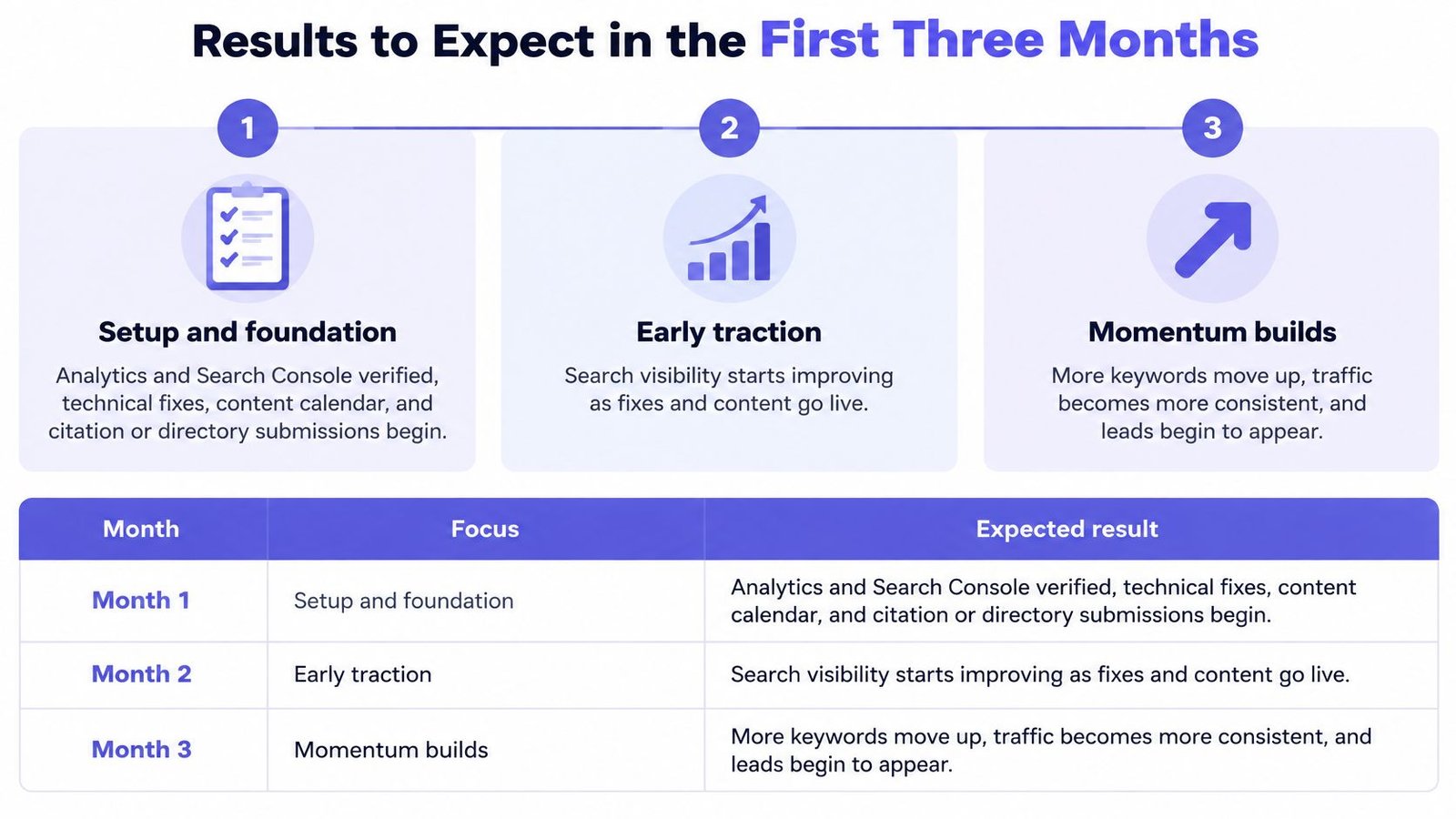
The first quarter builds instrumentation. The site gets measurable, links and profiles get indexed, and non-brand demand starts to show up in small, checkable ways. Anyone promising position-one dates in this window is selling a different product.
Month by month
Month 1 is setup. Analytics and Search Console get verified, crawl and index errors get fixed, and a content calendar exists on paper. Citation and directory submissions start. The first number that should move is referring domains. If the report celebrates a keyword jumping two spots while the referring-domain count stays flat, the work has barely begun.
Month 2 is indexation. Profiles and links begin to register, and early authority metrics like Domain Rating may start to improve as Google indexes them. There is no fixed pace to expect; new domains move on their own schedule, and any provider quoting you a precise DR gain and date is guessing. Brand searches and long-tail impressions usually appear in this window, which counts as early traction. For the citation side of that foundation, see how StartupSubmit handles citation building.
Month 3 is compounding, still early. Refreshed pages, internal links, and a wider set of non-brand impressions should be visible. Conversions stay thin unless the product already had a working signup path. Treat leads in this window as evidence that tracking works; the channel itself has not paid back yet.
What no honest provider will promise
Guaranteed rankings and fixed dates for position one are unprofessional promises. Competition, algorithm updates, and AI summaries all sit outside any provider's control.
A 2025 Pew Research Center analysis found the click gap in plain numbers. Users who saw an AI summary clicked a traditional result in 8% of visits, versus 15% when no summary appeared. They clicked a link inside the summary in 1% of visits. Organic sessions can fall for reasons that have nothing to do with your provider.
That is why the retainer should be judged on an evidence trail, not a position chart. Ask for leading indicators every month: referring domains, indexation, branded search, referral traffic from profile pages, and qualified conversions. Rankings can sit in the appendix. They should not be the contract.
Boost Your Startup's Traffic & SEO with up to 200+ Directory Listings
Skip the grind. Our team manually submits your product to relevant, high-authority directories, with screenshot proof for every submission, so you get real users, feedback and lasting backlinks without lifting a finger.
Get Listed TodayWhen Directory Submissions Complement Monthly SEO
A one-time directory push is the entity layer. Monthly work is what you add after that layer exists. Mixing them up is how founders buy a retainer for a site Google still cannot confidently describe.
The push itself is manual submission to startup and software directories that match the product: Product Hunt, G2, Capterra, BetaList, Indie Hackers, AlternativeTo, SaaSHub, and smaller community lists. Each profile should use an accurate category, a real description, and a link to the right URL. The point is citations, the first backlinks, and a brand that shows up as the same company everywhere. It is not a bulk anchor-text campaign.
| Dimension | One-time directory push | Monthly SEO retainer |
|---|---|---|
| Primary job | Entity, citation and first-backlink foundation | Compounding content, authority and technical health |
| Best stage | Pre-launch through early traction | Once the site foundation exists and needs steady growth |
| What moves first | Referring domains, Domain Rating, branded search results | Non-brand clicks, rankings and conversions over quarters |
| Cost anchor | About $1.33 per backlink on the $199 plan covering 150+ directories | Not published; quoted per deliverable |
| Failure mode | Stopping after the foundation with no authority or content layer | Starting a retainer before the site converts or basics are fixed |
The order that holds up
Directories come first because they establish the brand entity and give search engines more paths to the site. Contextual authority comes next: a few relevant guest posts and press placements, not a pile of interchangeable guest blogs. Ongoing content and on-page work come after that, once there is a page worth sending people to.
StartupSubmit is one version of the one-time model. A team of 20 SEO professionals submits each startup by hand to up to 200+ directories matched to its category, with no bots. They write a unique description for each directory and send two screenshots per directory as proof. The $199 option covers 150+ directories, about $1.33 per backlink. That is a different purchase from a monthly retainer, which is why the two should not be priced as substitutes. If you are comparing vendors, compare directory submission services on who writes the copy and who can show the live listing.
Published directory-campaign results, not retainer case studies, look like this. Replymer reached a Domain Rating of 30 in just over a month after directory submissions combined with a Product Hunt launch. Mediafast moved from a Domain Rating of 11 to 26 in three months. Transync AI's organic keywords rose from 31.8K to 68.9K in two months after its order. Those are foundation outcomes. They are not a promise that a monthly contract will do the same thing.
When the one-time push is enough
Google's spam policies classify "low-quality directory or bookmark site links" as link spam, alongside bought links, excessive exchanges, and paid articles that pass ranking credit. Ordinary ads and sponsorships are treated differently when the links use rel="nofollow" or rel="sponsored". Volume without curation is the failure mode. The SEO value of paid directory listings is worth reading with that policy open beside it.
A one-time push is enough when the site is pre-launch or early and mainly needs an entity, citations, and first backlinks. Add a retainer once that foundation exists, the roadmap needs steady content and on-page execution, and the site already converts.
How to Evaluate a Monthly SEO Provider
Run this on every proposal, including the one from a friend. The call should take less time than undoing a bad contract.
- Ask for a monthly schedule mapped to the workstreams above. Each line needs a task, a cadence, and the name of the person who executes it. "The team" is not a name.
- Request a sample report from a similar client, with identifying details removed. Reject a deck that is only keyword positions.
- Ask where links and directory placements come from. Walk away from bulk-link guarantees and from networks the provider owns.
- Clarify implementation. Do they edit the site, or do they email a list and wait? Email-only retainers look cheap until your engineers become the SEO team.
- Read the contract mechanics. Term length, the exit clause, and who owns the content, the logins, and the profiles if you leave.
- Speak with two reference clients at a similar stage. Ask what they canceled, not what they renewed.
What the report has to prove
Google states that AI Overviews and AI Mode use the same core crawling, indexing, and ranking systems as traditional Search, need no separate optimization checklist, and report AI-feature traffic inside Search Console's overall web reporting, as its AI features documentation explains. A positions-only report will misread an AI-driven click drop as a failure of the work.
I would require a blended scorecard: branded and non-branded clicks, qualified and assisted conversions, referring-domain quality, indexed-page health, appearance in AI responses, and revenue by landing-page cohort. Directory profiles can support branded discovery. They are not direct conversion sources unless attribution says so. The retainer is an evidence system, not a ranking subscription. Helpful pages and a sound technical base still do the work. There is no special "AI SEO" switch to buy.
Red flags you can check in five minutes
- Guaranteed number-one rankings. The provider is selling an outcome they do not control.
- A proprietary score you cannot recalculate. If you cannot rebuild it in Search Console or analytics, it is a sales prop.
- No access to raw data. Your properties should stay in your accounts.
- Pressure to prepay a year. A good operator earns the next quarter with the report, not with a discount for lock-in.
At the same budget, I would pick a small senior team that ships over a large agency whose fee mostly funds the account-manager layer. You can add specialists later. You cannot get the months back.
How to Sequence Your First 90 Days
Put the work on a calendar you can start this week. The retainer decision comes at the end of the window, not at the start.
Weeks 1–2. Verify GA4 and Search Console. Fix crawl and index errors before you publish anything new. Ship or polish the core pages: home, pricing, docs, and signup. Write one brand description and reuse it so every profile says the same thing.
Weeks 2–4. Build the citation and entity layer. Submit by hand to the startup and software directories that fit the category. If you do not have the hours, outsource the manual work. A done-for-you pass typically runs about 5–14 days and comes back as a report of live links with screenshots. You can submit your website to directories safely without turning it into a spam blast.
Month 2. Start a content cadence of two to four intent-matched pages or posts. Refresh the thin ones you already have. Add internal links between them so the new URLs are not orphans.
Months 2–3. Add a small amount of contextual authority: a few relevant guest posts or press mentions, chosen for the audience, not for a link count. Then decide whether the remaining roadmap needs a retainer or another one-time project.
The two checkpoints
On day 60, compare referring domains and Domain Rating with the day-zero baseline. If neither has moved, the foundation is not in the index yet, and buying more content will not fix that.
On day 90, use one rule. Bring in monthly help when there is a foundation worth compounding and a roadmap that needs steady execution. Stay with one-time projects when the site is still too early for either content volume or outreach to pay off.
Questions Founders Ask About Monthly SEO
These are the four questions that usually show up after the pricing call, once the deck is closed.
How long should you commit
SEO compounds, so I would judge a retainer over at least six months, and closer to twelve in a crowded category. That is a planning horizon, not a reason to sign a lock-in. Keep a real exit clause, and expect a capable provider to earn the renewal with the scorecard rather than with paperwork. If month four still cannot show referring domains, index health, or a content cadence, the term length is not the problem.
Can a founder do this alone
Yes for the foundation. Directories, on-page basics, and a few strong pages are realistic if you can protect five to ten focused hours a week. Buy help when speed, technical depth, or outreach becomes the bottleneck. Founder time is usually the most expensive line on the P&L, so doing every submission yourself is not automatically the cheaper path. A useful split is you owning positioning and they owning repetitive execution.
Should you run Google Ads at the same time
Yes, if you can fund a small test. Ads tell you which queries and messages convert within days, while organic work compounds in the background. Exclude brand campaigns when you judge organic lift, or paid clicks will make the SEO report look healthier than it is. Use the ad data to pick the next pages, not to replace them.
Can agencies resell directory work for clients
Yes, where the client contract allows the agency to bring in outside execution. Many teams already white-label citation and directory orders so the client sees one vendor. The agency still owns the advice, the reporting standard, and the decision about which profiles are worth keeping. If you want a shortlist of platforms that match a software buyer, browse leading SaaS startup directories before you approve a bulk list.
StartupSubmit handles the one-time foundation this article puts before any retainer: manual listings on startup and software directories, written by hand, with a report of live links and screenshots. If your site still needs that entity and citation layer, start there, then decide whether monthly work is justified. Visit StartupSubmit and match a plan to your category before you sign a retainer.
Ready to build high-quality backlinks?
We'll manually submit your product to 60 to 200+ directories in 5 to 7 days, with screenshot proof for every submission. No bots, no boring forms, just more time for selling and building.
See pricing & get started →