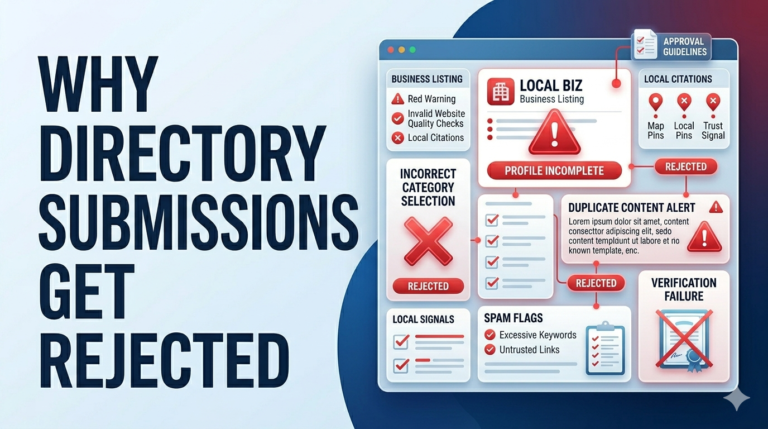

Search Engine Web Site Submission: What Still Works in 2026
The most common advice about search engine web site submission is incomplete: submit a sitemap in Google Search Console, then get back to building. That handles a discovery task. It doesn't handle the product profiles, review listings, launch pages, and company records buyers may find when they investigate your startup.
For SaaS founders, AI founders, and indie hackers, the useful approach is to separate technical submission from third-party placement. Give search engines clean access to your pages, then build accurate references where potential customers browse. Neither task replaces the other.
Table of Contents
- Website Submission Channels Compared
- How to Submit a Sitemap in Search Console
- Why a Submitted Page Still Fails to Appear
- Measuring Submitted, Crawled and Indexed URLs
- Directory Listings That Earn Their Place
- Submission and AI Answers Like Google AI Overview
- Confirm Your Submission Plan Before You Start
Website Submission Channels Compared
Search Console helps you manage how Google discovers and processes your own website. Modern website submission also includes creating external product and company profiles, but those placements serve different purposes.
A founder preparing a launch needs a different channel from a founder troubleshooting an excluded pricing page. Choose the job before choosing the platform.
Submission channels and what each one actually does
| Channel | What it does | What it cannot do | Examples |
|---|---|---|---|
| Search Console sitemap submission | Lists canonical URLs for Google to crawl | Guarantee crawling or indexing | Google Search Console |
| URL inspection request | Asks Google to recrawl one specific page | Force a ranking or fix thin content | Google Search Console |
| Bing URL and sitemap submission | Sends URLs and sitemaps through Bing's tools and APIs | Guarantee indexing | Bing Webmaster Tools |
| Software review directories | Create a referenced product profile and support user reviews | Guarantee inclusion in AI answers | G2, Capterra |
| Alternatives sites | Place your product beside competitors for alternatives searches | Replace a sitemap or first-party indexing | AlternativeTo, SaaSHub |
| Launch platforms | Create a dated profile and an opportunity for a launch-day traffic spike | Sustain traffic after the spike on their own | Product Hunt, BetaList |
| Business profiles | Record company name, founders, and funding facts | Work as a link-building shortcut | Crunchbase |
The distinction is control versus representation. You control your website's sitemap and internal links. On another platform, you submit information under that platform's rules, then wait for its moderation and publishing process.
Google's explanation of how Search works describes discovery through links, sitemaps, and redirects, not a central registry where every website registers for inclusion. A directory profile is an external reference, not an alternative registration route into Google's index.
Match the channel to the immediate problem
For a new SaaS product, I would establish first-party search tools before preparing review and comparison profiles. For a product with indexed pages but little buyer recognition, relevant third-party profiles may deserve more attention than another indexing request.
Local businesses have a separate consistency problem. If your company also serves a physical location, fix inconsistent NAP listings so the business name, address, and phone number don't conflict across profiles.
Practical rule: Pick each destination because a crawler or a customer has a reason to use it, not because it adds another row to a backlink report.
How to Submit a Sitemap in Search Console
A sitemap should describe the public pages you want search engines to consider, not every address your application can generate. Account screens, staging pages, redirects, and duplicate URL variants don't belong in that inventory.
Google's sitemap documentation requires fully qualified absolute URLs and describes submission as a hint. Google may not download the file, crawl every address, or index the pages it discovers.
Prepare the file and verify ownership
Generate an XML sitemap from your publishing system. Include canonical, publicly reachable pages using their complete addresses, because the file should identify the intended destination unambiguously. The common slip is including pages marked
noindex, especially utility pages generated by a CMS.Publish the sitemap at a stable, accessible location. Hosting it at the site's root makes it straightforward to find and maintain; open the file in a browser before submitting it. Watch for a sitemap that loads successfully but still contains your staging hostname.
Verify a Domain property in Google Search Console. Complete DNS ownership verification through your domain provider so the property covers protocols and subdomains. A common mistake is adding a narrowly scoped URL-prefix property and assuming it covers every version of the site.
If your CMS doesn't produce a clean file, Bruce and Eddy's step-by-step sitemap setup for SEO is a useful implementation companion. Get the generation process right rather than maintaining a separate hand-edited inventory that will drift from your published content.
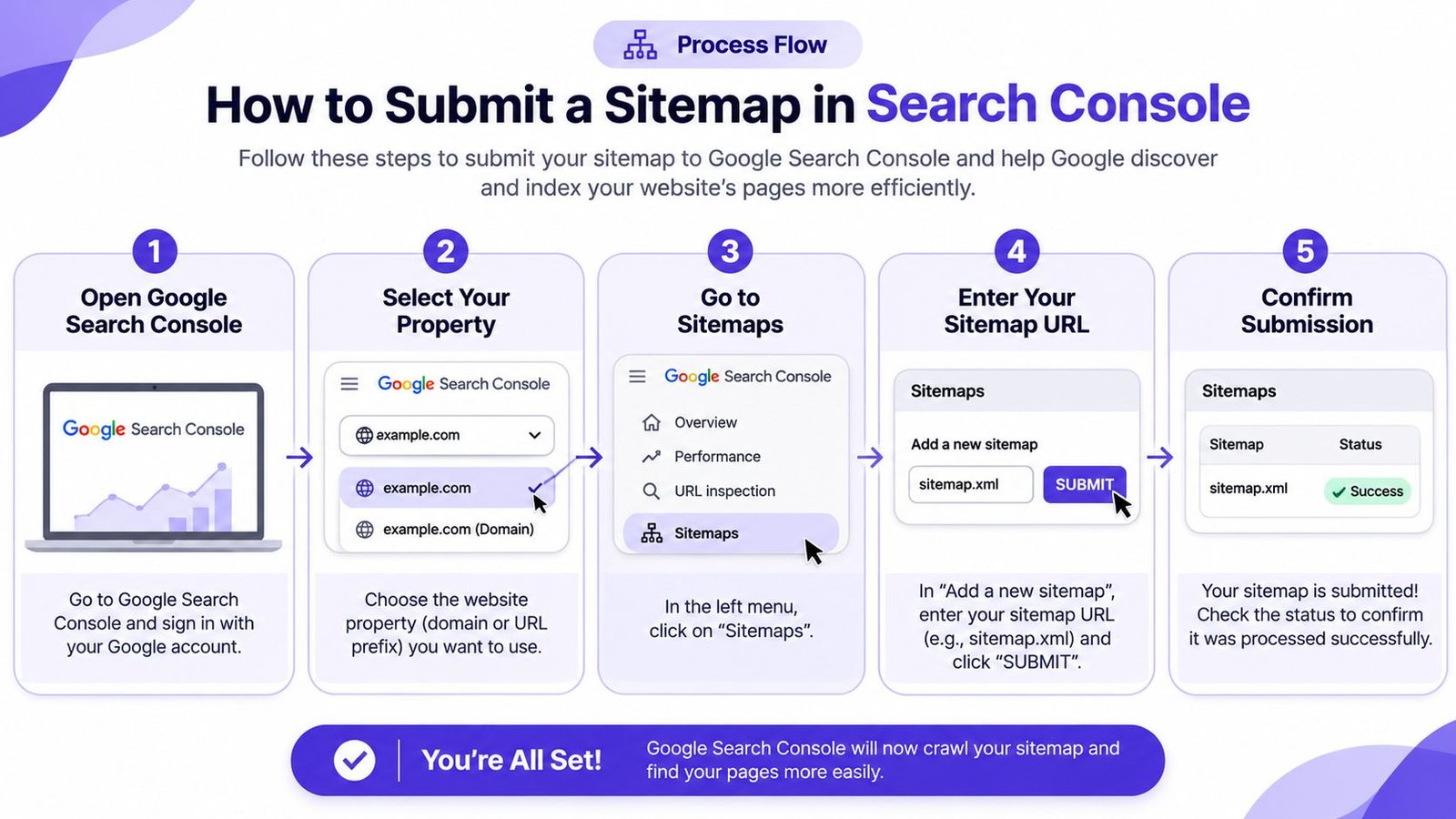
The submission sequence is straightforward once the file is ready.
Submit and check the result
Open Sitemaps under Indexing and submit the sitemap address. Use the file's actual published location so Search Console can fetch the intended inventory. Don't paste a webpage address or assume your CMS uses the same sitemap filename as another platform.
Check the status column. A Success status confirms the sitemap was processed, while a fetch error needs investigation before you spend time on directory work. Common causes worth checking include an incorrect path, access restrictions, and a file that isn't valid XML.
Open Page indexing and filter by that sitemap. This isolates the pages in your submitted inventory instead of mixing them with every URL Google knows about. Look for trailing-slash duplicates or alternate URL versions that slipped into the file.
Recheck after publishing a batch of content. Confirm that your generator includes new pages and removes retired ones, because Google revisits sitemaps on its own schedule. The frequent mistake is checking the submission once while leaving the underlying file stale.
A healthy report has a parsed count that matches your live canonical inventory and zero sitemap processing errors, without requiring every listed page to be indexed.
Why a Submitted Page Still Fails to Appear
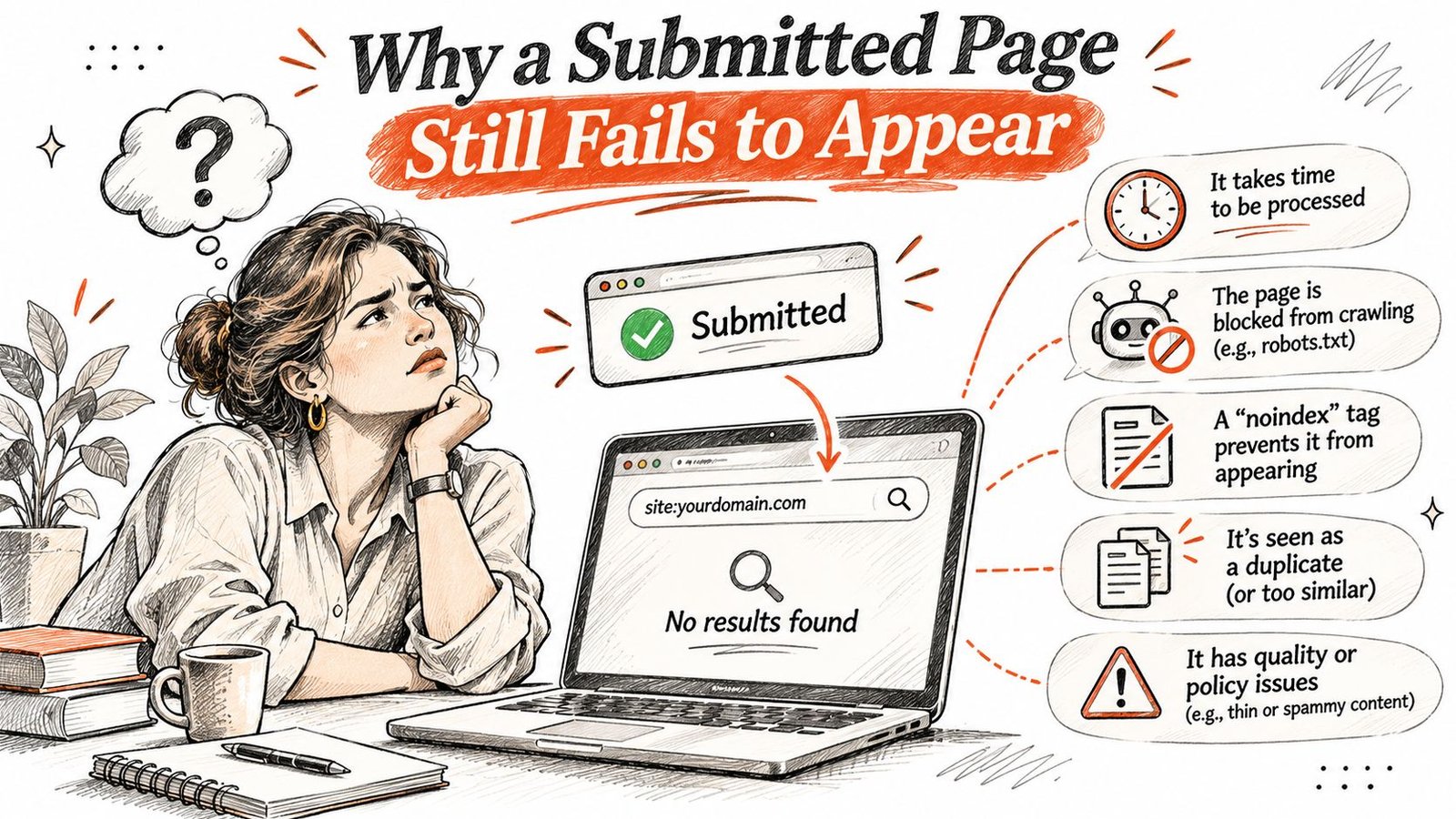
A submitted page still has to be discovered, crawled, and indexed before it can become eligible to appear in search results. Sending the address only helps with the first part of that process.
The history of search engines makes the distinction clear: ALIWEB introduced structured-file registration in 1993, Yahoo began as a manually organized hierarchy in 1994, and WebCrawler launched on April 21, 1994, with just over 4,000 sites, indexing fetched pages' full text rather than only titles or descriptions. Submission and searchable inclusion have never been the same operation.
Crawl capacity and crawl demand explain part of the gap
Google's crawl-budget guidance separates crawl capacity, how much crawling a site can support, from crawl demand, Google's perceived need to revisit its URLs. Submitting more files doesn't directly increase either.
For a startup, the practical response is to maintain a current sitemap, use accurate last-modified information, and avoid unnecessary URL variants. A slow or unreliable application deserves engineering attention, not another round of submissions.
This is particularly relevant to SaaS sites that generate filter pages, integration combinations, or near-identical landing pages. Before asking for more crawling, decide which addresses deserve to exist as standalone search destinations.
Diagnose the missing page itself
Inspect the exact address rather than relying on the homepage's status.
- Internal access: Confirm a relevant public page links to it, rather than leaving it reachable only through the sitemap.
- Server response: Check that the destination returns a successful response without a redirect chain or login requirement.
- Indexing controls: Review robots restrictions, the page's
noindexdirective, and response headers. - Canonical choice: Confirm the canonical points to the intended page, not a staging host or another product page.
- Page substance: Give the page a distinct purpose and useful content beyond a swapped keyword or category name.
For example, an integration page should explain setup, supported actions, and limitations. A logo and a generic paragraph don't give a buyer much reason to choose it.
Treat submission like handing over a guest list. You've supplied the names, but you haven't made the admission decision.
Bing Webmaster Tools provides another submission path for your sitemap and priority URLs. Keep that work auditable, but investigate the destination page whenever submission succeeds and visibility doesn't follow.
Boost Your Startup's Traffic & SEO with up to 200+ Directory Listings
Skip the grind. Our team manually submits your product to relevant, high-authority directories, with screenshot proof for every submission, so you get real users, feedback and lasting backlinks without lifting a finger.
Get Listed TodayMeasuring Submitted, Crawled and Indexed URLs
A large submission count is an activity metric, not a search result. Your reporting needs to distinguish the addresses you supplied from the pages Google fetched, stored, and showed to searchers.
Google's Search Console sitemap guidance says duplicate sitemap URLs are counted only once, and page-indexing results can be filtered by sitemap. It also explains that Google attempts to crawl a submitted sitemap soon after submission and revisits it independently of the site's normal crawl schedule.
Submission metrics and what each one proves
| Metric | Where to find it | What it proves | Common misreading |
|---|---|---|---|
| Submitted URLs | Sitemaps report in Search Console | You supplied the addresses | Treating submission as proof of indexing |
| Parsed URLs | Sitemaps report | Google read addresses from the file | Counting duplicates twice |
| Crawled URLs | Page indexing report and individual URL inspection | Googlebot fetched the page | Assuming a crawl means ranking |
| Indexed URLs | Page indexing report, filtered by sitemap | Google processed and stored the page in its index | Reading every gap as a penalty |
| Crawl requests | Crawl stats report | Crawler activity and server responses | Reading high request volume as progress |
| Impressions and clicks | Search performance report | Actual search appearances and visits | Reading directory placements as traffic |
Crawl requests aren't unique crawled pages. A crawler can request the same address repeatedly, and unsuccessful requests still contribute to activity.
Read the gap before choosing a fix
Consider a hypothetical 240-URL sitemap with 240 parsed URLs, 190 indexed URLs, and 50 pages marked Discovered, currently not indexed. The file has been read successfully; the missing pages need investigation at the crawling and content levels.
Start by grouping the excluded pages. If they're all thin category pages with weak internal links, strengthen or consolidate that template before requesting another crawl. If they're substantial product documentation pages, check navigation, access, and server reliability instead.
Don't diagnose a penalty from subtraction alone. The report identifies a processing state, not the full cause, and extra directory placements aren't a substitute for checking it.
For third-party work, track which directory placements stay live separately from your own website's indexing. A submitted form, an approved profile, and a referral visit are different outcomes.
Use a tracking sheet grouped by URL class, such as product pages, integrations, documentation, and editorial content:
- Discovery timing: Record publication time and the first confirmed crawler access.
- Index status: Store the current status and any exclusion reason.
- Placement exposure: Record platform-reported referral impressions where available; otherwise mark them unavailable.
- Search outcomes: Track organic impressions and clicks for the destination.
This lets a founder distinguish faster discovery from actual customer-facing visibility without turning every successful form submission into an SEO win.
Directory Listings That Earn Their Place
Manual submission isn't automatically good link building. The directory still needs a legitimate audience, a useful publishing function, and a reason to include your product.
Google's spam policies identify automated link creation, buying links for ranking purposes, and excessive reciprocal linking as link spam. Submitting an accurate product profile to a relevant catalog is a different activity from distributing links across a network built primarily to manipulate rankings.
Directory vetting checks before you submit
| Check | What good looks like | Red flag |
|---|---|---|
| Editorial review | People review listings before publication | Anything accepted with no review |
| Real purpose | A catalog, comparison, or review function for visitors | Pages that mainly hold links |
| Topical fit | A category that matches your product | Generic submit-everywhere pages |
| Indexability | A crawlable profile with a successful response | Blocked pages or redirect chains |
| Outbound links | Links that accurately describe the business | Sold ranking links or required link exchanges |
| Duplicate handling | One maintained profile per product | Cloned descriptions across unrelated domains |
| Ownership | You can claim, edit, and remove the profile | Listings you can't update or delete |
A paid listing isn't the problem. Paying for relevant exposure is different from buying a link on the promise that it will manipulate rankings, and appropriately qualified links can still send useful visitors.
Evaluate the page a buyer will actually use
Say you're launching an AI writing tool. A curated AI tools category can provide a relevant, reviewed reference if visitors can understand its use cases, pricing approach, and limitations.
A generic bulk-submission page offers a weaker proposition when its listings contain little beyond a name and a backlink. Use an AI tool discovery platforms list to build a shortlist, then inspect the actual categories and profile pages before submitting.
Google's March 2024 spam-policy update introduced explicit policies on scaled content abuse and site reputation abuse, making thin profile networks risky even when humans write the text. Human involvement doesn't turn low-value publishing into a useful catalog.
Editorial test: If the backlink disappeared, would the profile still help someone understand or evaluate the product?
Apply the same standard to your own submission. Write a distinct description within the platform's character limit, choose the category a buyer would browse, and record the acceptance or moderation outcome.
Avoid rewriting factual claims merely to make descriptions look unique. Change the emphasis and presentation: a developer directory needs technical requirements, while a review platform needs buyer-oriented use cases.
The strongest startup directories are useful because people can compare products there. Their value isn't reducible to a domain metric or a promised dofollow backlink.
Submission and AI Answers Like Google AI Overview
No directory submission guarantees inclusion in Google AI Overviews or ChatGPT answers. A published profile adds information that may be discoverable; it doesn't purchase a recommendation or citation.
The Pew Research Center analysis of browsing by 900 U.S. adults found that users clicked traditional results in 8% of visits when an AI summary appeared, compared with 15% without one. Links within summaries received clicks in only about 1% of visits, while 26% of visits ended without another action when a summary appeared, compared with 16% without one.
Those findings concern browsing behavior, not proof that directory listings cause AI citations. They do explain why clicks alone don't capture every possible benefit of being accurately represented in search answers.
Make your product easy to describe consistently
AI search systems can encounter third-party profiles alongside your homepage, documentation, and independent coverage. Consistent facts give them corroborating material; conflicting descriptions create ambiguity.
Suppose your homepage calls the product project management software, while Capterra presents it as team collaboration software. Both may be defensible, but they emphasize different buying decisions, and an answer could adopt either framing.
Maintain a shared factual reference for:
- Identity: Product name, company name, and official website.
- Category: The primary problem the product solves.
- Audience: The users and organizations it's designed for.
- Claims: Supported capabilities, integrations, and limitations.
Keep those facts aligned across review profiles, Crunchbase, founder biographies, documentation, and company pages. Adapt the writing to each audience without changing the underlying positioning.
For founders evaluating directory listings for AI tools, LLM SEO is a consistency and corroboration project, not a placement-count contest.
Frequently asked questions about AI search visibility
Does a directory profile guarantee ChatGPT visibility?
No. You can improve the accuracy and availability of public information, but you can't control which sources an assistant retrieves or cites.
Should every profile use identical copy?
No. Keep names, categories, audience definitions, and capabilities consistent, then tailor the description to each platform's purpose and fields.
Does an AI citation count as a visit?
No. Track observed citations separately from referral traffic, and don't assume an unclicked mention produced measurable brand recognition.
Confirm Your Submission Plan Before You Start
Start with a bounded publishing task rather than an open-ended backlink target. Assign an owner, prepare the assets, and agree on what counts as submitted versus published. A submitted URL is only a request; a live, indexable page is the result you can later measure against crawled and indexed counts.
Run the work in a practical order
Export your live canonical URLs. Confirm the Search Console sitemap status is Success before starting third-party placement work. This keeps promotion from masking an unresolved technical problem.
Clean the inventory. Remove staging hosts,
noindexpages, and trailing-slash duplicates so your submitted file reflects the pages you maintain.Build a buyer-relevant shortlist. For an initial campaign, I would choose 10 to 20 curated destinations as a working limit, not an SEO threshold. Mix a software review site such as G2 or Capterra, an alternatives site such as AlternativeTo or SaaSHub, a suitable launch platform such as Product Hunt or BetaList, and Crunchbase for company facts.
Prepare platform-specific assets. Write a master description, then adapt it to each site's limits, category choices, and required fields. Keep screenshots and logos ready, and use a company-controlled email account for verification.
Log outcomes and schedule a review. Mark each listing submitted, live, or rejected. Set a 30-day review as an internal reporting checkpoint, not a promised indexing deadline; check technical errors earlier and evaluate search impressions, clicks, and referral activity at the review.
Budget for the work between submission and publication
Account creation, repeated forms, captchas, email verification, and description edits take longer than founders expect. A profile can sit pending until somebody answers a moderation question, so assign responsibility for the inbox where those questions arrive.
StartupSubmit is our manual directory submission service for SaaS and AI startups. Every submission is made by hand by our team of 20 SEO professionals, without bots, and only to curated, editorially reviewed directories, not link farms or spam networks.
The typical execution window is approximately 5–14 days, with work starting within about 24 hours once onboarding is complete. We can't control whether a search engine or AI assistant mentions, recommends, or cites your business, so treat execution time separately from search outcomes.
If you want to get listed in AI tool directories, prepare your product facts and destination pages first. Outsourcing the form work doesn't outsource responsibility for accurate positioning.
StartupSubmit handles manual directory submissions for SaaS products, AI tools, and startups that need help executing a curated placement plan. Visit StartupSubmit to arrange the submission work while you keep ownership of your technical SEO, product messaging, and performance measurement.
Ready to build high-quality backlinks?
We'll manually submit your product to 60 to 200+ directories in 5 to 7 days, with screenshot proof for every submission. No bots, no boring forms, just more time for selling and building.
See pricing & get started →