10 Software Directories Worth Your Time in 2026
You launch on Product Hunt, answer comments, and watch sign-ups arrive for a couple of days. Then your analytics dashboard goes quiet. You've announced the product, but you haven't necessarily put it where someone will look when they need it next month.
That's the difference between launch attention and durable discovery. A buyer comparing invoicing tools has a different goal from an indie hacker browsing new releases. Both might become customers, but they won't use the same platforms or respond to the same listing.
Software directories deserve a place in that mix. In its 2024 Buyer Behavior Report, G2 found that 31% of more than 1,900 B2B software decision-makers consulted software review sites more often than other information sources during purchasing research. That measures research behavior, not a promised conversion rate.
Choose by buyer intent: Reviews help buyers validate a shortlist. Alternatives pages help them replace something. Launch platforms help them discover something new.
Category choice matters just as much as platform choice. An AI meeting assistant listed under broad productivity software may miss buyers browsing transcription tools. Pick the most specific category that accurately describes the job your product performs.
The same distinction applies beyond SaaS. Directory visibility for local businesses involves different discovery needs from software comparisons. Don't use a generic submission list when your buyers have a specific research habit.
Table of Contents
- 1. G2
- 2. Capterra
- 3. GetApp
- 4. TrustRadius
- 5. SaaSHub
- 6. AlternativeTo
- 7. SourceForge
- 8. Product Hunt
- 9. BetaList
- 10. Software Advice
- How the 10 software directories compare on audience, free options, and paid upgrades
- Pick Two Directories This Week and Set a Maintenance Calendar
1. G2
Buyers validating a shortlist want proof that real customers use the product, and G2 is where they go looking for it. Its product profiles combine descriptions, categories, images, pricing information, and customer reviews, with comparison pages and research reports providing additional context.
You can claim a free basic profile. Paid plans add marketing and analytics capabilities, but paying for features doesn't replace having customers who can explain what the product does.
A useful listing answers practical questions: Who uses this? What does it integrate with? What does deployment involve? A vague description about transforming workflows won't help someone compare your product with an established competitor.
Build evidence before buying exposure
Start by making the profile complete, then invite legitimate customers to review their experience under G2's current rules. Don't collect reviews only from people willing to praise you, and don't write their answers for them.
Review volume is the hard part. A product with twelve detailed reviews reads very differently from one with two short ratings, and closing that gap takes months of steady requests rather than a single push after launch.
- Best fit: B2B SaaS with active users and a recognizable software category.
- Main limitation: A bare profile offers little customer evidence, while advanced marketing features require additional spending.
- Maintenance priority: Keep categories, pricing context, screenshots, and integration details aligned with your website.
Pricing pages change, integrations get added, screenshots age. Use a canonical product document to keep directory listings consistent rather than rewriting your positioning from memory for every submission.
G2 profiles also surface when buyers research replacements, so the comparison content on your profile matters as much as the reviews themselves. A page discussing Belkins alternatives and buyer fit shows what replacement research looks like: buyers need to understand whether an alternative serves their situation, not merely whether it exists.
2. Capterra
A founder selling scheduling software should care less about appearing in a large directory than about appearing in the right scheduling category. Capterra is useful for that category-led discovery, with product comparisons, customer reviews, and vendor-managed listings.
Eligible vendors can start with a free listing. Product profiles can present features and social proof, while optional paid programs support promotion and lead generation.
The trade-off is straightforward: inclusion doesn't guarantee prominent placement or qualified demand. A broad category may contain recognizable competitors but attract buyers whose requirements don't match your product.
Validate the category from the buyer's side
Browse the category before submitting. Read the descriptions of adjacent products and inspect the requirements buyers are likely to compare. If your tool only handles appointment reminders, don't describe it as a complete practice-management system.
Capterra's historical analysis of software user reviews reported that adding ten product reviews was associated with a 2% increase in product traffic or clicks. That's an association, not a forecast for your listing, but it supports treating review development as ongoing work.
- What works: Specific features, clear buyer fit, current screenshots, and authentic customer feedback.
- What doesn't: Broad category claims intended to capture every possible visitor.
- Budget distinction: Profile creation and paid demand generation are separate decisions.
Before you submit your SaaS to directories, document your core category and any legitimate secondary categories. That small preparation step prevents inconsistent positioning across review platforms.
3. GetApp
GetApp suits buyers who know the kind of software they need but still need help comparing options. Its category guides, comparison tools, product information, and verified-user reviews support that evaluation process.
For a SaaS founder, the practical attraction is a free profile that can establish a presence before committing to sponsored exposure or lead-generation services. Pricing context and feature information let prospects assess basic fit without booking a sales call.
Say you sell project-management software for agencies. Your listing should make client permissions, billable-time tracking, and external collaboration easy to find. A generic description of task management gives buyers less reason to investigate.
Treat overlapping coverage carefully
GetApp shares an owner, Gartner Digital Markets, and much of its audience with Capterra and Software Advice. A profile on all three sites does not mean three independent pools of buyers, so count this coverage as reinforcement of one audience rather than three separate channels.
That shared ownership has a practical benefit too. Product information carries across the network, which reduces setup time. The trade-off is that the same details tend to surface in the same way everywhere, so inspect the published page yourself. Category placement, missing fields, and the comparison context around your listing still deserve attention before you consider it finished.
- Useful capabilities: Product profiles, software comparisons, category guides, and customer reviews.
- Commercial trade-off: Sponsored profiles may receive more prominent placement; paid lead services are separate from basic inclusion.
- Best use: Additional category-led coverage for an established SaaS product.
I'd prioritize GetApp when the relevant category contains credible competitors and your product has a clear distinction buyers can evaluate. If the category is a poor fit, publishing another profile just creates another page you'll need to maintain.
4. TrustRadius
Some products need more explanation than a star rating can provide. TrustRadius is particularly relevant when buyers need detailed reviews about implementation, integrations, support, and everyday use.
Vendors can claim a free profile and supply product information such as features, pricing, and integrations. The platform also supports verified buyer reviews, vendor responses, and premium profile, lead, and buyer-intelligence options.
The strongest use case is a product with customers who can describe a real workflow. A pre-launch founder has little evidence to contribute beyond vendor claims, which makes this a weaker starting point than an early-adopter platform.
A detailed review explaining an implementation limitation can help a qualified buyer more than another unexplained positive rating.
Ask for experience, not endorsement
Invite customers to describe what they use, what works, and where they encounter friction. Let them choose their wording and follow the platform's review policy.
Review evidence matters during evaluation. Capterra's UK Technology Trends Survey, cited by B2B Review Lab, found that 61% of 350 UK respondents surveyed in August 2024 used comparison and review sites to assess customer satisfaction from actual users.
For founders, the limitation is the effort involved in building that evidence. Premium capabilities may support a mature program, but they won't make a thin customer base produce substantive reviews. Choose TrustRadius when you can sustain credible participation, not just complete a registration form.
5. SaaSHub
If your best positioning starts with “an alternative to,” SaaSHub deserves attention. It connects live software products with categories and competitors, making it more useful for replacement discovery than launch-day spectacle.
Its submission process includes review and verification, including domain email verification. Products need to be live; waitlist-only pages, unreleased products, and free-hosting subdomains don't fit its stated eligibility requirements.
That creates a useful dividing line. A working AI transcription tool with a clear competitor belongs in a different submission queue from a landing page collecting interest.
Choose competitors for functional overlap
Don't associate your product with a famous tool merely because both use AI. Choose alternatives that perform a comparable job for a comparable buyer.
For example, an AI support assistant should explain whether it replaces a help desk, adds automation to an existing help desk, or only drafts replies. Those are different purchase decisions.
- Strong fit: Live SaaS, independent software, and eligible AI tools with clear comparison context.
- Submission friction: Missing competitor information can delay review, and approval isn't guaranteed.
- Useful extras: Product pages, category placement, alternative associations, and a submission tool for relevant directories after listing.
For founders using the StartupSubmit submission service, we select categories manually and check for existing profiles before submitting. SaaSHub still decides whether to publish the listing.
Don't judge this channel by approval alone. Track whether visitors reach a relevant landing page and activate, rather than treating the profile as a guaranteed source of backlinks or referral traffic.
6. AlternativeTo
A buyer searching for a replacement already has a reference point. AlternativeTo lets you explain how your app compares through alternative relationships, platform support, licensing information, tags, and community contributions.
That makes it particularly useful for products with a clear replacement story. A privacy-focused notes app, for example, can describe its supported devices and licensing model alongside its core note-taking capabilities.
Users can submit apps and contribute metadata. Developers can request access to maintain an approved product page, which matters because community-managed information still needs attention from someone who understands the product.
Make the switching reason explicit
The listing should explain what changes when someone switches. Is your tool self-hosted? Does it work offline? Is it designed for a narrower workflow? State the distinction without pretending to match every feature of the incumbent.
- Discovery strength: Existing-product alternatives provide a concrete route to your listing.
- Control trade-off: Community contributions and votes aren't vendor-controlled marketing assets.
- Review constraint: The free queue has no promised review date; paid priority review speeds consideration, not guaranteed approval.
When we submit AI startups to software directories, we match the platform mix to the product's category and eligibility rules. An AI feature alone doesn't make an app a credible alternative to unrelated software.
I'd choose AlternativeTo before a generic startup directory when the replacement use case is obvious. If you can't explain what someone would switch from, clarify your positioning before filling out the submission form.
Boost Your Startup's Traffic & SEO with up to 200+ Directory Listings
Skip the grind. Our team manually submits your product to relevant, high-authority directories, with screenshot proof for every submission, so you get real users, feedback and lasting backlinks without lifting a finger.
Get Listed Today7. SourceForge
SourceForge serves downloadable software, developer tools, and products aimed at technical evaluators. It combines software discovery with vendor product pages, categories, user reviews, and optional commercial features.
The directory grew out of open-source hosting and distribution, and that history shapes what visitors expect. Technical evaluators arrive looking for enough product substance to assess the software on the spot. A listing thin on specifics reads like a marketing landing page, and this audience is quick to close the tab.
For a developer tool, describe deployment, supported environments, integrations, and documentation. Don't make someone leave the directory just to discover whether the software runs in their environment.
Separate the listing from the marketing package
SourceForge offers review features, including an embeddable review widget, alongside paid options for enhanced placement, buyer-intent information, and lead generation. Evaluate those commercial capabilities independently from the value of a basic product presence.
A widget you embed on your own site solves a different problem than a paid upgrade that steers directory traffic toward you. Plenty of vendors treat the paid tier as part of the listing itself, then judge the whole platform on the upgrade's return.
New listings may also wait for review. Build that uncertainty into your submission schedule rather than promising a publication date internally.
- Prioritize it for: Developer-facing SaaS, technical utilities, downloadable applications, and relevant business software.
- Prepare carefully: Product identity, technical requirements, screenshots, documentation, and the correct destination URL.
- Deprioritize it for: Products with little connection to technical software discovery.
The mistake is submitting marketing copy that could describe any app. Technical buyers need boundaries as well as benefits. Be explicit about what your product supports, what it requires, and what it doesn't attempt to replace.
8. Product Hunt
Product Hunt is a launch platform, not a substitute for a review program. Use it for a new product, meaningful release, or announcement that gives a product-focused community something to explore and discuss.
Launching is free. A launch page supports descriptions, media, links, comments, and votes, while homepage featuring and leaderboard position aren't guaranteed. The persistent Product Page provides a record after the launch itself.
The preparation requirement is easy to underestimate. You need a working onboarding flow, clear visuals, and someone available to answer useful questions. Sending interested visitors into a confusing signup process wastes the attention you worked to attract.
Launch-day discipline: Decide what you want to learn before deciding how much attention you want.
Measure activated users, not applause
For a browser-based design tool, a meaningful outcome might be someone creating and exporting a project. Comments and votes offer feedback, but they aren't equivalent to that activation event.
Prepare a concise demonstration and answer questions about limitations candidly. A substantive reply about supported workflows is more helpful than repeatedly thanking people for their support.
Product Hunt belongs alongside more durable comparison profiles when deciding where indie founders should get listed. It serves a different moment in the buyer journey.
Its weakness is concentrated attention. Don't plan your startup marketing around repeatedly recreating launch day. Use the event to learn which explanation resonates, then carry that clearer positioning into your website and longer-lived software listings.
9. BetaList
BetaList fits a founder looking for early adopters rather than a procurement team assembling an enterprise shortlist. It features startups that are pre-launch, in beta, or already live, subject to screening.
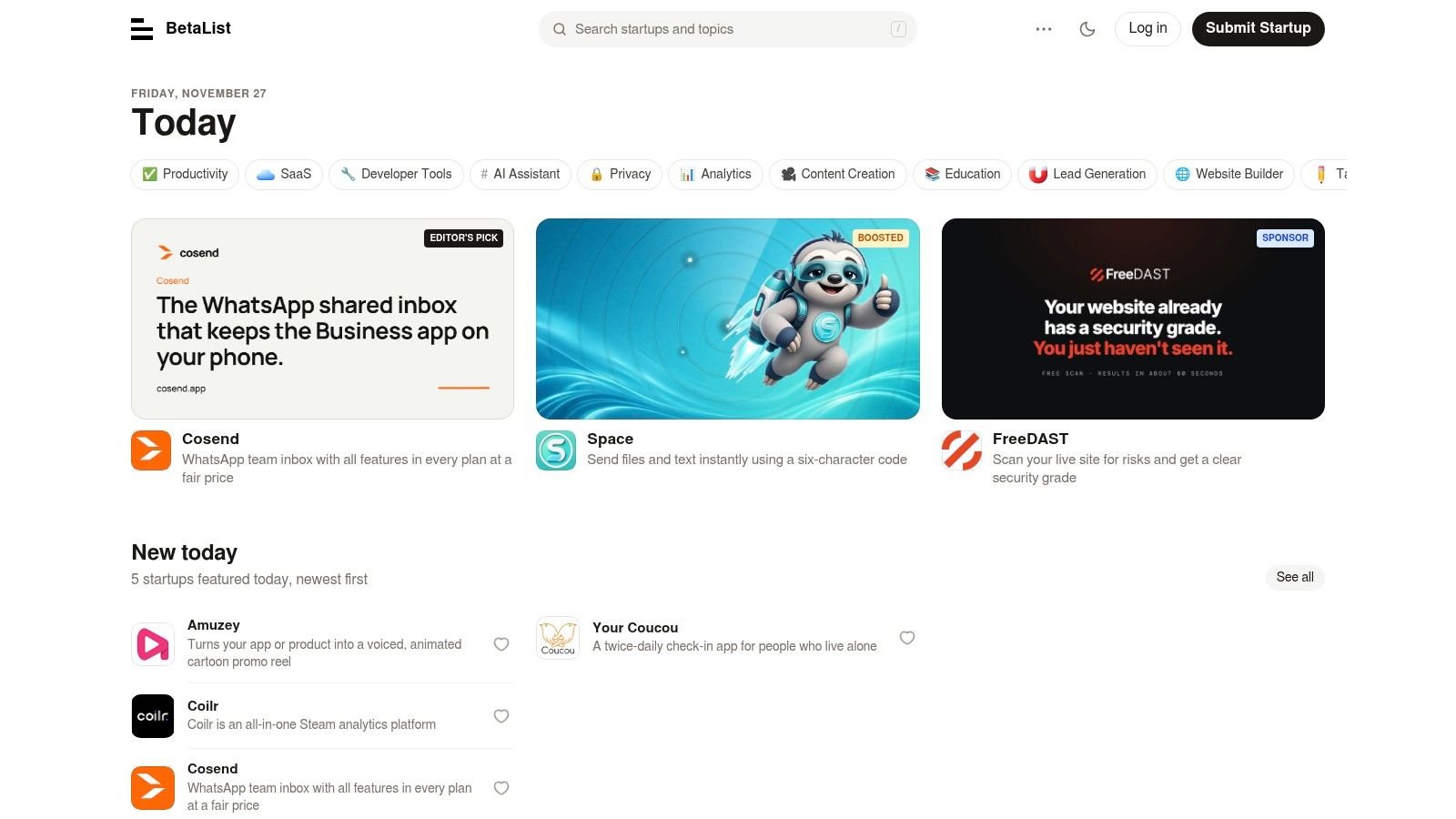
Submissions must use the startup's own domain. Paid plans offer different review or featuring timelines, there's no free submission option, and paying doesn't guarantee acceptance. Submissions that aren't selected are eligible for refunds under the platform's terms.
Give early adopters a concrete task
An early-access visitor needs to understand what they can try and what remains unfinished. If you're building an AI research assistant, explain whether they can upload documents, inspect citations, or only join a waitlist.
Avoid presenting beta access as a finished enterprise offering. That attracts mismatched expectations and gives you less useful feedback.
- Best outcome to pursue: Relevant testers who complete the core workflow and explain where they get stuck.
- Budget risk: Paid consideration without guaranteed selection.
- Audience limitation: Early-adopter curiosity doesn't necessarily indicate readiness to buy a business-software contract.
I'd use BetaList when feedback is the immediate objective and someone can respond to testers. If your priority is sales-qualified enterprise demand, put review platforms and category comparisons ahead of it.
Keep the destination page current after featuring, too. A startup that has moved from private beta to general availability shouldn't keep sending visitors to an obsolete access form.
10. Software Advice
Software Advice is worth assessing when your buyers want help narrowing software options. Alongside category browsing and product profiles, it supports advisor-assisted recommendations and connections between buyers and vendors.
Eligible products can request a free listing. Qualified-lead services are a separate commercial program, so don't confuse getting published with enrolling in a demand-generation channel.
Its advisor-assisted approach gives founders a useful preparation exercise: could someone outside your company describe the buyer you serve? If the answer requires a long explanation, your profile probably needs clearer boundaries.
Define qualification before paying for leads
Describe target company size, supported use cases, deployment model, and any meaningful exclusions. A specialist scheduling tool shouldn't appear suitable for a business that requires a complete operational platform.
- Useful distinction: Buyers can receive guidance rather than relying entirely on self-directed comparison.
- Operational consideration: Vendor profile management sits within the G2 Digital Markets ecosystem.
- Coverage limitation: Overlap with Capterra and GetApp means additional listings don't necessarily equal independent audiences.
Allow for submission review rather than treating publication as immediate. Once the profile is live, inspect the actual page and destination link before recording it as completed.
If you explore the lead program, agree internally on what qualifies as a relevant opportunity. Track whether referred buyers match your requirements and progress through sales. A lead count without fit, acquisition cost, or downstream outcomes is a weak basis for increasing spend.
How the 10 software directories compare on audience, free options, and paid upgrades
Read this table by buyer intent, not by brand recognition. G2, Capterra, GetApp, TrustRadius, and Software Advice serve trust-and-review evaluation, where buyers compare vendors inside a category. SaaSHub and AlternativeTo capture replacement searches. Product Hunt and BetaList deliver launch attention and early-adopter discovery. SourceForge skews toward downloadable and technical products.
| Item | Best For | Free Option | Paid Upgrades |
|---|---|---|---|
| G2 | B2B software buyers and vendors seeking verified reviews | Free basic profile | Expanded profiles, marketing, and analytics |
| Capterra | Business software discovery and category comparisons | Free listing for eligible vendors | Lead generation and promotion |
| GetApp | SaaS discovery and category-based comparisons | Free provider profile | Sponsored exposure and lead-generation services |
| TrustRadius | B2B products with customers who can provide detailed reviews | Free claimed profile | Premium profiles, lead features, and buyer intelligence |
| SaaSHub | Live SaaS and software products with relevant alternatives | Free submission for live products that pass review and domain email verification | None described in this comparison |
| AlternativeTo | Software with a clear competitor or replacement use case | Free submission, with no promised review timeline | Paid priority review |
| SourceForge | Downloadable software, developer tools, and technical products | Basic listing with user reviews; enhanced placement and lead features are paid extras | Enhanced placement, buyer-intent data, and lead generation |
| Product Hunt | Product launches seeking community feedback | Free launch submission | None described; homepage featuring is not guaranteed |
| BetaList | Early-stage startups seeking early-adopter feedback | No free submission | Paid plans with different review or featuring timelines |
| Software Advice | Business software vendors seeking category discovery and buyer connections | Eligible products can request a free listing | Qualified-lead program |
The free column gets you published. The paid column buys visibility, lead flow, or faster review, and none of it guarantees buyers will convert. That trade-off matters most on the review platforms, where a paid profile on a thin review base still looks thin.
Two practical consequences follow. First, choose the platform whose audience matches your buyers before weighing any upgrade. Second, treat category placement as the decision that matters most: a free listing in the correct, specific category will outperform a paid upgrade in a broad one, because buyers filtering by use case never see misfiled products. BetaList is the one row with no free path at all, so treat it as a paid experiment and judge it on the feedback quality it returns.
Pick Two Directories This Week and Set a Maintenance Calendar
Start with the platforms that match your buyer's research habit. Choose G2 or Capterra for review-led evaluation, SaaSHub or AlternativeTo for replacement searches, and Product Hunt or BetaList for launch attention and early feedback. Technical products should also assess SourceForge.
Before submitting, browse the categories yourself. Check which products appear, what buyers can compare, and whether your primary use case belongs there. Pick the most specific correct category, not the broadest category you hope might send traffic.
Make accuracy an operating task
Create a shared product record containing your canonical name, URL, description, pricing model, features, integrations, and screenshots. Assign an owner and schedule a quarterly review, with immediate updates after material product changes.
Manual profile builds are one-time work. Pricing, features, URLs, and positioning changes require a separate update, even when the original submission was handled correctly.
- Record status: Distinguish submitted, awaiting verification, approved, rejected, and live.
- Inspect publication: Confirm the category, public profile, destination URL, and visible product details.
- Maintain evidence: Invite genuine customers under each platform's own review policy. Never buy or fake reviews.
- Measure outcomes: Track referral sessions, activation, demo requests, and assisted pipeline rather than only referring-domain counts.
Trust requires more than consistency. The B2B Review Lab guide to verified reviews discusses review authenticity and the FTC prohibition on buying reviews conditioned on a particular sentiment. Use honest requests, disclose incentives where required, and report suspected fraudulent reviews through the platform's process.
Keep SEO and AI expectations grounded
For startup SEO and SaaS SEO, inspect the actual backlink rather than relying on the directory's reputation alone. Google's crawlable-link guidance explains that links help discovery and relevance, and generally need an HTML anchor with an href attribute to be crawlable.
AI Search Optimization and LLM SEO require the same restraint. Google's guidance for AI features says there's no separate submission process for AI Overviews or AI Mode; supporting pages must be indexed and eligible for a Search snippet.
Accurate third-party profiles are worth maintaining, but directory approval doesn't guarantee a Google AI Overview citation or ChatGPT visibility. Measure observed mentions and recommendation accuracy separately from referral traffic.
Choose your initial directories, finish their profiles properly, and put the next maintenance review on the calendar before expanding coverage. A smaller set of accurate, relevant listings is a better foundation than a large collection nobody owns.
StartupSubmit offers manual directory submissions for SaaS and AI startups, with category matching, duplicate checks, and reporting that includes submission status and live links where available. Visit StartupSubmit to choose relevant coverage and delegate the submission work while keeping profile maintenance on your marketing calendar.
Ready to build high-quality backlinks?
We'll manually submit your product to 60 to 200+ directories in 5 to 7 days, with screenshot proof for every submission. No bots, no boring forms, just more time for selling and building.
See pricing & get started →