
10 Business Listing Directory Options for SaaS Founders
Buying the biggest directory package isn't a shortcut to page-one rankings. A listing is not a ranking, and price alone won't tell you whether a service will produce useful profiles, relevant backlinks, or another spreadsheet of unfinished submissions.
Founders often buy a business listing directory package expecting traffic. Those outcomes depend on directory acceptance, editorial review, audience relevance, and whether the published profile carries real authority. A submission receipt proves that someone completed a form, not that buyers can find your product.
Directories can still earn meaningful search exposure. In a study of 8,000 Google organic search results, BrightLocal's business listings visibility study found that directories represented 31% of top-ten results for local-intent queries. That's evidence of visibility in local search, not a promise of SaaS leads.
Buying rule: Pay for relevant work you can verify, not a listing count you can't reconcile.
The options below serve different jobs: manual startup submissions, automated directory distribution, and ongoing local listing management. Compare their methods, reporting, excluded fees, and fit before comparing package sizes.
For campaign planning, how Flaex sequences startup submissions offers a useful perspective on choosing platforms deliberately rather than submitting everywhere at once. Your launch calendar should account for moderation delays and follow-up, not just the provider's delivery date.
Table of Contents
- 1. StartupSubmit
- 2. SubmitWell
- 3. LaunchPoly Directory Launch
- 4. LaunchDirectories
- 5. Submitator
- 6. SubmitSaaS
- 7. SaaSLyft
- 8. Submt
- 9. BrightLocal
- 10. Moz Local
- How the 10 Business Listing Directory Services Compare on Price, Delivery, and Method
- Choose the Directory Mix That Matches Your Stage, Then Verify Every Listing
1. StartupSubmit
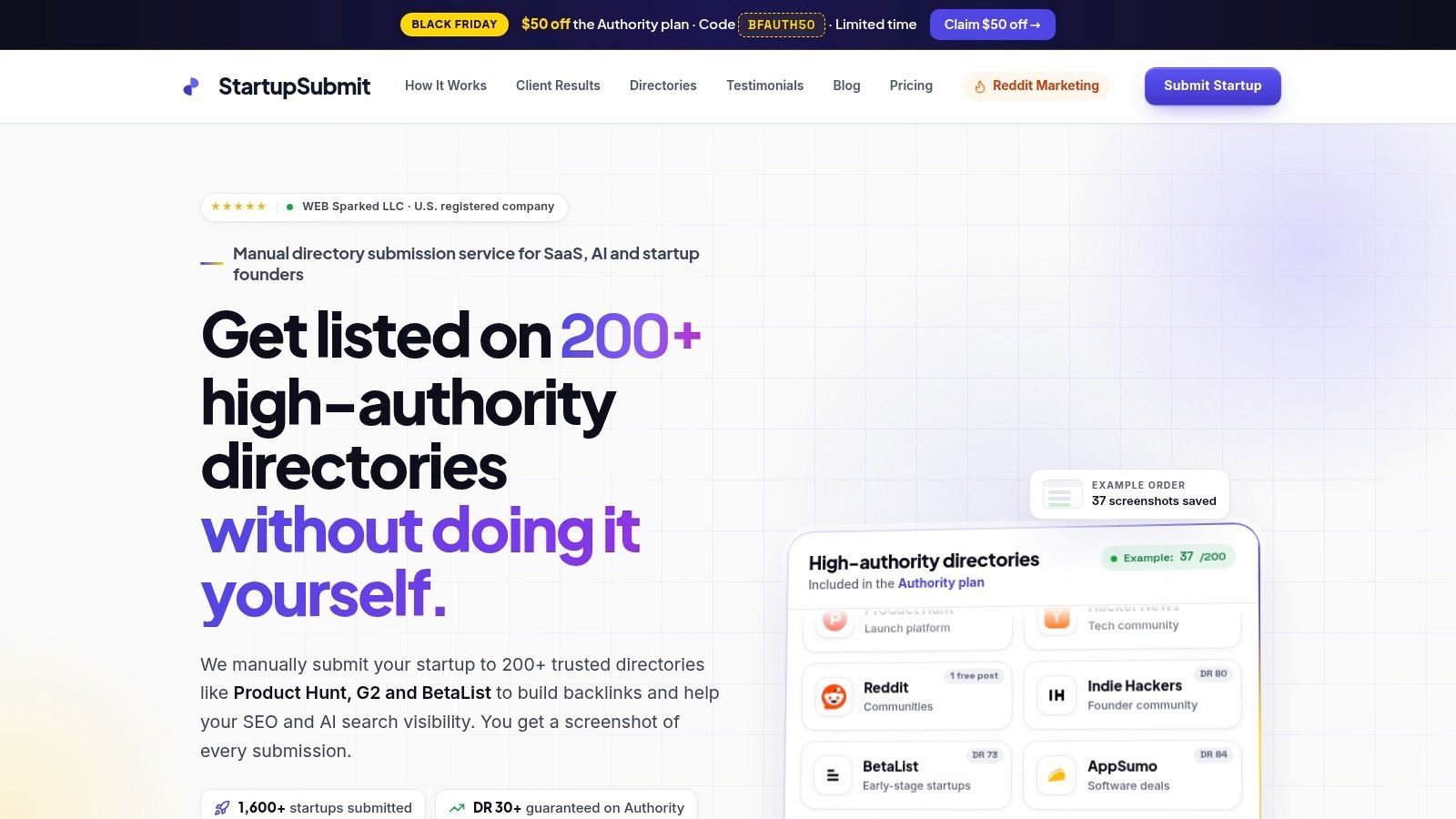
Listing totals are a weak buying signal. StartupSubmit handles manual submissions for SaaS and AI startups. The verifiable piece is the final report: submitted URLs, acceptance notes, and screenshots. Separate live profiles from pending submissions.
Plans are one-time payments chosen to match your coverage goals and budget, with a typical execution window of approximately 5–14 days and longer timelines for broader campaigns, so check the scope and delivery terms attached to your order. The Authority plan costs $299 as a one-time payment and includes listings on 200+ directories. Reconcile that purchased scope with the report.
StartupSubmit checks each directory before submitting. An existing listing is skipped, and another relevant directory is used where one is available. Tags and descriptions should match the product's real use cases. This is a one-time workflow, not an ongoing listing subscription. Third-party directories still decide whether to publish, and a published page may never be indexed or send traffic.
Verification checklist
- Manual versus automated: The stated method is manual, with no bots. Confirm a person handled each submission.
- Live versus pending: A screenshot of a finished form is not a public profile.
- Service fit: Startup, SaaS, and AI submissions are separate from the local citation service, which is for businesses that need to be found nearby.
I would open every URL in the report and count only the pages that are live.
2. SubmitWell
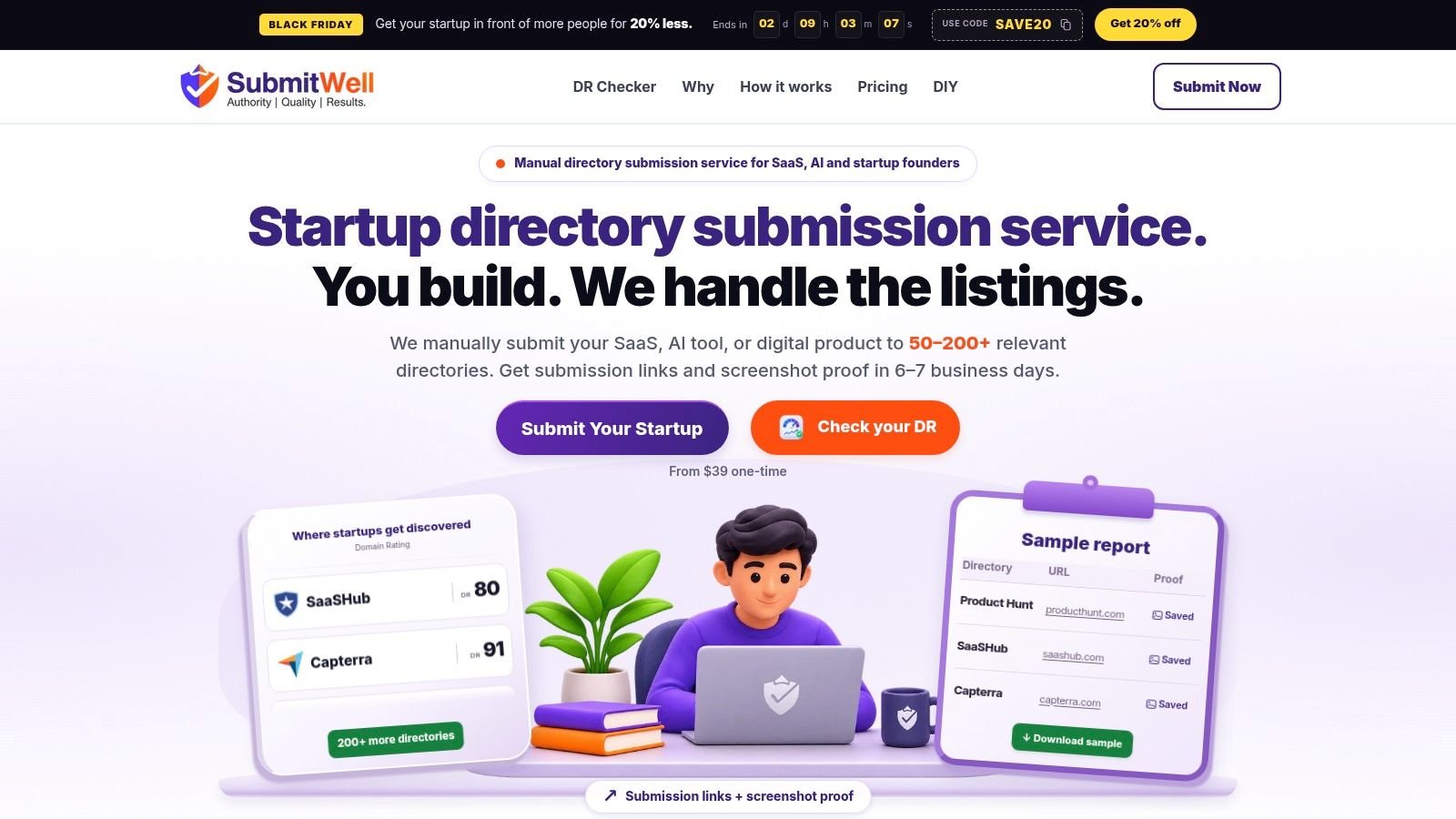
The service fee isn't necessarily the campaign budget. SubmitWell lists one-time packages at $39, $69, and $119, while fees charged separately by directories for paid placements or upgrades aren't included.
That distinction matters for an indie hacker working with a fixed launch budget. A provider can complete its submission work while a directory still requires payment before publishing or promoting the profile.
SubmitWell focuses on startup, SaaS, and AI directories. That specialization makes it a more relevant starting point for software founders than a package built around local addresses and map citations.
Verify the tier, not just the headline price
- Directory selection: Confirm which destinations belong to your chosen package and which accept your product category.
- Proof of work: Establish whether reporting includes submission receipts, public profile URLs, or both.
- Additional spending: Identify paid listings and upgrades before approving them.
- Existing profiles: Make sure previously published listings won't become duplicate submissions.
The appeal is straightforward budgeting for the service itself. The trade-off is that the exact directory mix and evidence can vary by tier, so the cheapest package isn't automatically the best value.
Use avoiding SEO risks from directory spam as a quality filter when reviewing destinations. Editorial review, real users, and relevant categories matter more than filling every available slot. Don't accept submission volume as evidence that the directories have an audience.
3. LaunchPoly Directory Launch
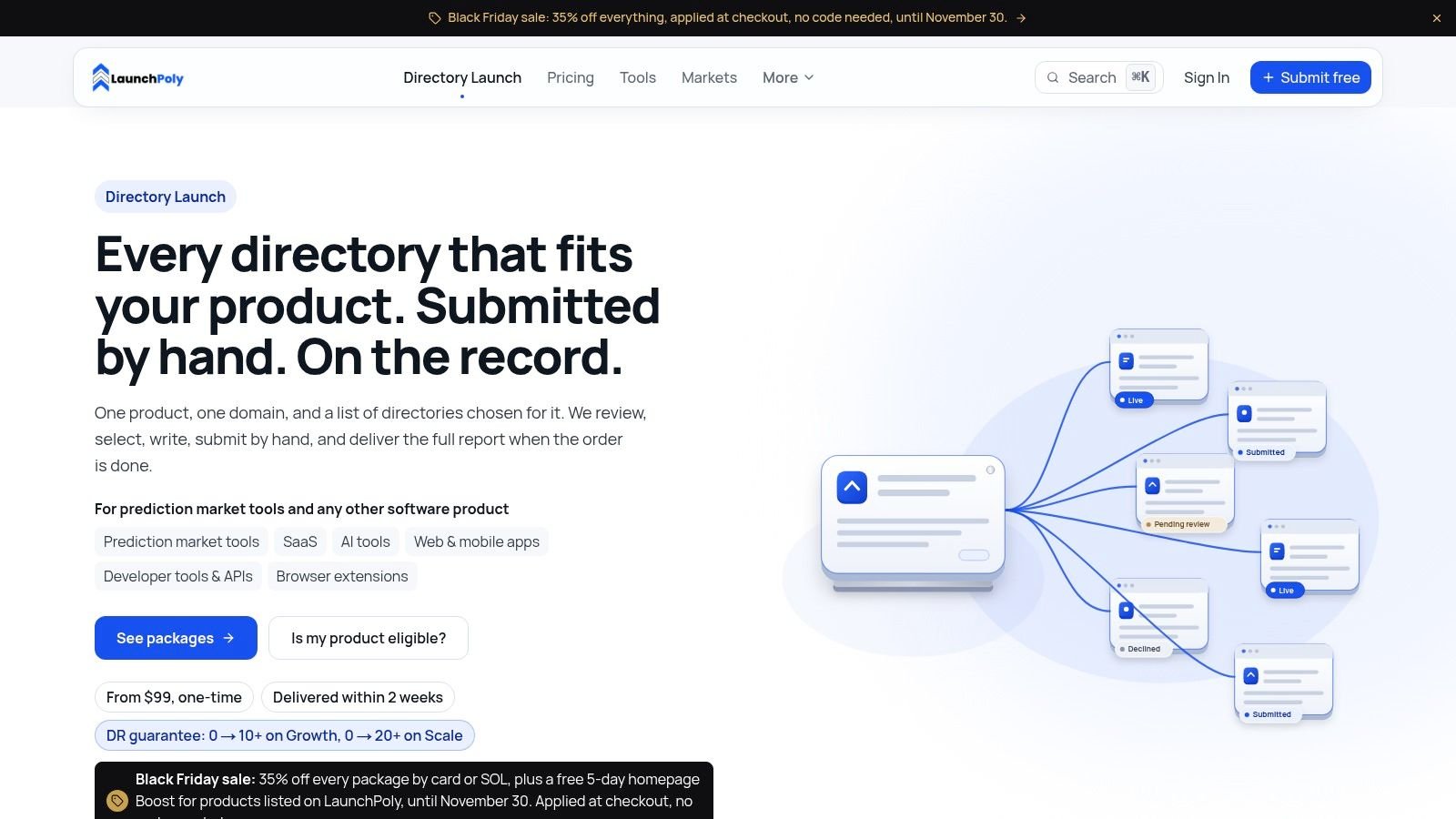
Status reporting is LaunchPoly's most useful distinction. Its final report separates live listings from pending or declined submissions, which makes the delivered work easier to evaluate than an undifferentiated list of directory names.
LaunchPoly Directory Launch lists $99 for 50 submissions, $179 for 100, and $299 for 200, with delivery potentially taking up to two weeks. The service accepts SaaS, AI, and other software products even though LaunchPoly's own directory focuses on prediction-market tools.
The team describes a manual process: select relevant destinations, submit by hand, and provide verified listing links in the final report. An order dashboard shows overall campaign progress, but not directory-by-directory activity during execution.
Check the final status definitions
- Live: Open the public profile and check the product name, category, destination URL, and description.
- Pending: Record whether moderation, email confirmation, or another action remains outstanding.
- Declined: Check the reason and whether a replacement falls within the purchased scope.
The trade-off is visibility during the campaign. Founders who need detailed daily progress may find the overall dashboard less useful than the final report.
Treat stated Domain Rating targets as selection criteria, not business outcomes. A high-rated domain can host an irrelevant or inaccessible profile. For startup SEO, the useful deliverable is a public, accurate page in a category where a prospective customer might evaluate your product.
4. LaunchDirectories
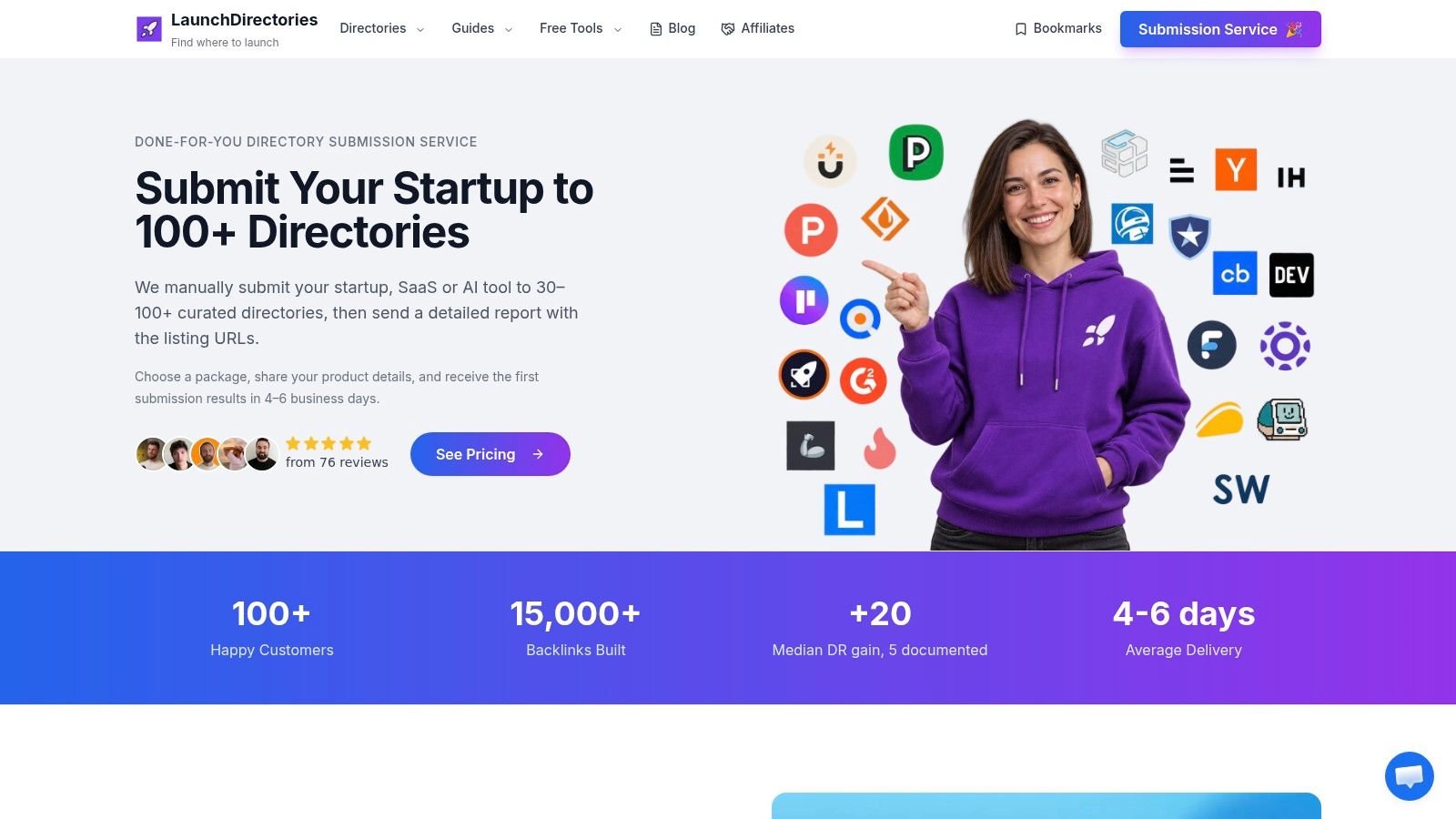
A launch placement and a permanent software profile solve different problems. LaunchDirectories combines manual directory submissions with paid launches on selected partner directories in some packages, so founders should evaluate those components separately.
LaunchDirectories lists a 60+ directory plan for $149 and a 100+ directory plan for $199. Its offering centers on hand-picked startup, SaaS, and AI directories, manual submission, and a final report.
That can suit a founder who wants directory coverage alongside launch-day distribution. It's less compelling if most included destinations don't match the product's buyers or if the partner placements duplicate launches already planned.
A launch slot buys an opportunity for attention. A maintained review profile gives buyers somewhere to evaluate you afterward.
Separate coverage from promotion
- Directory coverage: Review the actual destinations, not only the package count.
- Partner launches: Confirm which paid placements are included and what each placement provides.
- Extra fees: Establish whether any third-party charges remain outside the package.
- Delivery evidence: Require published URLs to be distinguished from submissions awaiting review.
Compare the proposed destinations with ranked software review directories before committing. A product category page with credible customer evidence may be more useful to a B2B buyer than a short-lived launch feed.
The service's software focus is a strength. Its limitation is the same one that applies to every submission provider: completing the work doesn't control a directory's publication decision or guarantee useful referral traffic.
5. Submitator
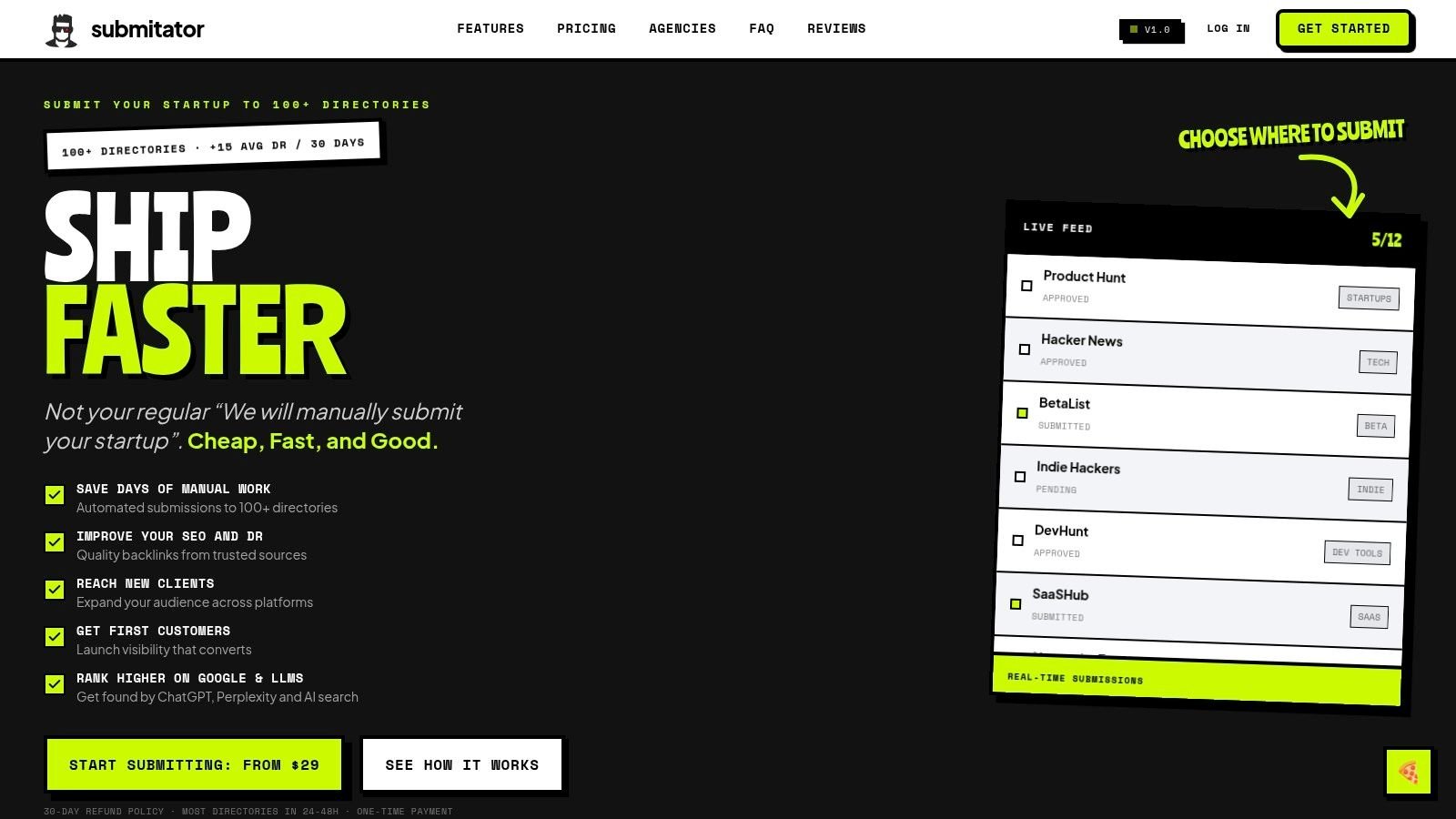
Choose Submitator for selection and dashboard control, not because you want an entirely manual service. Its terms describe automated submissions, which distinguishes it from manual-first providers.
Submitator lists one-time packages at $29 for 30 directories, $49 for 60, $79 for 100, and an all-directories offer at $149. It also states a 30-day refund policy subject to conditions, and directory rejection alone doesn't qualify for a refund under its terms.
The catalog lets founders select destinations and manage submissions centrally. That flexibility is useful when you already know your target categories and want to exclude directories that don't fit.
Check what automation leaves unfinished
- Platform requirements: Identify badges, verification emails, and other directory-specific actions.
- Status meaning: Confirm whether the dashboard tracks form submission or actual publication.
- Refund conditions: Read the exclusions before treating the policy as protection against rejection.
- Account access: Establish how you'll update profiles after delivery.
Automation isn't automatically a problem. The practical question is whether it handles each directory's required fields accurately and flags exceptions instead of treating them as completed work.
Say your AI product supports customer-support teams, but a generic description places it under content generation. The submission may succeed technically while attracting the wrong audience. Review categories and copy before execution, then inspect the published results rather than trusting the dashboard's completion indicator.
6. SubmitSaaS
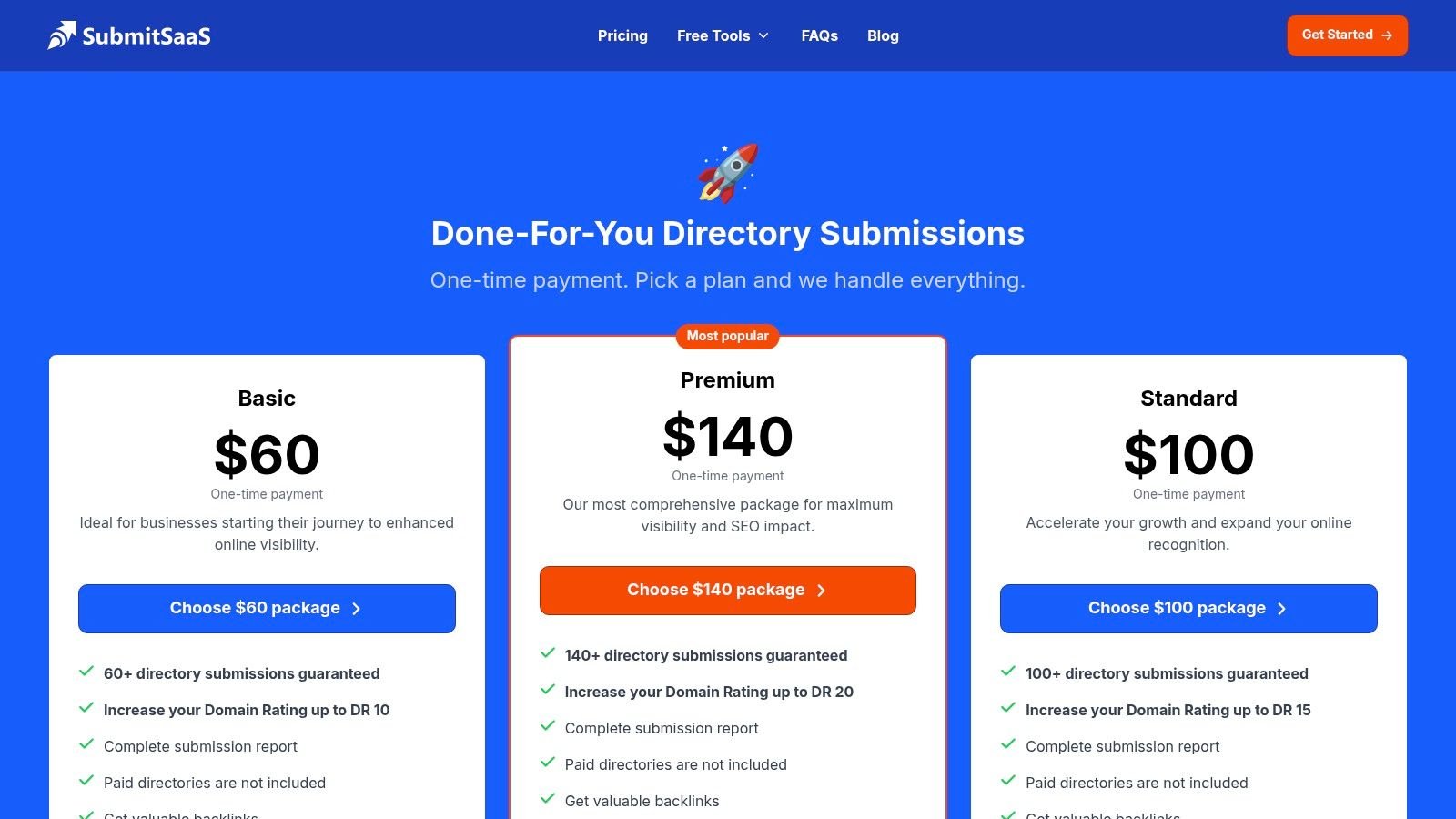
A fast submission window helps with launch preparation, but it doesn't shorten a directory's moderation queue. SubmitSaaS is worth considering when operational speed and account handover matter more than a fully manual workflow.
SubmitSaaS's pricing page lists $60 for 60+ submissions, $100 for 100+, and $140 for 140+, with a stated 48-hour turnaround. Its process combines automation with human review, and paid-directory fees aren't included.
The dedicated email option is useful. Registration credentials are handed over to the client, giving the founder a way to recover accounts and maintain profiles when pricing, positioning, or product details change.
Inspect the reporting limitation
The pricing page says it doesn't provide a list of approved submissions. That matters more than the speed claim if your main purchasing criterion is a verified inventory of published profiles.
- Submission report: Check whether screenshots prove form completion or live publication.
- Credential handover: Test account access and recovery before closing the campaign.
- Approval follow-up: Decide who will resolve verification messages and moderation requests.
- Directory fees: Keep optional paid placements outside the service-fee comparison.
Compare manual listing services side by side if workflow differences affect your decision. Neither human review nor automation guarantees acceptance.
For a deadline-driven launch, quick execution can be useful. For a backlink audit, missing approval-level reporting means you'll need to do more reconciliation yourself. Domain Rating targets don't remove that work.
Boost Your Startup's Traffic & SEO with up to 200+ Directory Listings
Skip the grind. Our team manually submits your product to relevant, high-authority directories, with screenshot proof for every submission, so you get real users, feedback and lasting backlinks without lifting a finger.
Get Listed Today7. SaaSLyft
Product-specific directory selection is SaaSLyft's strongest reason to make the shortlist. The provider describes manual submissions, customized listing copy, relevance and spam-risk checks, and reporting with URLs, screenshots, and submission statuses.
SaaSLyft's pricing page advertises a Starter package at $99 for 30+ submissions. Multiple package sizes are described, but current tiers and exact counts need checking before purchase.
For a narrowly positioned product, fewer suitable destinations can be preferable to broad distribution. An AI tool for veterinary practices needs different categories and descriptions from a general-purpose writing assistant, even when both qualify as AI software.
Make relevance inspectable
- Selection rationale: Ask why each directory fits the product's category or audience.
- Customized copy: Check that adaptations preserve factual claims while addressing platform-specific fields.
- Status evidence: Match screenshots and URLs to the same directory record.
- Replacement terms: Confirm when unsuitable directories can be replaced and what conditions apply.
Conditional replacement is useful, but it isn't an unconditional publication guarantee. Submission totals also shouldn't be read as published-profile totals.
For AI tool directory submissions, prioritize accurate use cases over broad AI labels. A founder should be able to read the final profile and recognize the same product described on the company website.
The trade-off is the need to validate the package details. Strong process language helps only when the delivered report shows which destinations were selected, what was submitted, and what became public.
8. Submt
Submt offers a comparatively straightforward proposition: manual SaaS-directory submissions and a delivery report. It's aimed at software founders rather than businesses buying local citations.
Submt lists an 85-listing premium package for $129 and mentions an optional press upgrade. That makes initial price comparison easy, but the package headline leaves important operational questions unanswered.
The public information gives less detail about status tracking and acceptance follow-up than some competing services. Before buying, establish whether delivery means submission completion, published profiles, or a mixture of both.
Verify the scope behind the package
- Directory inventory: Check which destinations accept your product and whether existing profiles count toward delivery.
- Timing: Confirm the expected execution window separately from directory approval times.
- Follow-up: Establish who handles rejected submissions, email verification, and requested edits.
- Press upgrade: Evaluate its destinations and deliverables separately from the directory campaign.
Provider-site testimonials can help you understand how the company presents its service. They aren't independent reviews, and they don't prove that your product will receive the same outcome.
The SaaS focus is appropriate for founders seeking software discovery rather than map visibility. The main trade-off is reporting depth: a fixed-price package is easy to purchase, but its value remains difficult to assess without status definitions.
I'd prioritize a sample delivery report over the optional press upgrade. A founder needs to know which profiles can be maintained and measured before adding another distribution channel.
9. BrightLocal
BrightLocal belongs on the local-business shortlist, not the SaaS launch shortlist. Its citation-building and listings-management services address geographic discovery and business-information accuracy.
BrightLocal's listings-management page describes human-submitted citation building starting at $3.20 per site, or as low as $2 with bulk credits. The pay-as-you-go option can suit one-off citation work without committing to an ongoing subscription.
The underlying customer need is practical. In a survey of U.S. consumers, BrightLocal's consumer search behavior study found that 85% consider contact information and opening hours important when researching a local business.
Check location accuracy before expanding coverage
- Geographic fit: Prioritize directories serving the business's actual country, region, and service area.
- Cleanup scope: Establish whether existing errors and duplicates are included or separate work.
- Owner verification: Keep someone available for phone, email, or postal confirmation.
- Ongoing changes: Assign responsibility for updating hours, addresses, and services.
The guide to how many citations a business needs helps frame quantity around coverage rather than an arbitrary target.
Agencies may find the local workflow appropriate across client accounts, but per-listing costs accumulate across locations. Confirm supported platforms and the selected service's scope before estimating the total.
For a SaaS company selling globally without a local discovery requirement, these citations won't substitute for software-review profiles, comparison categories, or relevant startup directories.
10. Moz Local
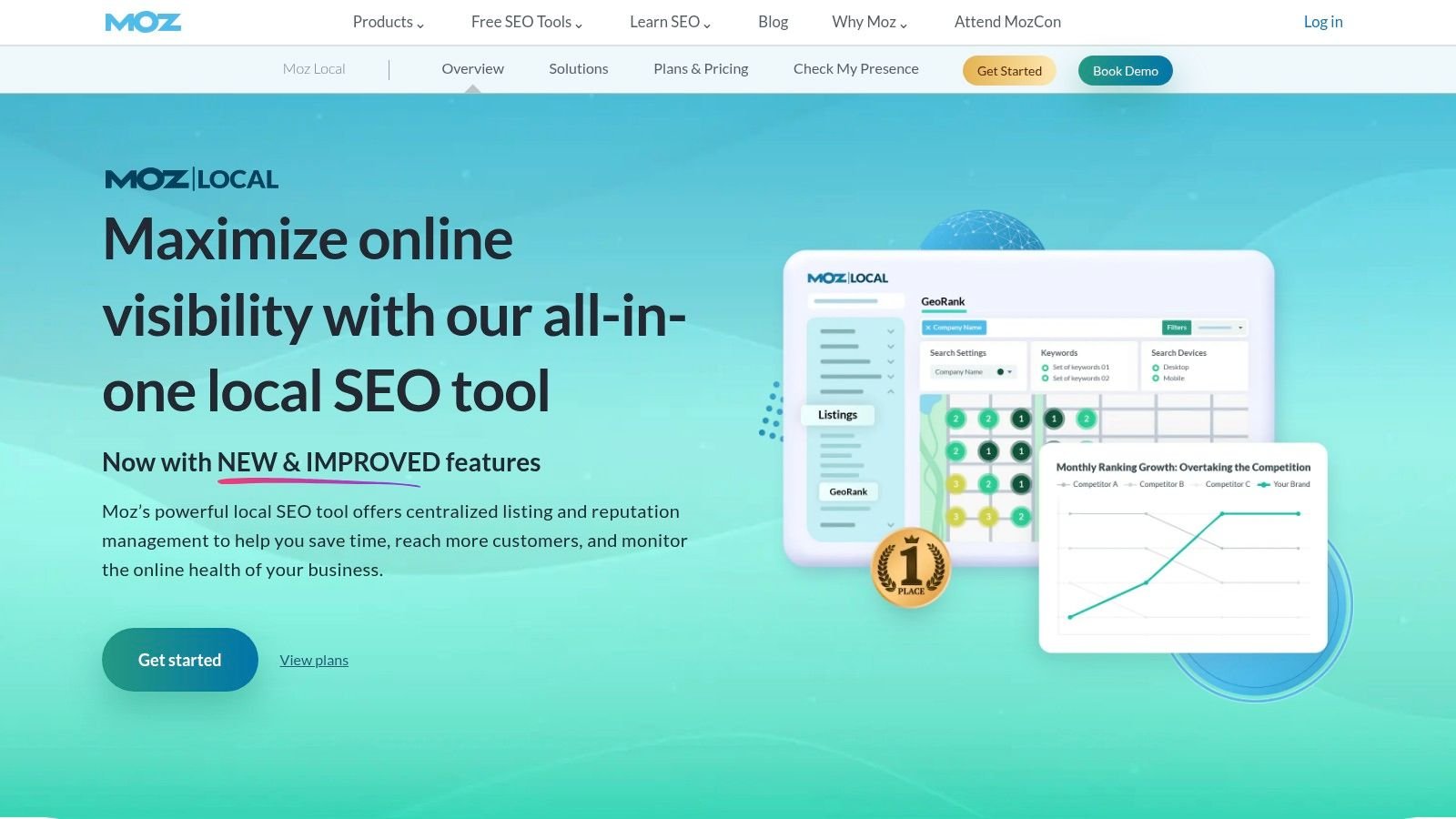
A submission campaign ends. Business information does not. Hours change, locations move, phone numbers rotate, and every stale listing keeps collecting wrong impressions until someone fixes it. That recurring maintenance problem is what Moz Local is built for: distributing and maintaining local business details across listings for companies with physical locations or local service areas.
Moz Local is sold on a recurring plan rather than a one-off campaign fee. Before subscribing, compare current plan prices, supported directories, and location limits directly on Moz's product page, since those terms determine whether the cost makes sense for the number of locations you manage.
The operational distinction matters. A submission service delivers a campaign; listing-management software supports an ongoing workflow for information that can change after publication.
Don't subscribe to local listing management to solve a software-launch problem. Buy it when maintaining location data is the recurring job.
Verify the ongoing commitment
- Platform coverage: Check the actual supported directories rather than assuming universal distribution.
- Location limits: Map the plan to the number of locations you manage.
- Update control: Understand which fields synchronize and where manual intervention remains necessary.
- Cancellation terms: Establish what happens to listing access and management when the subscription ends.
Moz Local is a recognizable local SEO option, but recognition is not a reason to skip coverage checks. A platform is useful only if it manages the destinations relevant to your customers, and the update-control question above matters more than it first appears. If core fields still require manual edits on individual platforms after syncing, the subscription is buying partial automation, so test that workflow on one location before rolling it out across several.
For a local service business, ongoing updates can justify recurring spending. For an indie SaaS founder seeking G2-style evaluation profiles or startup launch placements, this is the wrong category of tool, whatever the monthly entry price.
How the 10 Business Listing Directory Services Compare on Price, Delivery, and Method
Price tells you less than the verification trail does. Two services can charge the same amount and deliver completely different proof: one sends a report that separates live listings from pending submissions, the other sends a spreadsheet of URLs you cannot confirm. Read the table below with that filter in mind, and treat any unstated delivery time or unspecified method as a question to ask before paying, not after.
| Item | Listed Starting Price | Stated Delivery | Submission Method | Best Fit |
|---|---|---|---|---|
| StartupSubmit | One-time plans; Authority plan $299 for 200+ directories | Approximately 5–14 days | Manual, done-for-you | SaaS, AI, and startup teams seeking hands-on submissions and proof |
| SubmitWell | $39 | Not stated | Done-for-you; method not specified | Early-stage software teams wanting a straightforward submission service |
| LaunchPoly Directory Launch | $99 | Up to two weeks | Manual, done-for-you | Products seeking a reported campaign with listing status details |
| LaunchDirectories | $149 | Not stated | Manual, done-for-you | SaaS and AI startups wanting directory coverage and possible launch placements |
| Submitator | $29 | Not stated | Automated, dashboard-managed | Founders who want to select and manage submissions themselves |
| SubmitSaaS | $60 | 48 hours | Automation with human review | SaaS teams prioritizing a fast stated turnaround and account handover |
| SaaSLyft | $99 | Not stated | Manual, done-for-you | Software teams seeking relevant directory selection and campaign reporting |
| Submt | $129 | Not stated | Manual, done-for-you | SaaS founders comparing fixed-price listing packages |
| BrightLocal | $3.20 per site | Not stated | Human-submitted listings | Local businesses and agencies managing citations |
| Moz Local | $16 per month | Ongoing subscription | Listing management and distribution | Local businesses needing ongoing listing updates |
A few patterns stand out. Manual services cluster between $39 and $299 as one-time payments, while the two lowest prices belong to automated or self-managed options. That trade-off is real: automation is cheaper because the labor moves to you, and platform moderation tends to catch bot-driven submission patterns that manual work avoids. Delivery claims matter too. A stated 48-hour turnaround reads very differently once you ask how many of those submissions are live versus merely submitted.
The last two rows belong to a different category entirely. BrightLocal and Moz Local serve local businesses, priced per site or per month, because citation upkeep is recurring work rather than a one-off campaign. Comparing their sticker price against a startup submission package is a category error, and a cheap monthly plan is expensive if it solves a problem you do not have.
Whichever row you pick, the deliverable that counts is the final report: submitted URLs, publication status per directory, and screenshots or account access you can check yourself. A service that cannot tell you which listings are live, pending, or declined has given you an invoice, not evidence.
Choose the Directory Mix That Matches Your Stage, Then Verify Every Listing
Match the service to your product type first. A SaaS founder needs software categories and evaluation-stage profiles; an AI founder needs accurate use-case descriptions; a local business needs location-specific citations and maintained contact details.
For software buyers, reviews deserve attention beyond the backlink. G2's 2024 Buyer Behavior Report, surveying more than 1,900 B2B software decision-makers, found that 31% consult review sites more often than other information sources. A complete profile should help those buyers evaluate integrations, pricing, implementation, and suitability.
Use a report that separates work from outcomes
Keep a canonical record of your product name, URL, categories, description, and approved claims. Adapt wording to each platform without changing the underlying facts.
- Work completed: Submission date, directory, evidence, and account ownership.
- Publication status: Live, pending, declined, duplicate, or awaiting verification.
- Discovery quality: Correct category, accessible profile, accurate brand description, and working destination.
- Business results: Referral sessions, qualified inquiries, assisted conversions, and branded-search changes.
Use Search Console to inspect changes in branded queries and landing-page performance on your own site. Use analytics referral reports to identify directory visits, and record major campaign dates so you don't casually attribute every movement to backlinks.
Treat AI visibility as a verification task
AI Search Optimization and LLM SEO don't turn directory submission into guaranteed ChatGPT visibility. Google's AI features documentation says there are no special technical requirements, special schema markup, or separate submission process for inclusion in its AI search features.
Consistent public profiles can make your business easier to identify, but they don't guarantee inclusion in a Google AI Overview. Test representative branded and category questions, record inaccurate descriptions, and correct the underlying profiles where you control them.
Recognized profiles can also shape what investors and buyers encounter during brand-name searches. Treat that as an opportunity to publish credible information, not a promise that your preferred profiles will occupy page one.
Before paying for another campaign, review the existing report. Confirm included directories, excluded fees, publication status, and account access, then revisit weak profiles once you have actual search and referral evidence. Expand what produces useful discovery, repair what misrepresents the business, and stop paying for irrelevant coverage.
StartupSubmit offers manual directory submissions for SaaS and AI startups, with category matching, duplicate checks, and reporting to help you verify the work. Visit StartupSubmit to review the available coverage and choose a campaign that fits your product and launch stage.
Ready to build high-quality backlinks?
We'll manually submit your product to 60 to 200+ directories in 5 to 7 days, with screenshot proof for every submission. No bots, no boring forms, just more time for selling and building.
See pricing & get started →