Link Building for Startups: A Practical Playbook for 2026
Most advice on link building for startups starts with the wrong target: get as many links as possible, as fast as possible. That made sense when a big list and an automated submitter could look like progress. On a new domain, it creates a messy profile that's hard to defend and even harder to measure.
Search is still worth building for. BrightEdge Research reported in 2019 that organic search generated 53% of trackable website traffic, and search overall accounted for 68% when paid and organic were combined, in the BrightEdge organic traffic research. That doesn't prove a directory listing will send you customers. It does explain why a startup with no brand recognition can't rely only on launch day attention.
I treat directories as an entity and discovery layer, not a volume trick. Your first job is to make it easy for Google, AI tools, and buyers to agree on who you are, what category you're in, and why you exist. Editorial links, partner pages, and press work better once that footprint is clean.
Table of Contents
- Pick the Tactics That Earn Links First
- How to Vet Directories and Prospects in Four Passes
- How Many Prospects You Need
- Partnerships, Press and Guest Posts Without the Penalty Risk
- Tracking Links and Referring Domains That Matter
- Where AI Search Fits Into Your Link Plan
- Start Your First 30-Day Link Sprint
Pick the Tactics That Earn Links First
Volume is the wrong target for a new domain. You have little authority, few indexed pages worth citing, and no pattern of trusted mentions for a search engine to read. Chasing hundreds of random placements at that point gives you a spreadsheet, not a foundation.
Start with consistency. Use the same company name, category, and one-line description across trusted profiles, then add links that come from real relationships and real content. We recommend building directory submissions first as the foundational entity layer, then adding guest posts and press placements for contextual authority. If you want a broader map before you commit time, explore startup link acquisition tactics and compare them against the order below.
How the Main Tactics Compare
| Tactic | Effort | Link quality | Time to first link | Best stage |
|---|---|---|---|---|
| Curated startup directories | Medium, one-time bulk work | Low to medium, mix of dofollow and nofollow | Days to weeks | Pre-launch and launch |
| Launch platforms such as Product Hunt and BetaList | Low to medium | Medium, spike-driven | Launch day | Launch week |
| Integration and partner pages | Medium | High when the partner links editorially | Weeks | After first customers |
| Customer stories and case studies | Medium to high | High when written by the customer | Weeks to months | After early traction |
| Guest posts on niche sites | High | High only with real editorial control | Weeks to months | Growth phase |
| Digital PR and press coverage | High | High when earned by real news | Weeks to months | When there's a data point or launch to share |
| Outreach to resource pages | High | Medium to high | Weeks | Once you have a linkable asset |
Curated directories and launch platforms come first because they're controllable. You can finish them before you have customers, journalists, or a study to pitch. A selective list of startup directories worth checking helps search engines and AI systems find the same facts in several places.
Launch platforms have a clear limit. Product Hunt or BetaList can send a sharp spike, collect early users, and create one useful profile, but that attention fades quickly. Treat launch day as distribution, not your whole Startup SEO plan.
Integration pages and customer stories come next because they need proof. A partner won't document an integration that doesn't work, and a customer story has little value before a customer has a result. Guest posts and press also improve once you have something specific to say, such as original data, a launch, or a founder point of view that isn't a product pitch.
This week, list the tactics that fit your stage, pick two for the first month, and write down the one metric you'll check at day 30. For most early SaaS and AI teams, that metric should be distinct referring domains added, not total submissions.
How to Vet Directories and Prospects in Four Passes
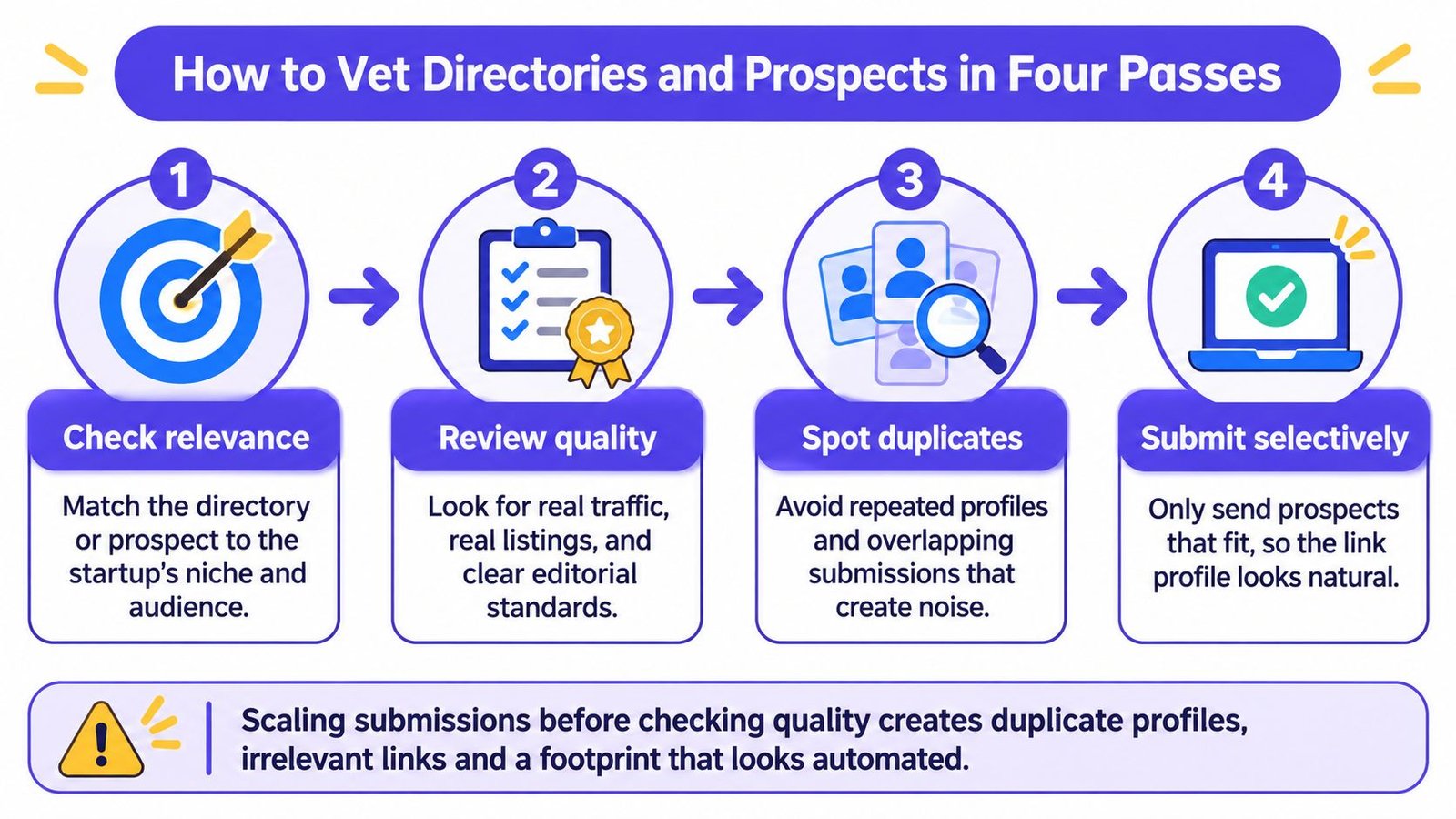
A directory listing is useful when it helps people and search systems understand what your product does. A large pile of unrelated profiles does neither. Vet for relevance, quality, and accurate brand information before submitting.
Google classifies automated link-generation services, low-quality directory links, paid links intended to manipulate rankings, and excessive reciprocal exchanges as link spam in its Google link spam policy. A directory listing can still serve as a useful citation and discovery point when it has a genuine profile purpose, accurate categorization, and a natural reason to exist.
The Four Passes
Define the category. Describe the product and its buyer in plain language, such as invoicing software for freelance translators. Use that description to screen candidates. A relevant niche directory is usually more useful than a broad listing your buyers are unlikely to visit.
Build a matched candidate list. Research directories in the startup's category, match each platform to the product, and skip places where the startup is already listed. Short on time? A smaller, repeatable process beats a giant list you'll abandon halfway, as this manageable approach for time-strapped business owners suggests.
Check quality and indexability. Review actual listings and confirm that profile pages can be crawled and indexed. Look for moderation, clear editorial standards, sensible categories, and current listings. Avoid thin pages packed with unrelated outbound links, copied profiles, or categories that don't fit the product.
Deduplicate and document. Search the platform and Google for the brand, domain, and founder name. Claim or update an existing profile rather than creating a duplicate. Record the destination URL, anchor text, link attribute, submission status, and live listing URL.
Prepare One Data Set Before You Submit
Create a source file with the tool's name, logo, short and long descriptions, pricing model, founder name, use cases, and keywords. Keep the facts consistent, but adapt the length and category details to each platform's fields. Read each form before submitting; identical information does not require identical copy everywhere.
StartupSubmit's in-house SEO team handles submissions by hand, without bots or auto-fill. A manual directory submission service should account for category fit, duplicate listings, and platform requirements, rather than treating every directory as interchangeable.
A listing does not guarantee a backlink. Citation building is not the same as link building, and some profiles may be nofollow, delayed, or rejected.
| Directory type | Examples | Check before submitting | Main risk |
|---|---|---|---|
| Launch platforms | Product Hunt, BetaList | Launch timing and a clear one-line description | Attention may fade after launch |
| Review directories | G2, Capterra | Category fit and review policy | A profile may remain empty without genuine reviews |
| Maker and founder communities | Indie Hackers | Profile completeness and community rules | Promotional posts may be removed |
| Alternatives and comparison lists | AlternativeTo, SaaSHub | Accurate category and feature summary | Listings may be thin or outdated |
| Company data profiles | Crunchbase | Company identity and founder details match other profiles | Conflicting company information |
| Niche and dev-tool lists | Lists matched to your category | Topical relevance and editorial standards | Little audience or discovery value |
After submission, check the live page as a visitor, save a screenshot, and record the listing. Confirm that the profile appears for the brand name, identifies the right category, and links to the correct destination. Track distinct referring domains and, where available, AI referrals. Submitted URLs alone do not show whether listings are improving discovery.
How Many Prospects You Need
A list of twenty friendly blogs is not a pipeline for ten links. Editorial outreach requires more qualified prospects than the number of placements you want, and replies do not guarantee publication.
An Ahrefs poll of more than 800 practitioners reported an average outreach conversion rate of only 1–5%, according to the Ahrefs link outreach guide. Use that range to set expectations, not as a promise. Your asset, niche, and prospect quality can shift the result.
The Planning Math
| Target editorial links | Prospects at 5% conversion | Prospects at 1% conversion |
|---|---|---|
| 5 links | 100 | 500 |
| 10 links | 200 | 1,000 |
| 20 links | 400 | 2,000 |
Ten editorial links could require 200 qualified prospects at a 5% conversion rate, or 1,000 at 1%. If you cannot research enough relevant pages, lower the target or improve the asset. A larger list of unrelated sites will not solve the problem.
Replies and placements are separate measures. A pitch can earn responses yet produce few published links. Track reply rate to judge whether the message is getting attention, then track live placements to measure the outcome.
Build the Asset Before the List
Start with something that addresses a buyer problem. A SaaS startup might publish a benchmark based on public pricing pages, offer a calculator that replaces a spreadsheet task, or share a template users already request. For churn software, a focused study of cancellation flows could give resource-page editors a specific point to cite. A generic product tour gives them less reason to link.
- Compile by relevance: List publications, resource pages, newsletters, and comparison sites your buyers already read.
- Inspect manually: Open each target page and decide whether your asset would improve it, rather than match a keyword.
- Personalize the opening: Name the page, its audience, or an outdated detail. One accurate sentence is stronger than a manufactured compliment.
- Send one concise email: Explain what the asset covers, who it helps, and where it might fit. Avoid requesting exact-match anchor text.
- Follow up once: Keep the follow-up short, then close the loop. Persistent chasing rarely turns a poor fit into a useful placement.
- Classify each outcome: Record replies, referrals, placements, rejections, and nonresponses so the next campaign can use what you learned.
Generic mass email, promotional assets with no new information, irrelevant prospects, aggressive anchor requests, and paid placements presented as editorial wins all weaken a campaign. Count a link as an earned ranking asset only when the placement makes sense to the reader.
Planning rule: Set the prospect count using a conversion rate you can defend, not one that makes the target look easy.
Boost Your Startup's Traffic & SEO with up to 200+ Directory Listings
Skip the grind. Our team manually submits your product to relevant, high-authority directories, with screenshot proof for every submission, so you get real users, feedback and lasting backlinks without lifting a finger.
Get Listed TodayPartnerships, Press and Guest Posts Without the Penalty Risk
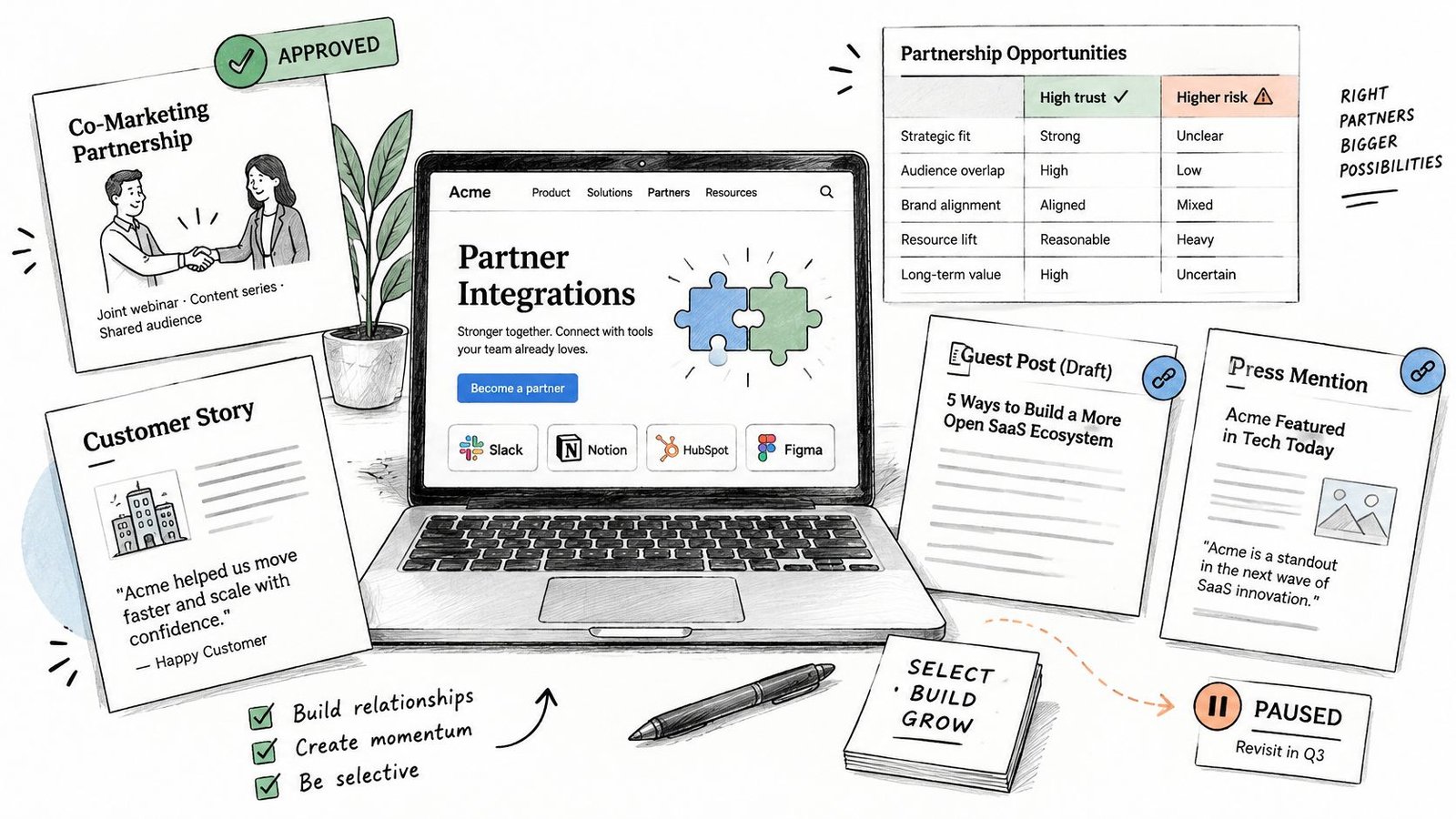
The safest links usually come from relationships that would exist without SEO. Integrations, customers, co-marketing, interviews, and genuine press give another site a reason to mention you. They're slower than buying placements, but they also send relevant readers.
Start With Product and Customer Proof
If your tool ships a working integration with a complementary product, both companies have a natural reason to publish documentation, a marketplace listing, or a launch note. That link is useful because a buyer evaluating either product may need the other one. It's also product work, so it doesn't depend on a cold pitch.
Customer stories work the same way when the customer describes its own result in its own words. A founder interview can do similar work early on, especially when the founder offers a specific lesson rather than a funding announcement. Community participation belongs here too, provided you're answering questions first and using a channel such as Reddit marketing for startups with the community's rules in mind.
Guest posts need more scrutiny. Check who edits the site, whether real authors publish there, whether articles get indexed and read, and whether the topic sits close to your buyers' problems. Pitch original data, a teardown, or a practical framework. If the site sells followed links to anyone with a card, walk away.
Apply the Editorial Test
Google defines link spam as creating links primarily to manipulate rankings, and its Google link spam documentation names buying or selling links for ranking purposes, automated link creation, excessive reciprocal exchanges, and low-quality directory links. Violations can lead to lower rankings or removal from search results.
Paid placements aren't the same as paid ranking credit. Sponsored or advertising links should carry rel="sponsored" or rel="nofollow" so they don't pass ranking credit. Document that attribute instead of reporting every paid mention as an editorial backlink.
Before you pursue a placement, answer four questions:
- Does the page sit in a category your buyers read?
- Is the link editorial, or clearly labeled if it's paid?
- Does the anchor use your brand name or a natural phrase?
- Would you still want it if it passed no ranking credit?
If question four is no, you're probably buying a metric rather than earning exposure. For each placement you keep, write one sentence explaining why a human reader would click. That sentence is a surprisingly effective filter.
Tracking Links and Referring Domains That Matter
Submitted URLs are the wrong headline metric. A submission can be rejected, noindexed, duplicated, left without a link, or removed a month later. Distinct referring domains tell you whether new, separate sites are referencing you.
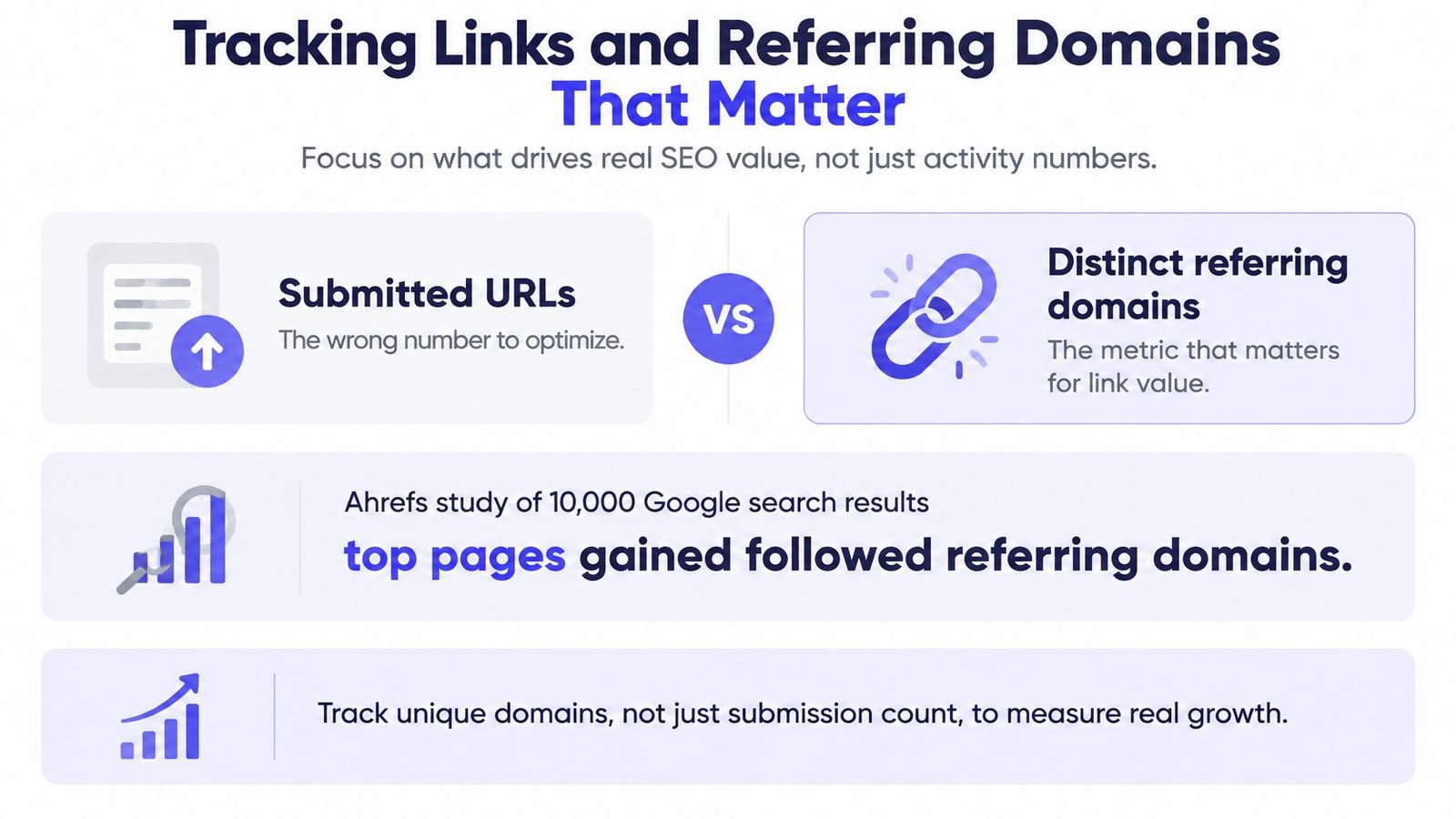
An Ahrefs analysis covering 10,000 Google search results found most top-ranking pages gained new followed referring domains at roughly 5% to 14.5% per month, in the Ahrefs backlink growth study. That doesn't set a quota for a startup. It does argue against one launch spike followed by silence, or repeated links from the same domain dressed up as growth.
The Monthly Dashboard I Would Use
- Referring domains added: Count distinct, relevant domains, and name the source of each one.
- Indexed live links: Confirm the listing or article is published, crawlable, and visible in search.
- Link survival: Recheck placements every 30 days, including changed URLs and removed profiles.
- Referral traffic: Use UTM parameters where you control the destination link, then inspect sessions and conversions.
- Branded search: Watch whether more people search your company or product name after coverage.
Put Domain Rating below those measures. It's a third-party estimate, useful for spotting broad movement, but it isn't revenue, traffic, or proof that a specific directory worked. Tools also gather and model data differently, which is why a comparison such as Semrush vs Similarweb is worth reading before you treat one dashboard as truth.
Your monthly report can fit on one page: new domains, links lost and why, referral sessions, branded search movement, and the next action. That specificity matters. In 2025, 40% of more than 300 SEO professionals surveyed said their link-building reports effectively demonstrated ROI, according to the Citation Labs and BuzzStream link building survey.
Keep a per-link record underneath the summary with index status, anchor text, link attribute, destination URL, and acceptance status. The same discipline applies whether the source is a startup profile, an editorial article, or a listing created through a local citation service. If a link sends nobody and doesn't strengthen your entity footprint, ask who reads that page before you chase more like it.
Where AI Search Fits Into Your Link Plan
Link building for AI discovery is not the same as link building for Google rankings. A backlink can support a page in search without making your startup the source an AI system chooses to cite. Treating every directory profile as an AI visibility win overstates what the listing can do.
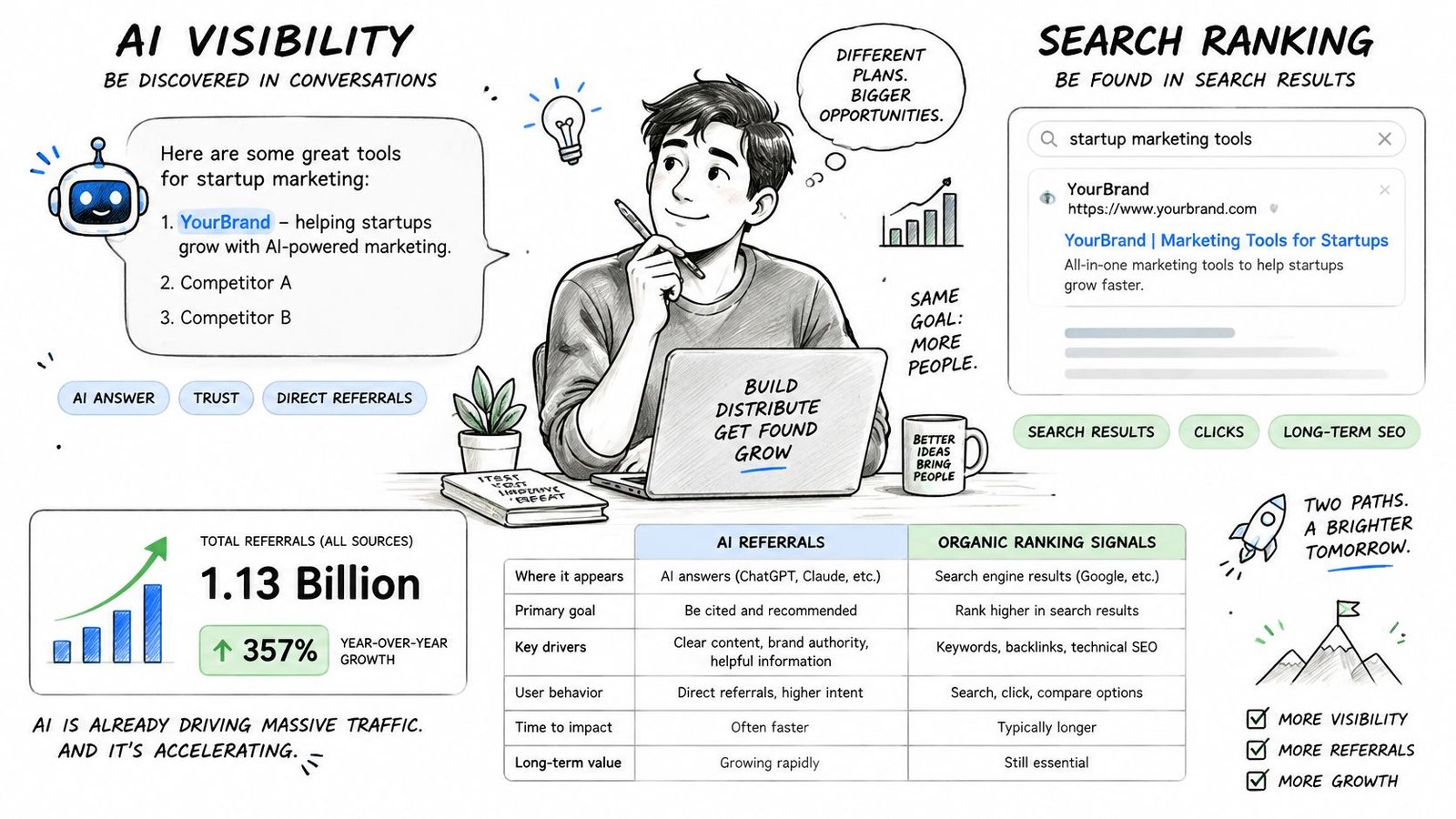
Similarweb data reported by TechCrunch found AI platforms sent more than 1.13 billion referrals to the top 1,000 websites in June 2025, up 357% year over year, while Google Search generated about 191 billion referrals, in TechCrunch reporting on AI referrals. AI referrals are growing from a much smaller base. They deserve tracking, not a separate strategy built on hope.
Google also gives startups a technical baseline for AI Search Optimization and LLM SEO. Pages must be indexed and eligible to appear in normal Google Search with a snippet before they can be shown as supporting links in AI Overviews or AI Mode, according to Google guidance on AI features in Search. A blocked or noindexed profile can't become a supporting source just because it mentions your name.
What Makes a Startup Easier to Cite
Keep your name, category, one-line description, pricing model, and product URL consistent across profiles. Make product, pricing, comparison, and documentation pages crawlable, with unambiguous language a buyer and a retrieval system can both parse. Then earn independent coverage, because third-party evidence carries more weight than your own description repeated across listings.
Click expectations need honesty too. A Pew study cited in the same TechCrunch reporting found links were clicked 8% of the time when an AI Overview appeared, versus 15% without one. If an AI citation sends fewer, better-informed visitors, the landing page has to answer the next question and convert quickly.
Run four checks each month:
- Brand check: Confirm key profiles appear when someone searches your brand name.
- Index check: Confirm the pages you want cited are indexed and snippet-eligible.
- Prompt check: Ask AI tools the questions your buyers ask and log which sources they cite.
- Referral check: Track AI referrals, branded searches, and assisted conversions separately from rankings.
A directory link alone won't make a startup visible in Google AI Overview results or improve ChatGPT visibility. It can make your entity easier to corroborate. The citation still depends on useful pages, independent mentions, and a clear answer to the buyer's question.
Start Your First 30-Day Link Sprint
A 30-day sprint should produce a clean foundation and one outreach test, not a promise of category rankings. Keep the work narrow enough to finish, and measure what went live.
Week by Week
Week 1: Lock the data set. Finalize your tool URL, name, logo, short and long descriptions, problem solved, pricing model, target use cases, founder name, and keywords. Build the candidate list with the four vetting passes, remove duplicates, and decide which pages each listing should point to.
Week 2: Submit selectively. Work through the directories that passed, including any relevant options you find among free startup directories. Submit manually, confirm publication, inspect the live page, save proof, and log the URL, anchor, attribute, and acceptance status. Don't count a form confirmation as a link.
Week 3: Publish and pitch one asset. Release the calculator, benchmark, template, or teardown you built for buyers. Prospect according to your target, personalize each pitch, send one follow-up, and record every outcome. If the asset isn't ready, use the week to finish it rather than pitching a features page.
Week 4: Review and choose the next tactic. Check distinct referring domains, indexed links, referral traffic, branded search, and AI mentions. Fix broken or mismatched profiles first. Then decide whether integrations, customer stories, guest posts, or press offer the strongest next source based on assets you have.
The Handoff Decision
Manual directory work is repetitive, so handing off that layer can make sense when founder time is better spent on customers, partners, and outreach. To start, we need the same intake fields listed in week 1. A directory campaign can build 60–220+ backlinks from established domains, many with DA 60–92, and the Growth plan includes priority processing at approximately $1.33 per backlink. A typical execution window is about 5 to 14 days.
Judge us, or any provider, by the itemized report: live URLs, screenshots, acceptance notes, anchor text, attributes, and rejected listings. No provider can promise a backlink from every directory.
Run the directory layer yourself or hand it off, but keep relationship-led outreach in-house either way. Nobody can explain your customers, integrations, or founder story better than your team.
Your next step is to finish the data set, vet the first directory batch, and put the day-30 review on the calendar before you submit anything. That sequence keeps SaaS SEO grounded in evidence instead of a growing list of untested URLs.
If you'd rather spend the next month on customers and partnerships than repetitive directory forms, StartupSubmit can handle the manual submission layer with category matching, duplicate checks, and an itemized report of live placements. Send over your product details, keep editorial outreach with your team, and use the report to track distinct referring domains rather than submission counts.
Ready to build high-quality backlinks?
We'll manually submit your product to 60 to 200+ directories in 5 to 7 days, with screenshot proof for every submission. No bots, no boring forms, just more time for selling and building.
See pricing & get started →