What Is Listing Optimization for Startup Directories
Listing optimization is improving a startup or product profile across directories so it is accurate, complete, consistently categorized, and easy for people and search systems to verify.
The popular advice is to submit your startup everywhere and collect the links. That's a distribution tactic, not an optimization strategy. If those profiles describe different buyers, point to old URLs, or place your software in unrelated categories, you've created more pages without making the company easier to understand.
Table of Contents
- What Listing Optimization Means for Software Startups
- The Listing Fields That Search Systems Actually Read
- Why Directory Profiles Affect SEO Discovery and Trust
- Make the Company Profile Machine Readable
- How Moderation Rewards Hand-Written Listings
- How to Shape Listings for AI Answers
- Worked Examples and the Mistakes That Get Listings Ignored
- Build a Consistent Profile Before You Submit More
What Listing Optimization Means for Software Startups
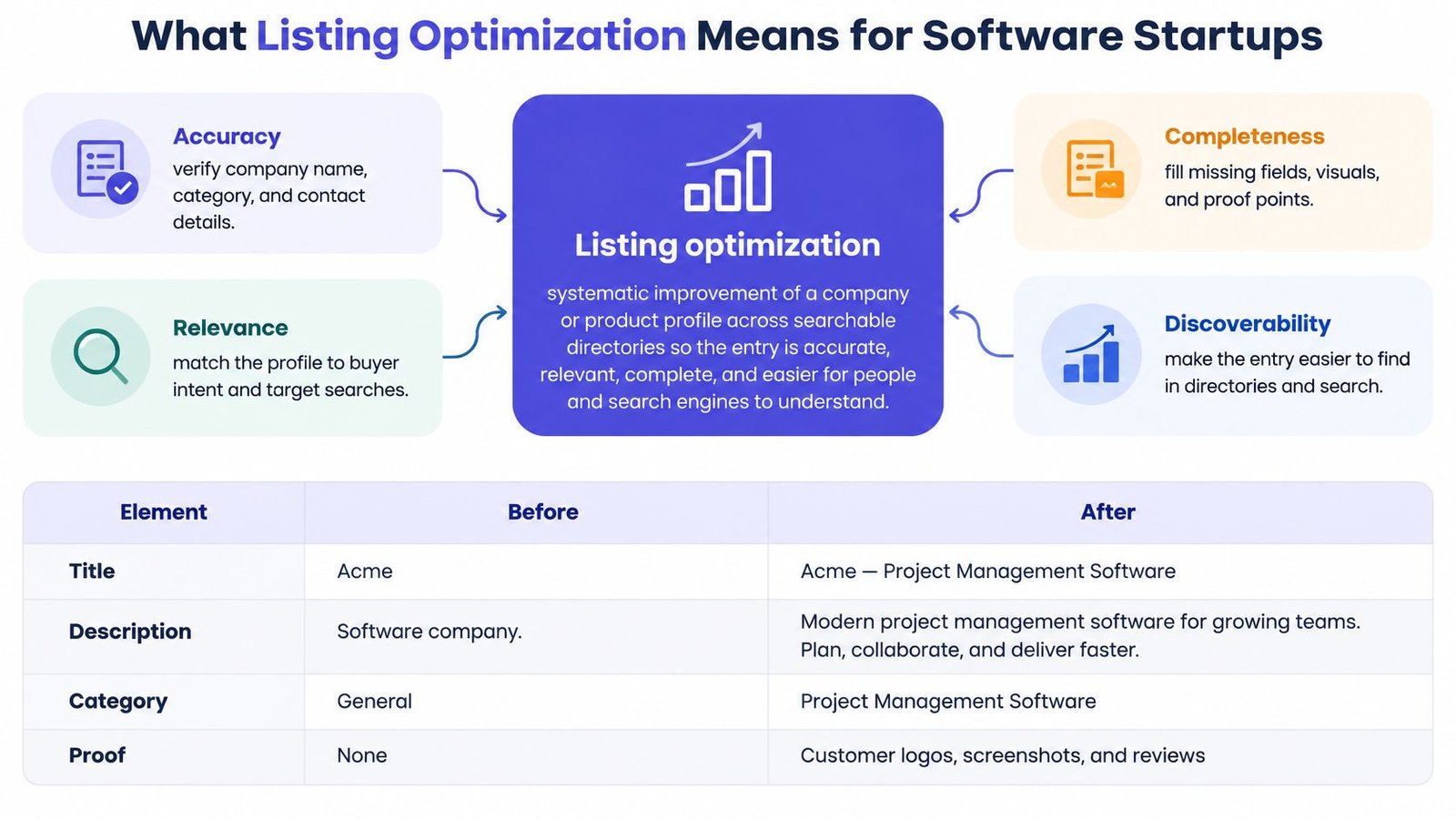
Listing optimization is the systematic improvement of a company or product profile across searchable directories. For software founders, the useful question isn't just whether a profile exists. It's whether someone can understand and verify the product from that profile.
Search results for this topic often focus on Amazon titles, bullets, and product images. This guide concerns startup and software directories such as Product Hunt, G2, Capterra, BetaList, Indie Hackers, AlternativeTo, and SaaSHub.
A profile isn't the same as a clear product identity
Say you're launching an AI assistant for customer support. Your homepage calls it support software, your launch profile calls it an AI productivity platform, and a review site places it under marketing automation.
Each description might contain something true. Together, they leave a buyer uncertain about the main job your product does.
Optimization starts by choosing the central category and buyer, then expressing those facts in each platform's format. You can change the wording without changing the underlying identity.
Translate local search principles carefully
Google's local ranking guidance identifies three primary factors: relevance, distance, and prominence, with prominence influenced by links, articles, directories, and the number and quality of reviews.
That isn't a published ranking formula for SaaS directories. It's a useful way to separate matching from corroboration.
For a software product without a storefront, geographic distance usually falls away as a practical consideration. Relevance becomes category and use-case fit. Prominence becomes the external evidence that helps a prospect recognize and validate the company.
| Profile element | Before optimization | After optimization |
|---|---|---|
| Title | Brand plus an ambitious slogan | Recognizable product name and permitted category language |
| Description | Broad claims about productivity | Specific buyer, workflow, and outcome |
| Category | Whatever gets the form submitted | Closest accurate category on that platform |
| Proof | Unsupported claims | Product visuals, documentation, and genuine reviews |
A SaaS directory submission workflow should preserve those distinctions rather than treating every directory as another place to paste a paragraph.
Practical test: A stranger should be able to name the product, the buyer, and the canonical website from the listing alone.
Creating the account gets you access to a form. Optimizing the profile turns that form into an externally verifiable description of the business.
The Listing Fields That Search Systems Actually Read
Search systems can only interpret information they can access. Start with the visible profile fields, not speculative tricks for influencing an algorithm.
A buyer should find the same basic product facts whether they open your homepage, a review profile, or a niche software list. That doesn't require identical copy. It requires compatible answers.
Directory listing fields and what breaks them
| Field | Optimize for | Why it matters | Common failure |
|---|---|---|---|
| Title | Product name plus plain category | Query match and scannability | Slogan or keyword stuffing |
| Short description | Buyer and job in a concise sentence or pair of sentences | Snippets and AI summaries | Same blurb pasted everywhere |
| Long description | Use cases, exclusions, differentiator | Relevance and entity clarity | Vague all-in-one platform copy |
| Category | The directory's own closest category | Classification and browse discovery | Wrong or generic bucket |
| Tags | Only tags that directory offers | Related-query matching | Invented tags or off-category keywords |
| Images | Logo and a readable screenshot | Moderation and recognition | Missing, tiny, or mismatched assets |
| Links | Canonical site URL and live social profiles | Entity connection and clicks | Tracking URLs or dead social links |
| Reviews | Honest ratings plus founder replies | Trust on branded searches | Unclaimed profile and no responses |
| Pricing and audience | Facts that match the homepage | Contradiction checks | Outdated price or a different buyer |
Lead the title with the actual product name. Add a plain category only when the platform permits it; a name-only field isn't an invitation to append search terms.
The short description should identify who uses the product and what they do with it. When space is tight, remove adjectives before removing the buyer or workflow.
Use the long description for the details that help someone qualify themselves: supported use cases, integrations, exclusions, and a concrete difference from alternatives. If your tool generates drafts but doesn't publish them, say so. That boundary prevents the wrong expectations.
Classification needs judgment, not more keywords
Choose categories from the directory's own taxonomy. A developer tool forced into a broad startup bucket may technically be listed but remain absent from the browsing paths its buyers use.
At StartupSubmit, an SEO strategist matches the full directory list to the product's exact category. Each listing gets tags selected from the options that specific directory offers. Those are separate decisions: choosing an appropriate platform doesn't automatically produce an appropriate profile.
Handle the remaining fields with the same discipline:
- Images: Use a current logo and a screenshot that shows the actual workflow. Crop out empty browser space and make the interface readable.
- Links: Put the clean canonical address in the website field. Use dedicated campaign fields for tracking where available, and test every social link.
- Reviews: Claim eligible profiles and respond with useful context. Don't invent customer ratings or write testimonials on someone else's behalf.
- Pricing and audience: Match the homepage's current billing basis and customer definition. A monthly price and an annually billed monthly equivalent aren't interchangeable.
A person should review the form before submission and inspect the published result afterward. StartupSubmit performs both checks, including a human check of each field before submitting.
Before opening another form, freeze a source-of-truth document containing the name, URL, category, positioning sentence, buyer, pricing, logo, and screenshot. Assign an owner to approve changes so a product update doesn't leave every submitter working from a different version.
Why Directory Profiles Affect SEO Discovery and Trust
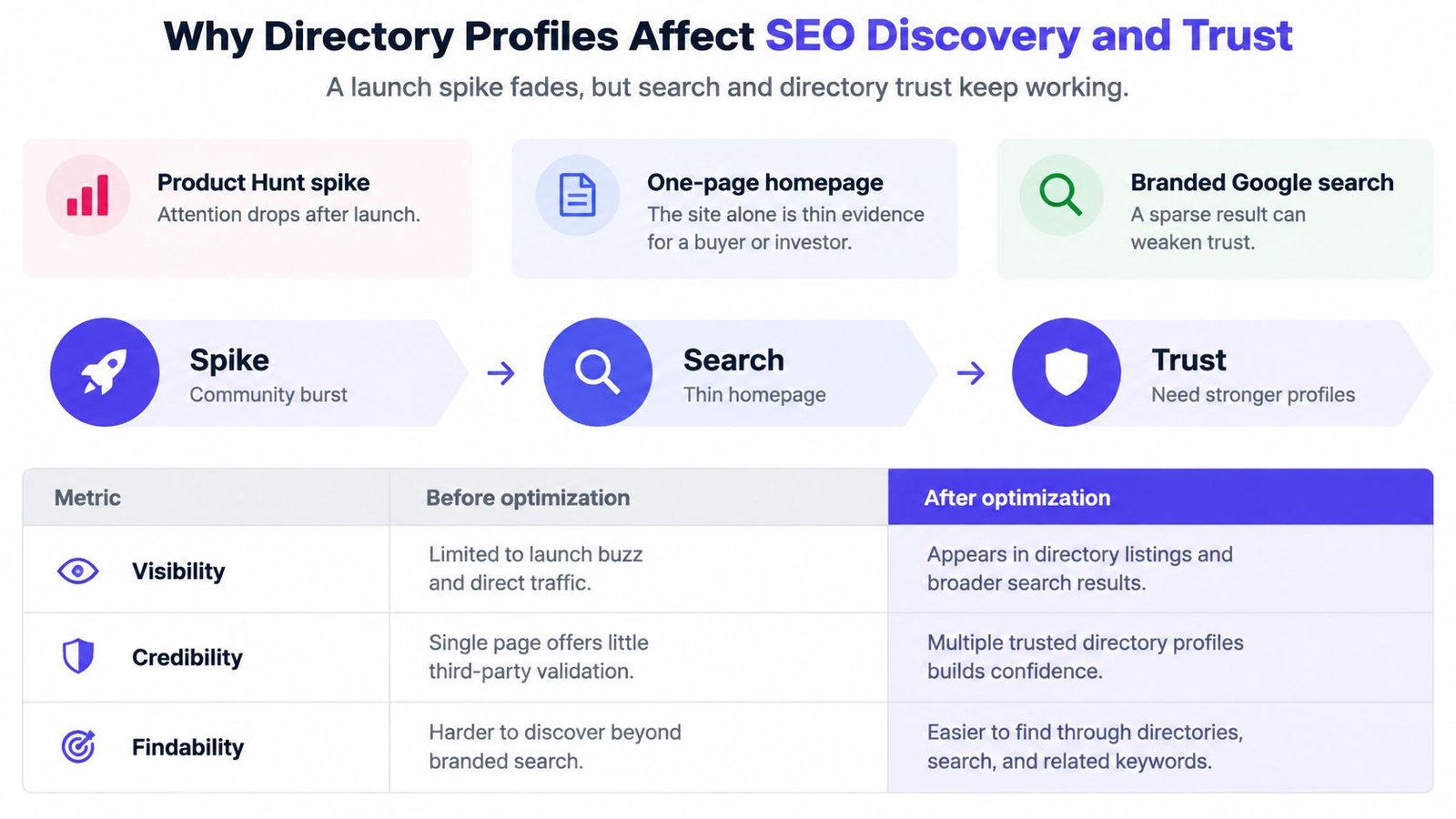
A launch can generate attention without leaving much evidence behind. Once the Product Hunt discussion slows, a prospect may search your brand and find little beyond the homepage.
That creates a verification problem. The buyer isn't necessarily asking whether your website looks professional. They're checking whether the company exists beyond its own claims.
Buyers use external profiles to reduce uncertainty
BrightLocal's 2025 Local Consumer Review Survey, based on responses from 1,026 U.S. adults, found that 74% check reviews on at least two platforms when researching a local business, while 89% would use a business that responds to all reviews compared with 44% for one that doesn't respond.
Those are local-business findings, not SaaS conversion benchmarks. The relevant lesson for software founders is the comparison behavior: buyers can check several independent pages before deciding whether your claims hold together.
Similarly, a 2024 survey reported by Fit Small Business found that 91% of consumers said local reviews affected their overall perception of a business.
For a software buyer, a G2 profile, a Capterra review, and a clear startup profile can provide different kinds of reassurance. None replaces working software, useful documentation, or credible customer evidence.
Backlinks and buyer confidence are different outcomes
A directory link isn't automatically a ranking win. Its value depends on whether the page is accessible, relevant, maintained, and useful to people searching in your category.
The Ahrefs backlink-growth study reported that most pages ranking in Google's top position acquired followed backlinks from new referring domains at approximately 5% to 14.5% per month. That observation doesn't establish causation or tell a new startup how quickly its rankings will improve.
Use it as a reminder that link acquisition is an ongoing activity, not a launch-day checkbox. Inspect the actual linking page rather than accepting a domain-level authority score as proof of value.
A recognizable directory can help a buyer trust you even when its link doesn't pass ranking credit. A followed link can exist on a page that no qualified buyer ever opens.
Keep separate reporting for:
- Discovery: Directory impressions, qualified referral visits, and relevant category exposure.
- Trust: Useful branded-search coverage, substantive reviews, and accurate company information.
- Link equity: Distinct relevant referring domains, link attributes, crawlability, and indexed profile pages.
Collapsing these into a single backlink count hides the trade-offs. A founder evaluating startup SEO needs to know which outcome improved, not just how many forms were completed.
Make the Company Profile Machine Readable
The profile people read and the identity information crawlers process should agree. Structured data helps describe that identity on your own website, where you control the implementation.
You usually can't edit the markup on an external directory. You can control whether your site's company information supports or contradicts what that directory publishes.
Mark up facts you can defend
Google's structured-data introduction recommends JSON-LD where feasible because it's generally the easiest implementation method, and requires markup to accurately represent visible content for enhanced-search eligibility.
Start with the organization name, canonical URL, logo, description, and applicable sameAs profile links. Use relevant software or offer markup only when it accurately describes content on the page.
Don't add an invented founding date, address, award, or review to make the markup look complete. More properties aren't better if they're irrelevant or false.
Validate before expecting search benefits
Google's Organization documentation states that Organization markup has no required properties and recommends validation, accessible deployment, URL inspection, and sitemap submission.
A practical deployment sequence is:
- Validate the markup. Run the page or code through Google's Rich Results Test. Check applicable properties rather than assuming every valid organization page will qualify for a special display.
- Publish on an accessible page. Don't place the company identity behind a login, a
noindexdirective, or a crawl block. - Inspect the URL. Use Search Console to check whether Google can access the intended canonical page and see the rendered content.
- Refresh discovery signals. Update the sitemap and submit it when appropriate. This supports discovery; it doesn't force immediate recrawling or inclusion.
Check the visible page alongside the JSON-LD. A markup description calling the company an enterprise analytics vendor won't help if the page presents a consumer writing app.
The distinction matters for SaaS SEO: structured data describes content; it doesn't repair weak positioning. Nor does valid markup guarantee a rich result, a Google AI Overview citation, or a correct AI-generated recommendation.
How Moderation Rewards Hand-Written Listings
A complete form can still fail moderation. Common reasons include the wrong category, descriptions that don't fit the directory, vague positioning, missing assets, and suspicious velocity patterns such as many identical submissions from one IP.
Submission quality isn't just about spelling. It's about respecting what the platform accepts and giving a moderator enough information to make a decision.
Use a deliberate submission sequence
A careful operator works through the directory, not around it:
- Search for an existing profile. Check the brand name, website, and old product names. Claim or update an existing page where possible instead of creating a duplicate.
- Inspect the available taxonomy. Choose the closest truthful category and supported tags. If there's no defensible fit, skip the platform.
- Rewrite for the form. Fit the character limit and editorial tone without removing the product's essential meaning.
- Attach the required assets. Use the requested file formats and readable product visuals. Don't substitute a logo for a screenshot field.
- Submit individually. Use a normal founder or operator session rather than blasting cloned entries.
- Check the result. Review the fields before sending, then inspect the published page for truncation, broken links, category changes, and missing images.
At StartupSubmit, we submit every listing by hand and rewrite each description for that platform's character limit and tone. Our directory submission service follows that manual approach rather than sending the same paragraph through automated forms.
Manual work improves control, not certainty
Bots and spam networks remove the judgment from the process. They can repeat the same anchors, unsuitable categories, and descriptions across unrelated sites, leaving moderators to deal with the mismatch.
Hand-written doesn't mean elaborate. A plain description that answers the form's questions is usually more useful than polished copy that avoids naming the buyer.
Submission rule: Optimize for an accurate, publishable profile, not for the largest submission counter.
Each directory still controls publication. Some publish immediately; others review submissions over days or weeks or request owner verification.
Track pending verification separately from rejection. If the founder hasn't confirmed ownership, sending another submission won't resolve the problem and may create a duplicate.
The benefit of manual submission is better editorial control and fewer avoidable moderation problems. It isn't a promise that every application becomes a live profile or that every published profile provides a followed backlink.
How to Shape Listings for AI Answers
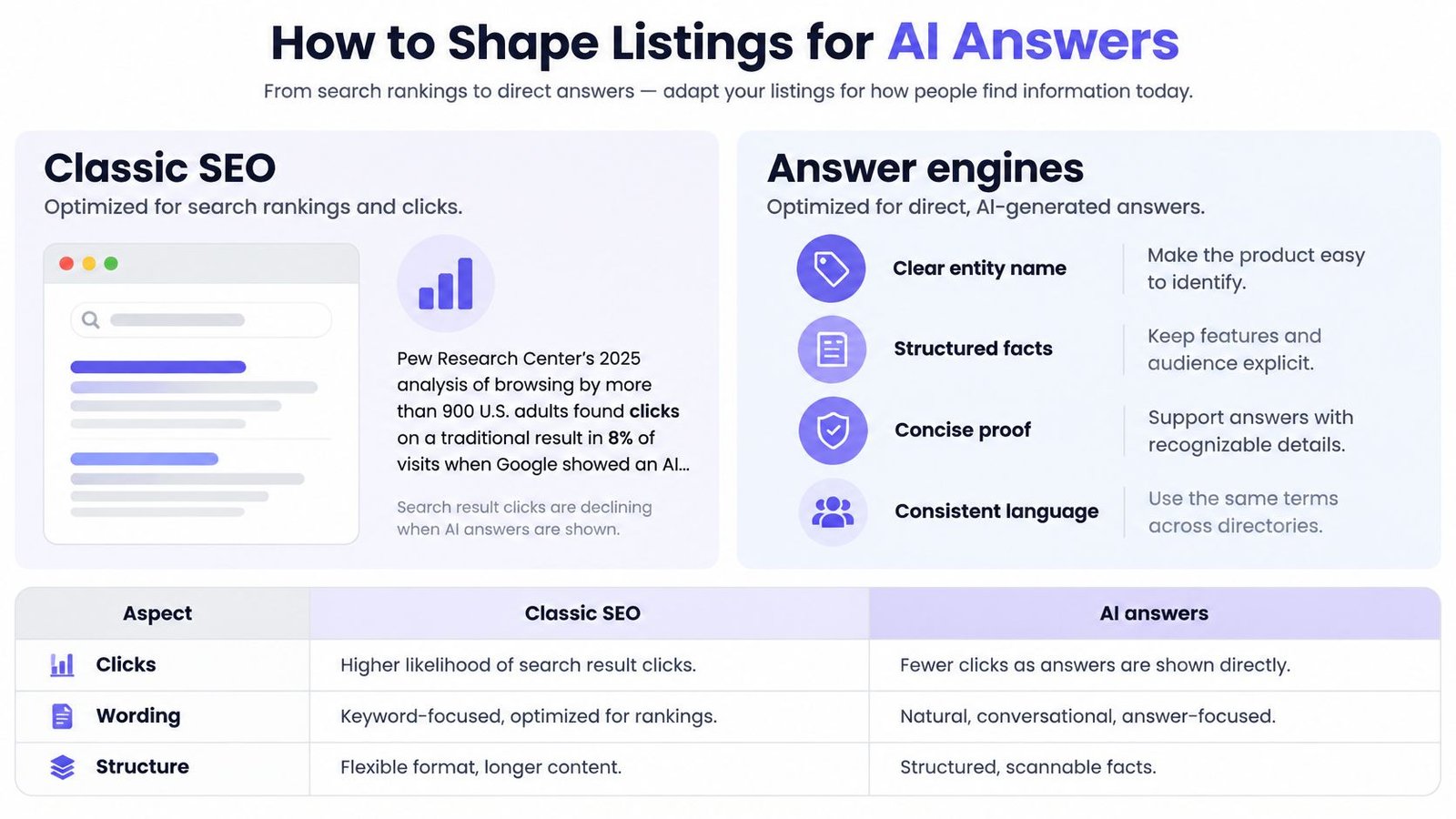
AI search optimization changes what a useful directory profile needs to do. The entry must give an answer system explicit facts it can accurately summarize, not merely include phrases that resemble a search query.
In Pew Research Center's 2025 analysis of browsing by more than 900 U.S. adults, users clicked traditional results on 8% of visits with an AI summary versus 15% without one, clicked summary links on only 1% of visits, and ended sessions on 26% of pages with a summary versus 16% without.
That doesn't make organic clicks irrelevant. It means accurate representation inside an answer deserves its own measurement.
Different discovery systems need separate checks
A Yext analysis of 6.8 million citations from 1.6 million AI responses found that industry-specific directories supplied 24% of citations for unbranded subjective queries in Perplexity, while listings supplied 48.73% of OpenAI citations.
Those findings describe the analyzed responses, not guaranteed placement for a particular startup. Google organic, Google AI Overview, Perplexity, and ChatGPT-style answers don't operate as a single shared ranking list.
What different discovery systems take from a listing
| System | What a listing supplies | Evidence to respect | What to track |
|---|---|---|---|
| Google organic | Category match, links, reviews, prominence | Relevant external references can support business discovery | Indexed URL, referring domain, branded clicks |
| Google AI Overview | Repeated entity facts and a canonical URL | Summary visibility and website clicks are different outcomes | Whether the answer states the right product and buyer |
| Perplexity | Niche directory corroboration | Industry-specific directories appeared in the analyzed citations | Category fit and whether the directory is cited |
| ChatGPT and OpenAI-style answers | Listing facts alongside outside corroboration | Listings appeared in the analyzed citation mix | Sampled answers for category, audience, and URL accuracy |
Choose citation-worthy platforms, not just available forms
Evaluate a directory against these checks:
- Category fit: Does it organize products around the problem your buyer has?
- Factual completeness: Can you state the buyer, workflow, compatibility, geography where relevant, and canonical website?
- Third-party corroboration: Does the platform contain genuine reviews, editorial context, or independent discussion?
- Update access: Can you maintain the profile when the product changes?
- Observed citations: Does the platform appear in answers to the discovery questions you care about?
An AI directory submission workflow should start with relevance, not a list of every website accepting an AI tool.
For LLM SEO and ChatGPT visibility, write descriptions that answer ordinary buyer questions. State what the product does, who it's for, what it integrates with, and where its limits are.
Pair listings with useful first-party documentation, genuine reviews, and independent mentions. Sample the same relevant prompts over time, recording the system, query, answer, cited pages, and factual accuracy. A single screenshot isn't evidence of dependable visibility.
Worked Examples and the Mistakes That Get Listings Ignored
Correct fields don't guarantee useful exposure. A profile can pass moderation and still attract the wrong buyer, sit on an irrelevant site, or supply an outdated fact that gets repeated elsewhere.
The following scenarios show what a useful editorial change looks like. They're examples, not claims about named customers.
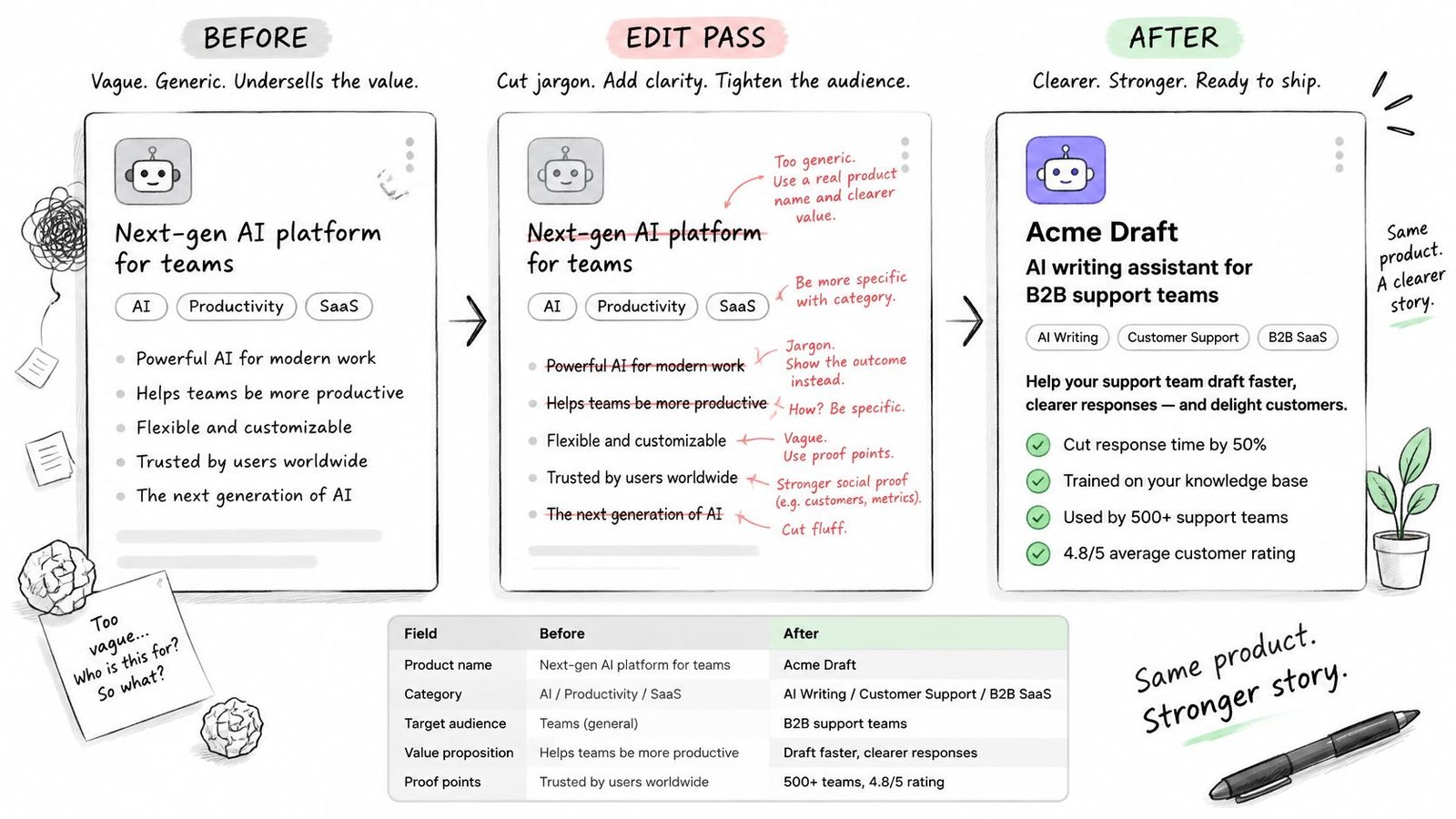
Rewrite around the actual buying decision
| Product scenario | Before | After |
|---|---|---|
| AI writing tool | Next-gen AI platform for teams | Acme Draft, an AI writing assistant for B2B support teams |
| Developer tool | We help developers ship faster | Acme CI, pull-request checks for TypeScript monorepos |
| Vertical SaaS | The same broad paragraph pasted into every form | Platform-specific descriptions preserving the same customer, pricing basis, and website |
For the writing assistant, choose the directory's relevant AI or support category and show the editor in use. A logo alone doesn't demonstrate whether the product drafts replies, manages tickets, or creates marketing copy.
For the developer tool, prioritize dev-tool lists and relevant indie hacker communities. A generic startup board may accept the entry without reaching anyone looking for monorepo checks.
For vertical SaaS, adapt emphasis to the directory. A review platform may need implementation details, while a short startup profile needs a tighter buyer-and-job statement.
Frequently asked questions about listing performance
Will getting listed everywhere keep my startup in AI answers?
No. A 2025 AirOps study analyzing more than 45,000 AI citations across 800 queries found that approximately 57% of brands that disappeared later resurfaced, and brands with both a mention and citation were 40% more likely to reappear than citation-only brands.
Treat generated visibility as variable, not as a permanent ranking position. Broader evidence helps systems evaluate a company, but it doesn't lock the company into an answer.
Are free directories worth using?
Yes, when they're relevant, maintained, and useful to the audience. A curated starting point such as this list of free startup directories still needs product-level screening.
An irrelevant network of profile pages doesn't become valuable just because submission costs nothing. Founder time, profile maintenance, and potential brand confusion are costs too.
What can go wrong after approval?
A stale pricing claim can conflict with your homepage. An unclaimed review page can leave a buyer's question unanswered. A redirect after a rebrand can send visitors somewhere unexpected.
Log more than accepted status. Record the live URL, inspect whether it's discoverable, and check whether it sends qualified visits or supports an accurate branded search result. Recheck affected profiles when the product, category, pricing, or company identity changes.
Build a Consistent Profile Before You Submit More
Start with the smallest set of actions that removes ambiguity. Adding distribution before settling the product story makes every later correction more expensive.
A practical execution checklist
- Approve the source of truth. Settle the product name, buyer, category, job, canonical URL, current pricing, logo, and screenshot with the person responsible for positioning.
- Align the website. Make the visible company information accurate and crawlable. Add structured data only for facts you can substantiate.
- Choose a focused shortlist. Use a selection such as these startup directories worth evaluating to identify review sites, startup communities, and niche lists that fit the product. Exclude spam networks.
- Submit and document. Rewrite for each form, work manually, and record the submission date, status, published URL, and verification requirements.
- Manage review profiles. Claim eligible pages and give helpful replies without pressuring customers to change honest ratings.
- Evaluate the published evidence. Check accessibility, search visibility, referral quality, branded results, and sampled answers. Correct inaccurate profiles before expanding coverage.
For founders delegating the form work, our team skips existing listings and reports placement URLs with screenshots. Use that help after the facts are approved, not as a substitute for deciding what the product is.
Set expectations before hiring help
StartupSubmit doesn't promise a number of listings that will go live because each directory decides whether to publish. Some platforms publish instantly; others require review or owner verification on their own timeline.
Florin described the manual approach on X: “If you want to rank higher in Google & LLMs, they manually submit your startup to 250+ directories. Pretty cool!” That's a customer comment, not a guarantee of rankings, approvals, or citations.
The useful starting question isn't how many profiles you can buy. It's which missing or inaccurate profiles prevent a qualified buyer from understanding and checking your company.
More listings aren't the same as a clearer entity. Expand coverage when the existing profiles tell a precise, defensible story.
Pick the most consequential correction, assign an owner, and update the source-of-truth document before starting the next submission batch.
StartupSubmit offers manual, category-matched directory submissions with descriptions adapted to each platform and reporting that helps you inspect the results. If your product facts are settled and you want help turning them into consistent external profiles, visit StartupSubmit to review the submission options.