
SaaS Directory Submission: A Practical Guide for 2026
Submitting your SaaS to every directory you can find isn't a distribution strategy. It's a form-filling project unless the resulting profiles help buyers evaluate your product or give search systems accurate information about it.
SaaS directory submission works best as buyer-verification infrastructure, with backlinks as a possible additional benefit. Start with the places your prospects check, publish information you can maintain, and measure what happens after the forms are submitted.
Table of Contents
- What a SaaS Directory Listing Actually Does
- Directory Tiers Worth Your Time
- How to Vet a Directory Before You Submit
- Preparing a Listing That Gets Accepted
- Mistakes That Waste Founder Time and Weaken Listings
- Measuring Results Across Search and AI Answers
- Audit Your Listings This Month Before Submitting Again
- Frequently Asked Questions About SaaS Directory Submission
What a SaaS Directory Listing Actually Does
A backlink isn't the most useful thing every directory gives you. Sometimes the bigger benefit is a credible page that confirms your product exists, belongs in the right category, and does what your website says.
A B2B SaaS Reviews compilation of buyer research reported that 89% of B2B buyers who use review sites check them often or always before purchasing business software. That's a specific group, not all buyers, but it makes the practical point: your profile is somewhere prospects may investigate you, not merely somewhere you leave a link.
Discovery and verification are different jobs
Discovery means someone encounters your product while browsing a category or comparing alternatives. Verification happens when someone already knows your name and wants reassurance before signing up, sharing company data, or booking a demo.
Say a prospect requests a demo for your new B2B tool, then searches its name. They find a review profile showing pricing from two years ago and a description aimed at a different customer. Before you've spoken, they're wondering which version is accurate.
For an early-stage product, I'd prioritize verification. You may not have enough reviews to compete on a category leaderboard, but you can still give a cautious buyer a coherent company record.
Practical rule: A profile earns its place through accuracy and relevance, not because it adds another URL to a spreadsheet.
Give buyers enough information to decide
A useful profile should answer:
- Identity: Is this the same company and product I found elsewhere?
- Fit: Does it solve my problem, and does it integrate with my workflow?
- Commitment: What does it cost, and can I inspect the product before contacting sales?
When choosing how to monitor the search side, compare SaaS SEO tools through LLMrefs with those questions in mind. A tool that helps inspect referring domains and branded visibility is more useful here than a dashboard built around a single authority score.
Don't confuse a published profile with an endorsement. The value comes from what a buyer can verify on it.
Directory Tiers Worth Your Time
| Directory tier | Examples | What it delivers | Skip when |
|---|---|---|---|
| Review and comparison | G2, Capterra | Buyer reviews and category verification | The product has no users who can leave reviews |
| Alternatives and comparison | AlternativeTo, SaaSHub | Visibility for alternatives-style searches | The category has no obvious competitors to compare against |
| Launch and early adopter | Product Hunt, BetaList | A potential short traffic spike and early signups | The product isn't ready for public users |
| Founder community | Indie Hackers | A builder audience and a profile tied to your story | There's no build story to share |
Match the platform to the buying moment
Review platforms belong near the evaluation stage. A prospect comparing business software wants evidence from customers, not another version of your homepage copy. With no users, a review profile will look thin, so don't make review acquisition your main launch activity before anyone has used the product.
Alternatives platforms suit products with a recognizable replacement story. Explain what someone gains and gives up by switching. A focused tool might be easier to configure than an incumbent while offering fewer enterprise controls. That trade-off is more persuasive than claiming to be better at everything.
Launch platforms serve a different purpose. Treat attention as temporary, and have onboarding, support, and a usable product ready before you invite it. Beta access can work, but visitors should be able to do what the listing promises.
Founder communities require participation. On Indie Hackers, a useful account of a product decision gives builders something to discuss; a static sales pitch doesn't.
Evaluate specialist directories by the task
For AI founders, category fit needs extra scrutiny. An AI sales agent and a general writing assistant shouldn't share positioning just because both use language models. Stamina's AI agent evaluation checklist for SDRs is a useful resource for thinking about the workflow-specific questions buyers bring to an agent listing.
Use a curated guide to where to submit your startup to build candidates, not an obligation to submit everywhere.
Core profiles are free on many of these platforms, while featured placements, sponsored slots, and lead-generation packages are paid extras. Check current terms before committing. Get the basic profile right first, then judge upgrades against qualified visits and customer acquisition, not the prominence of a badge.
Choose the tiers that match how your buyers search. You don't need every type of directory to have a useful presence.
How to Vet a Directory Before You Submit
A Grou Global review of 42 SaaS directories considered only roughly a dozen worth the time for most SaaS companies. That's an editorial assessment, not a universal ranking, but it's a good reason to inspect a directory before completing its form.
Use a short, repeatable review rather than relying on a domain-level SEO score.
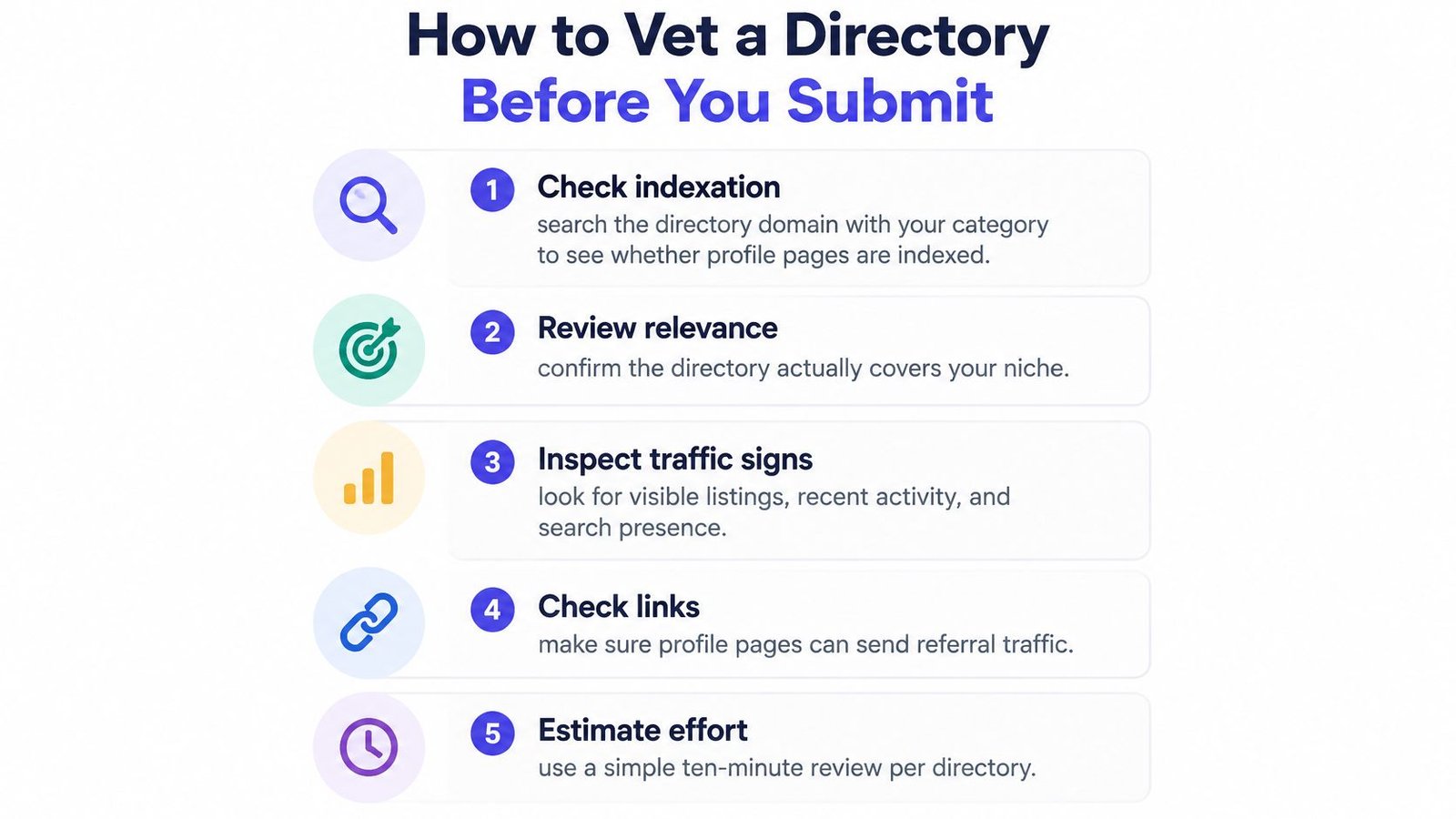
Run these checks on actual profiles
- Check indexation. Search Google for the directory domain alongside your category and a listed product name. Finding profile pages is encouraging; their absence warrants investigation, though search operators aren't a complete indexation audit.
- Check freshness. Look for recently added products, updated descriptions, and recent comments. An old footer alone isn't decisive, but stale content across the site is a warning.
- Check audience fit. Open your likely category. Would a buyer reasonably compare your product with the tools already there?
- Check duplicates. Search your product name, previous brand name, and website address. An existing profile changes the task from submission to ownership or correction.
- Check moderation. Read the guidelines. Look for eligibility requirements and an understandable review process, rather than assuming instant publication means quality.
- Check outbound links. Open a live profile and test its website button. Inspect whether the link uses
nofollow,sponsored, orugc, but don't reject a useful buyer platform solely because of those attributes. - Check buyer activity. Look for genuine reviews, saves, questions, or comments. Distinguish customer discussion from promotional posts by vendors.
Score the evidence, not the sales page
My suggested scoring system is zero to two per check, with a provisional pass mark of ten out of fourteen. This is a working decision rule, not a research-backed threshold: zero means missing or problematic, one means uncertain, and two means convincing evidence.
Record the reason beside each score. A good total shouldn't override a serious issue such as deceptive billing or a category full of unrelated submissions.
You can apply this method to no-cost software directory listings before spending money. Free placement still costs preparation and future maintenance.
A short list with documented reasons is easier to improve than a long list nobody can explain.
Preparing a Listing That Gets Accepted
Start with a single source document, not an empty submission form. Keep the product name, tagline, category, pricing, descriptions, integrations, demo link, screenshots, and account owner together.
At onboarding, we collect clear pricing and use cases because those details affect how a listing should be positioned. An editor shouldn't have to infer what the product does from a slogan.
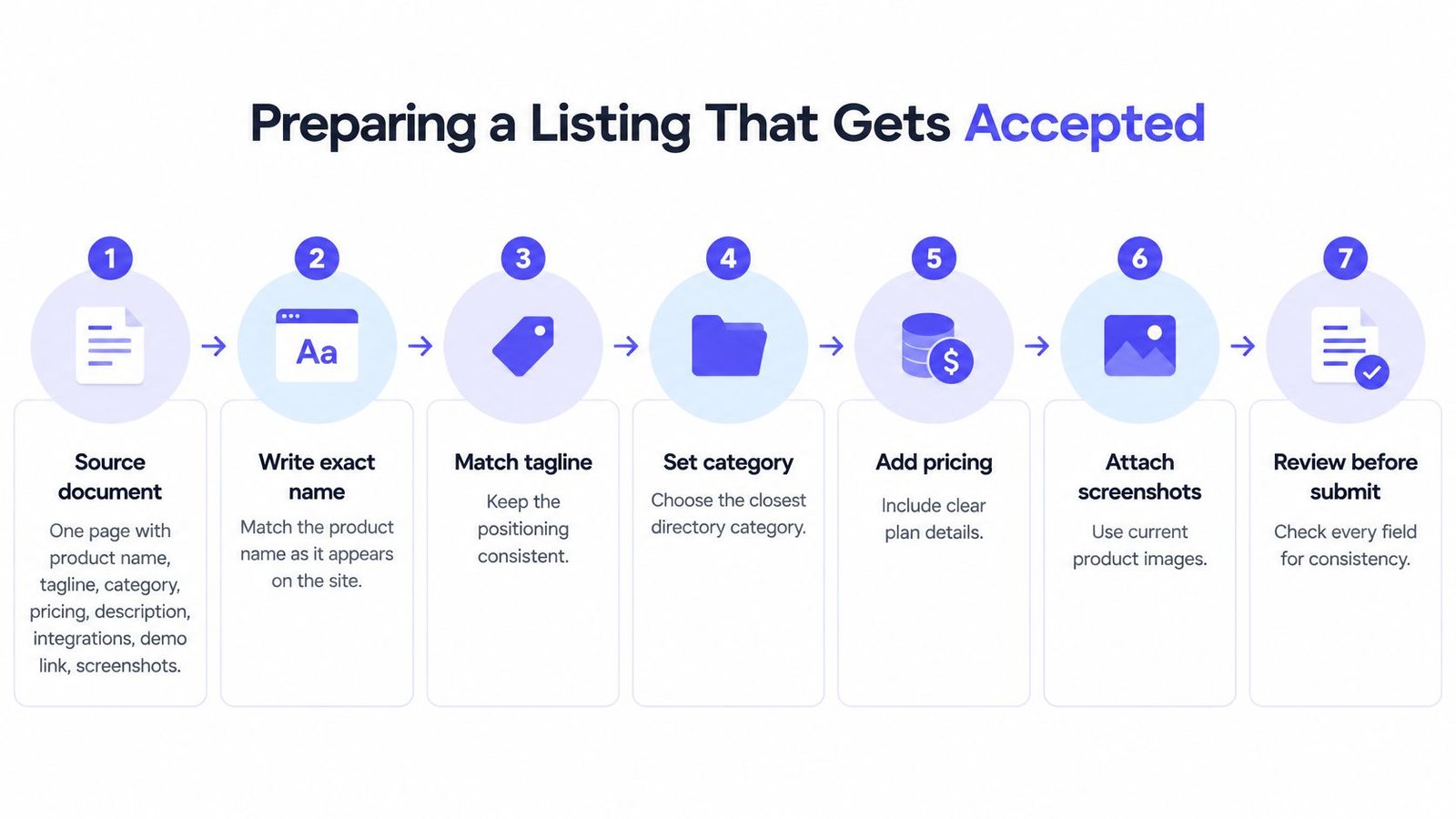
Make the core facts unambiguous
Use the exact product name. Don't append AI, Pro, or a keyword unless it's part of the brand. Otherwise, buyers may mistake separate profiles for separate products.
Write a tagline in plain outcome language. For example, a reconciliation tool could describe itself as software that matches invoices to payments for finance teams. That tells an editor more than a claim about transforming financial operations.
Choose the most specific category available. Invoice reconciliation is more informative than finance software when the platform offers both. Keep your intended category consistent across platforms, mapping it to the closest available label rather than forcing a label the directory doesn't support.
Pricing needs the same care. Match the starting price, billing basis, and free-tier availability to your pricing page. Don't describe a time-limited trial as a free plan, or present an annually billed equivalent as an unrestricted monthly price.
Show the product and its workflow
Prepare screenshots that demonstrate the interface, not just the landing page. I'd select three to five current images as a working asset set, then follow each platform's required dimensions and upload limits.
- Show the core task: Include the screen where users perform the main job.
- Show the result: Let buyers see the output, report, or completed workflow.
- Protect customer information: Use sample records and remove sensitive details.
- Name integrations accurately: Use official product names and distinguish native integrations from connections requiring another service.
A working demo, walkthrough, or sandbox helps an editor understand the product. Test it while logged out. If signup is required, label the destination clearly rather than promising an immediately accessible demo.
Finish the account work
Use a monitored email address and complete verification. Some directories send confirmation emails to the customer's address; StartupSubmit tells customers which ones to expect.
Paste approved facts from the source document, but respect platform-specific fields and character limits. Consistency doesn't require identical formatting. A shorter description can preserve the same audience, outcome, and capabilities without introducing new claims.
Before submitting, compare the preview against your website side by side. Check the destination URL, pricing, category, screenshots, and demo access. Clear positioning and complete assets improve the application; they don't override a platform's eligibility rules or guarantee acceptance.
Boost Your Startup's Traffic & SEO with up to 200+ Directory Listings
Skip the grind. Our team manually submits your product to relevant, high-authority directories, with screenshot proof for every submission, so you get real users, feedback and lasting backlinks without lifting a finger.
Get Listed TodayMistakes That Waste Founder Time and Weaken Listings
Automating link creation is the wrong shortcut. Google's link-spam policy explicitly includes using automated programs or services to create links, as well as low-quality directory links created primarily to manipulate rankings.
That doesn't mean a shared source document is a problem. Standardizing accurate facts is sensible; generating indiscriminate links is not. The risk comes from the purpose and execution of the campaign, not merely from reusing your product name.
Mistaking form completion for editorial work
A bot can populate fields while missing the platform's actual requirements. It may classify a sales assistant as a chatbot, put a trial price in a permanent pricing field, or submit a product that the directory doesn't accept.
The fix is human review of the platform, fields, and preview. Keep the factual foundation consistent while adapting the application to the form.
Creating another profile instead of resolving ownership
A second profile can separate customer feedback from the page you control. Buyers then have to decide which record is current.
We check each directory before submitting. If the business is already listed, StartupSubmit skips that directory and uses another relevant one where available; an existing record still belongs in your own correction queue.
For broader workflow checks, use this guide to avoid SEO mistakes when submitting listings, especially when handing work between a founder, marketer, and contractor.
Leaving cleanup until after a rebrand
Consider a hypothetical founder who submits to 150 platforms, then discovers three profiles using an old product name and two showing pre-rebrand pricing. The difficult part isn't rewriting the sentence. It's finding account access, proving ownership, and waiting for moderation.
Prevent that administrative mess with a submission log:
- Record ownership: Store the account email and responsible team member.
- Separate statuses: Distinguish submitted, verification required, accepted, rejected, and live.
- Preserve evidence: Save the profile address, submission date, and screenshot.
- Track changes: Flag profiles affected by pricing, positioning, or brand updates.
Correct, claim, or request removal of a conflicting record before creating something new.
Measuring Results Across Search and AI Answers
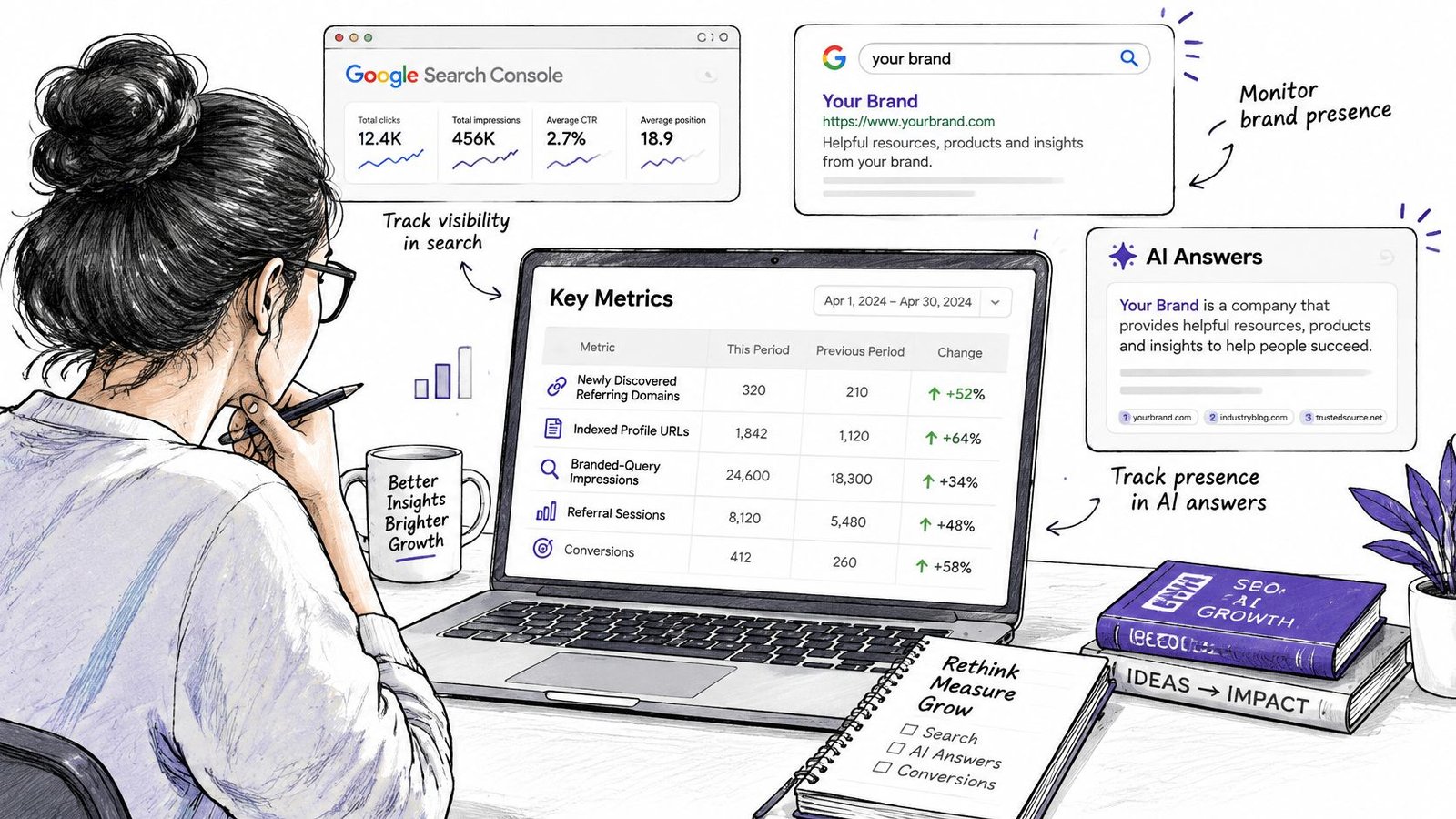
Submission count tells you what you paid for. It says nothing about whether the profiles do their two real jobs: verifying your product for buyers and supplying accurate facts to AI answers. Measure those instead.
| Metric | Where to check | What it tells you |
|---|---|---|
| Newly discovered referring domains | Ahrefs or Google Search Console links report | Whether placements add new sources, not just more links |
| Indexed profile URLs | Google Search Console URL Inspection where you control the directory property; otherwise public search checks | Whether profile pages appear indexed, subject to access and reporting limits |
| Branded query impressions | Google Search Console performance report | Whether visibility for searches containing your name changes |
| Referral sessions | GA4 referral traffic report | Whether listings send actual visitors |
| Conversions | Signup or demo-request event in your analytics | Whether that traffic becomes users or leads |
Separate delivery from business outcomes
Domain Rating alone won't tell you whether buyers arrived. It's a third-party domain metric, not a record of qualified traffic, demos, or revenue.
An Ahrefs analysis of approximately 920 million pages found a positive correlation between unique referring domains and organic search traffic. That supports tracking distinct sources, but it doesn't establish that an individual directory link caused a ranking improvement.
Judge a listing's effect on organic results over a defined baseline and time window. Compare referring domains and branded impressions from the thirty days before publication against the thirty to ninety days after, keeping your other marketing as steady as you can. One strong week or one quiet month proves little either way.
StartupSubmit's report includes every submitted backlink URL and a screenshot proof for each directory. Use that evidence to reconcile the work with live profiles: is the page public, does it point to the right destination, and does the recorded status match reality? A submission screenshot is not proof of indexation.
You generally can't inspect third-party directory URLs through your own Search Console property. Use public search checks cautiously and reserve definitive URL Inspection diagnostics for properties you control.
Branded impressions need interpretation too. An increase can reflect launch activity, customer referrals, or a paid campaign rather than directory exposure. Preserve your baseline and campaign dates so the comparison survives; the Month17 data retention use cases explain a useful approach to retaining Search Console history for longer windows.
Test AI answers without promising citations
Google's documentation for AI Overviews and AI Mode says there is no special submission process or special markup required. A supporting page must be indexed and eligible for ordinary Search with a snippet, and Google determines which links appear.
Treat directory profiles as potential corroborating sources for AI Search Optimization, not a direct placement mechanism. A profile that states your category, pricing model, and positioning cleanly is a fact source an AI system can repeat; a thin or contradictory one is noise. That distinction matters for ChatGPT visibility, LLM SEO, and Google AI Overview discovery.
Build a repeatable test:
- Save prompts: Include your brand name and unbranded buyer tasks.
- Repeat conditions: Run the same prompts before and after publication in ChatGPT, Gemini, and Google's available AI search experiences.
- Log evidence: Record the date, answer, cited pages, and factual errors.
- Separate outcomes: A brand mention, a citation, and a recommendation are different results.
When an answer repeats a stale price or the wrong category, trace it back to the profile that fed it and fix that record first. If AI catalogs fit your product, browse AI tool directory listings with those buyer tasks in mind. No provider can promise an AI citation.
I'd review the campaign every thirty days, comparing live placements, referral quality, and answer accuracy rather than reacting to isolated ranking changes.
Audit Your Listings This Month Before Submitting Again
Open your existing profiles before buying more coverage. The first action is simple: create a sheet of the pages a prospect can already find under your product name.
A directory campaign is easier to manage when each record has a clear owner and next action. You're not trying to make every page look identical; you're trying to eliminate contradictory facts and identify useful gaps.
Work through the audit in order
- Inventory existing profiles. Search your current name, previous names, and website address. Open the pages rather than trusting a search snippet.
- Compare against your source document. Check the name, tagline, category, pricing, and screenshots.
- Resolve conflicting records. Correct what you control, claim what you can verify, and request removal where a profile is obsolete or misleading.
- Rank new opportunities. Apply the vetting checks and retain the strongest matches for your buyers.
- Submit and document. Keep one profile per platform and log the submitted destination, live profile, status, and account owner.
- Schedule a follow-up. Review public availability, branded impressions, and referral activity after thirty days.
If you also operate a location-based business, keep software discovery separate from address-based citations. The StartupSubmit local citation workflow addresses that distinct task; a SaaS category profile doesn't replace a local business record.
Hand off execution without handing off judgement
If you'd rather not do the form work, StartupSubmit submits manually and provides a screenshot for every directory submission. Our guarantee covers the number of submissions in your plan, not acceptance on every platform.
Keep the shortlist tied to a buying decision, even when someone else executes it. Which two directories would a buyer check before your demo? Make those profiles useful before extending the campaign.
Frequently Asked Questions About SaaS Directory Submission
How long does directory approval usually take?
Human-reviewed applications can take days or weeks, and there's no universal approval window. Follow the platform's published guidance, monitor verification emails, and record pending applications. I'd schedule a follow-up after two weeks unless the directory states a longer review period.
Do directory backlinks help Google AI Overview visibility?
Not directly. A useful, indexed profile may become a supporting information source, but acquiring a backlink doesn't buy inclusion. Concentrate on correct product facts and credible buyer-facing content rather than a promised AI placement.
Should a SaaS startup use a paid submission service?
Use one when repetitive execution is taking time away from higher-value work and you can verify the deliverables. We check for existing listings, match categories, and provide screenshot evidence; you should still review the resulting profiles against your approved product information.
How often should listings be re-audited?
I recommend a quarterly audit as a manageable maintenance schedule. Review affected profiles sooner after a pricing change, rebrand, or major feature launch, especially when the update changes who the product serves or what buyers can expect.
StartupSubmit offers manual SaaS directory submission with category matching, duplicate checks, and screenshot reporting. Visit StartupSubmit if you want to hand off the submission work while keeping a checkable record of where your product was submitted.
Ready to build high-quality backlinks?
We'll manually submit your product to 60 to 200+ directories in 5 to 7 days, with screenshot proof for every submission. No bots, no boring forms, just more time for selling and building.
See pricing & get started →